Consider the following three statements, namely S1, S2 and S3 : S1. Protecting the environment is an existential exigency for humans, given the impact of environmental degradation on climate change. S2. Scientific consensus has not been achieved with regard to the extent of the contribution of human intervention to climate change. S3. Environmental activism includes climate alarmism and other extremist points of view that often become the focus of climate change deniers. Which of the following relationships based on the statements given above is/are correct? 1. S3 is a counterpoint to S1 2. S3 is unconnected to S1 and S2 3. S2 could be the reason for S3 Select the answer using the code given below.

- A2 and 3 only
- B1, 2 and 3
- C1 and 2 only
- D3 onlyCorrect
Explanation
The correct answer is D (3 only). This question tests logical reasoning and reading comprehension regarding the global discourse on climate change.
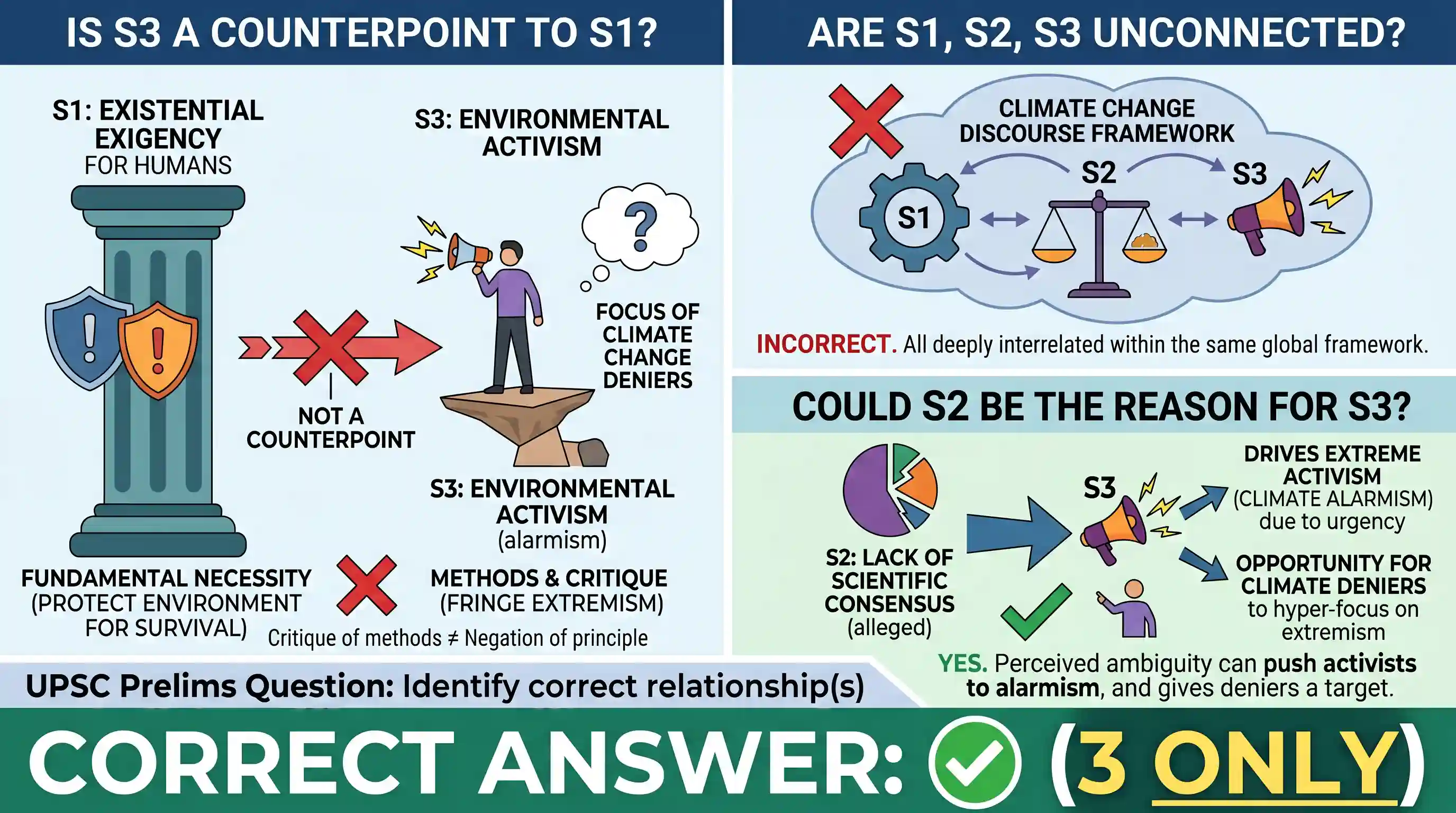
Why the correct option is correct: Statement 2 (S2) posits a lack of scientific consensus on the extent of human contribution to climate change. Statement 3 (S3) notes that environmental activism includes "climate alarmism," which frequently becomes the target of climate deniers. Logically, S2 could be the reason for S3. The perceived ambiguity over scientific consensus can drive activists toward extreme narratives (alarmism) to force urgency. Conversely, climate deniers leverage this alleged lack of consensus (S2) to hyper-focus on discrediting the most extremist activist claims (S3) rather than debating the actual science.
(Note for aspirants: Factually, the UN's IPCC Sixth Assessment Report (AR6), published in August 2021, established an "unequivocal" consensus on human-induced climate change. However, in CSAT logical reasoning, we evaluate the causal linkage strictly presented in the premises).
Why the other options are wrong:
- Statement 1 (S3 is a counterpoint to S1): Incorrect. S1 asserts that protecting the environment is an "existential exigency" (an urgent necessity for human survival). S3 merely points out that extremist methods exist within the movement. Criticizing fringe activist methods does not negate the fundamental, existential necessity of environmental protection.
- Statement 2 (S3 is unconnected to S1 and S2): Incorrect. All three statements are deeply connected by the shared thematic framework of climate change, scientific debate, and environmental advocacy.
Takeaway: In logical reasoning questions, distinguish between a cause and its methods. A critique of the methods of a movement (alarmism) is rarely a logical counterpoint to the underlying validity of the movement itself.
Related questions
More UPSC Prelims practice from the same subject and topic.
- Prelims 2026GS1environment
Consider the following statements with reference to India's response to climate change : I. India's Long-Term Low Emission Development Strategy (LT-LEDS) is a crucial tool for achieving net-zero emiss…
- Prelims 2026GS1environment
With reference to Madhav National Park, which of the following statements is/are correct ? 1. It was declared a Tiger Reserve in India in 2025. 2. Sakhya Sagar, which is designated as a Ramsar Site, i…
- Prelims 2026GS1environment
Consider the following statements about Rhynchostylis retusa (Foxtail orchid) : 1. It is an epiphytic orchid. 2. The species is endemic to North-east India. 3. It is the State flower of Arunachal Prad…
- Prelims 2026GS1environment
At the United Nations Ocean Conference (UNOC) held in June, 2025 in France, the Food and Agricultural Organization (FAO) of the United Nations demonstrated its leading voice on marine and ocean issues…
- Prelims 2026GS1environment
Which one of the following is the first Plan Vivo certified Reducing Emissions from Deforestation and Forest Degradation (REDD+) project in India ?
- Prelims 2026GS1environment
With respect to the Western Hoolock Gibbons, which of the following statements is/are correct? 1. A Sanctuary in North-east India is home to this ape species listed as Endangered in the International …