Match List-I with List-II and select the answer using the code given below the Lists : List-I (Relationship category) A. Between cricket captain and team members B. Between judge and lawyers in court C. Between Vice Chancellor and Deputy Registrar D. Between peers and coworkers List-II (Communication type) 1. Informal and firm 2. Informal and open-ended 3. Formal and open-ended 4. Formal and firm

- AA-1, B-3, C-4, D-2
- BA-1, B-4, C-3, D-2Correct
- CA-2, B-4, C-3, D-1
- DA-2, B-3, C-4, D-1
Explanation
Correct Option: B (A-1, B-4, C-3, D-2)
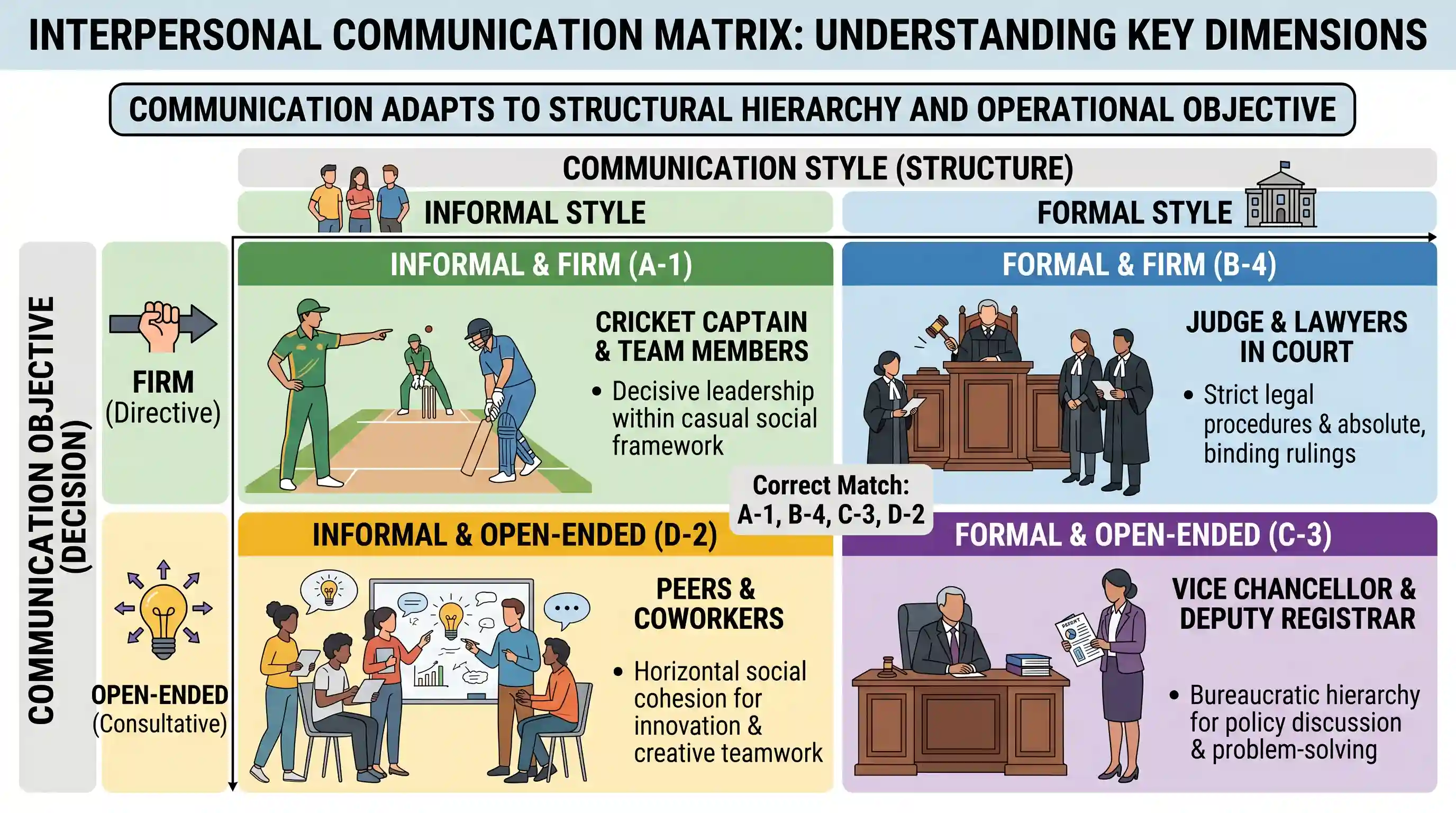
According to principles of Organizational Behavior (OB) and Communication Theory, communication styles adapt to structural hierarchy and operational objectives:
- A-1 (Cricket captain and team members): Informal and firm. Sports leadership relies heavily on camaraderie and lateral social bonds, making the overarching environment informal. However, a captain's on-field tactical decisions (e.g., bowling changes) demand directive leadership and immediate compliance, making the communication firm.
- B-4 (Judge and lawyers in court): Formal and firm. Courtrooms operate under strict procedural laws and legal etiquette. A judge’s rulings and directives are absolute, legally binding, and non-negotiable, making this communication strictly formal and firm.
- C-3 (Vice Chancellor and Deputy Registrar): Formal and open-ended. University administration utilizes a bureaucratic, formal vertical structure. Yet, because their roles involve policy formulation, problem-solving, and administration, they require ongoing consultation and feedback, making the dialogue open-ended.
- D-2 (Peers and coworkers): Informal and open-ended. Horizontal communication (lateral communication) among peers is typically informal to foster social cohesion. It thrives on an open-ended approach to encourage brainstorming, innovation, and collaborative teamwork.
Why other options are incorrect:
- Option A: Incorrectly pairs judicial communication as "open-ended" (B-3), fundamentally disregarding the authoritative and legally binding nature of courtroom rulings.
- Option C: Incorrectly characterizes peer communication as "firm" (D-1) and a cricket captain's instructions as "open-ended" (A-2), contradicting the collaborative nature of peers and the decisive leadership required in sports.
- Option D: Inverts established dynamics by mischaracterizing a judge's rulings as open-ended (B-3) and lateral peer communication as rigidly firm (D-1).
Concluding Takeaway: When evaluating communication, analyze two axes: Structure (Formal for institutional hierarchy vs. Informal for peers/sports) and Objective (Firm for execution and rulings vs. Open-ended for planning and brainstorming).
Related questions
More UPSC Prelims practice from the same subject and topic.
- Prelims 2026GS1other
Which of the following statements with regard to the Grand Slam Tennis Tournaments is/are correct ? 1. The tournaments have a shared governance structure establishing the partnership among the four Gr…
- Prelims 2026GS1other
Ms. X is a mid-level civil service official working in the urban development department of a major city. Recently, she was involved in approving a contract for a public infrastructure project — a new …
- Prelims 2026GS1other
Which one of the following pairs is not correctly matched? (Indian Army Corps) : (Headquarters)
- Prelims 2026CSATother
For ⅓ < x < y < 2, which of the following statements is/are always correct? I. x + 1/x < y + 1/y II. √(1 + y²)/y < √(1 + x²)/x Select the answer using the code given below.
- Prelims 2026CSATother
What is the minimum number of times one needs to measure to get 298 litres of water from a tank, if the measuring cylinders have capacities 1 litre, 6 litres, 25 litres and 100 litres?
- Prelims 2026CSATother
There are four types of weights, namely 1 kg, 2 kg, 5 kg and 10 kg. What is the maximum number of different ways one can measure 20 kg, if at least eight but not more than eleven weights of 1 kg are t…