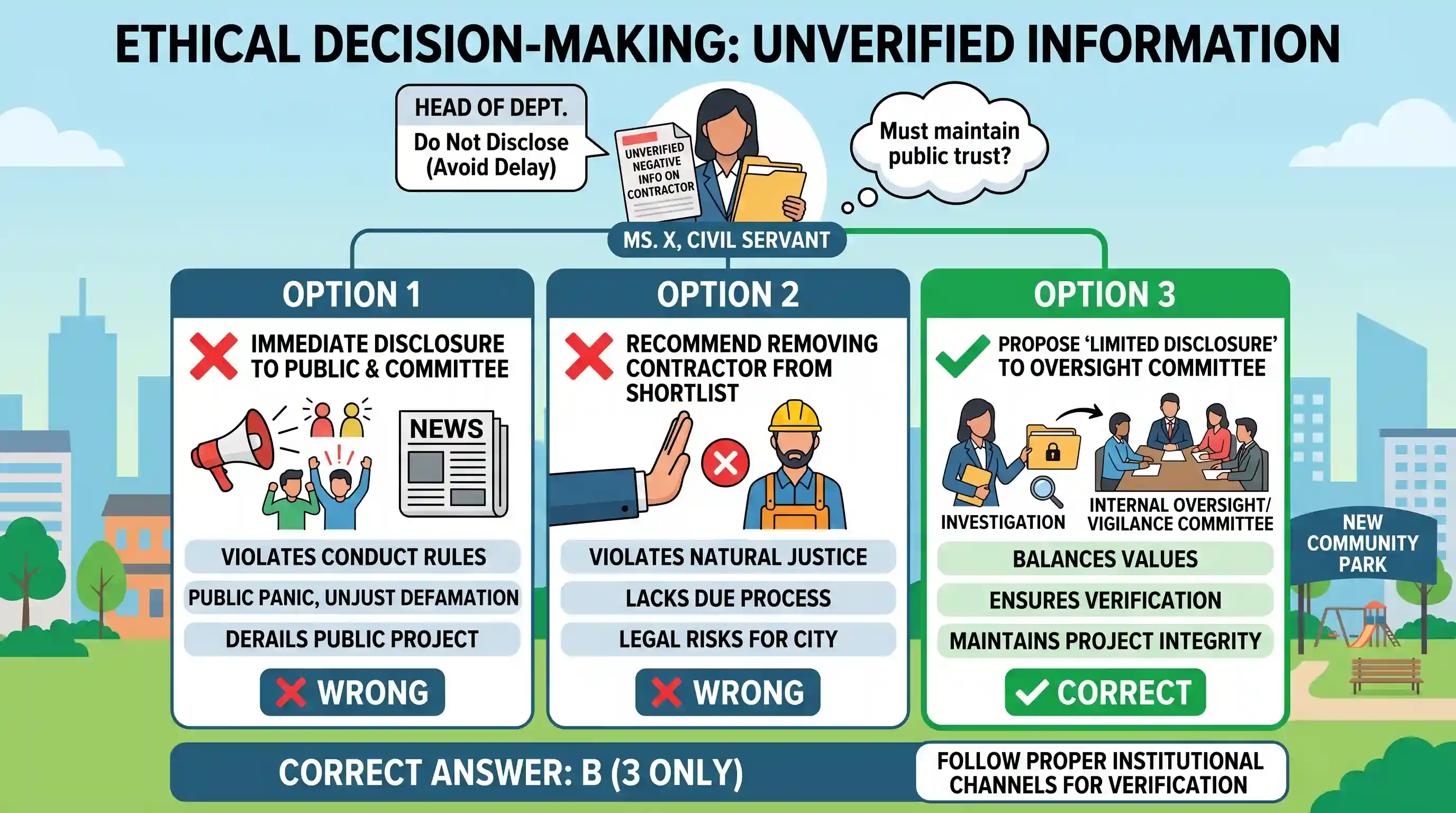
Ms. X is a mid-level civil service official working in the urban development department of a major city. Recently, she was involved in approving a contract for a public infrastructure project — a new community park. During the approval process, she received a piece of confidential information indicating that one of the shortlisted contractors had a history of poor workmanship and allegations of corruption in other cities, though nothing had been legally proven. The Head of the Department, Mr. Y, advised her not to disclose this information to the project committee or the public because it could delay the project and damage the city's reputation. However, Ms. X believed that withholding such information compromised transparency and public trust. What amongst the following should Ms. X do now ? 1. Immediately disclose the information to the project committee and the public 2. Recommend removing the contractor from the shortlist to protect the project's integrity 3. Propose a 'limited disclosure' to an oversight committee, while keeping the information confidential from the public for the time being Select the answer using the code given below :

- A1 and 2 only
- B3 onlyCorrect
- C2 and 3 only
- D1, 2 and 3
Explanation
The correct answer is Option B (3 only).
Statement 3 is correct: Proposing a 'limited disclosure' to an internal oversight or vigilance committee is the most ethically sound and procedurally correct action. According to the Central Vigilance Commission (CVC) guidelines on public procurement and complaint handling, unverified allegations must be thoroughly investigated through proper designated channels (such as a Chief Vigilance Officer) before definitive action is taken. This approach successfully balances the civil service values of transparency and accountability with the need to maintain official confidentiality, ensuring the project's integrity is verified without causing undue administrative disruption.
Statement 1 is incorrect: Immediately disclosing unverified, confidential information to the public or the general project committee violates established civil service conduct rules (such as the All India Services Conduct Rules), which prohibit the unauthorized communication of sensitive official information. Reckless disclosure based on hearsay can cause unwarranted public panic, defame the contractor unjustly, and derail a public interest project.
Statement 2 is incorrect: Recommending the contractor's removal based solely on unproven allegations violates the principles of natural justice and objective evaluation in public procurement. Blacklisting or penalizing an entity requires legally proven facts and due process, not hearsay or unverified rumors from other jurisdictions.
Takeaway: In public administration, ethical decision-making requires balancing transparency with confidentiality. Always follow the "Verify before Acting" principle—utilize established institutional oversight mechanisms to investigate allegations before making public declarations or punitive administrative decisions.
Related questions
More UPSC Prelims practice from the same subject and topic.
- Prelims 2026GS1other
Which of the following statements with regard to the Grand Slam Tennis Tournaments is/are correct ? 1. The tournaments have a shared governance structure establishing the partnership among the four Gr…
- Prelims 2026GS1other
Which one of the following pairs is not correctly matched? (Indian Army Corps) : (Headquarters)
- Prelims 2026CSATother
For ⅓ < x < y < 2, which of the following statements is/are always correct? I. x + 1/x < y + 1/y II. √(1 + y²)/y < √(1 + x²)/x Select the answer using the code given below.
- Prelims 2026CSATother
What is the minimum number of times one needs to measure to get 298 litres of water from a tank, if the measuring cylinders have capacities 1 litre, 6 litres, 25 litres and 100 litres?
- Prelims 2026CSATother
There are four types of weights, namely 1 kg, 2 kg, 5 kg and 10 kg. What is the maximum number of different ways one can measure 20 kg, if at least eight but not more than eleven weights of 1 kg are t…
- Prelims 2026CSATother
A cut on a solid object divides the object into two parts where the new surfaces thus produced are plane. On the other hand, one single cut can be used to cut more than one object at a time. In an exp…