For ⅓ < x < y < 2, which of the following statements is/are always correct? I. x + 1/x < y + 1/y II. √(1 + y²)/y < √(1 + x²)/x Select the answer using the code given below.

- AI only
- BII onlyCorrect
- CBoth I and II
- DNeither I nor II
Explanation
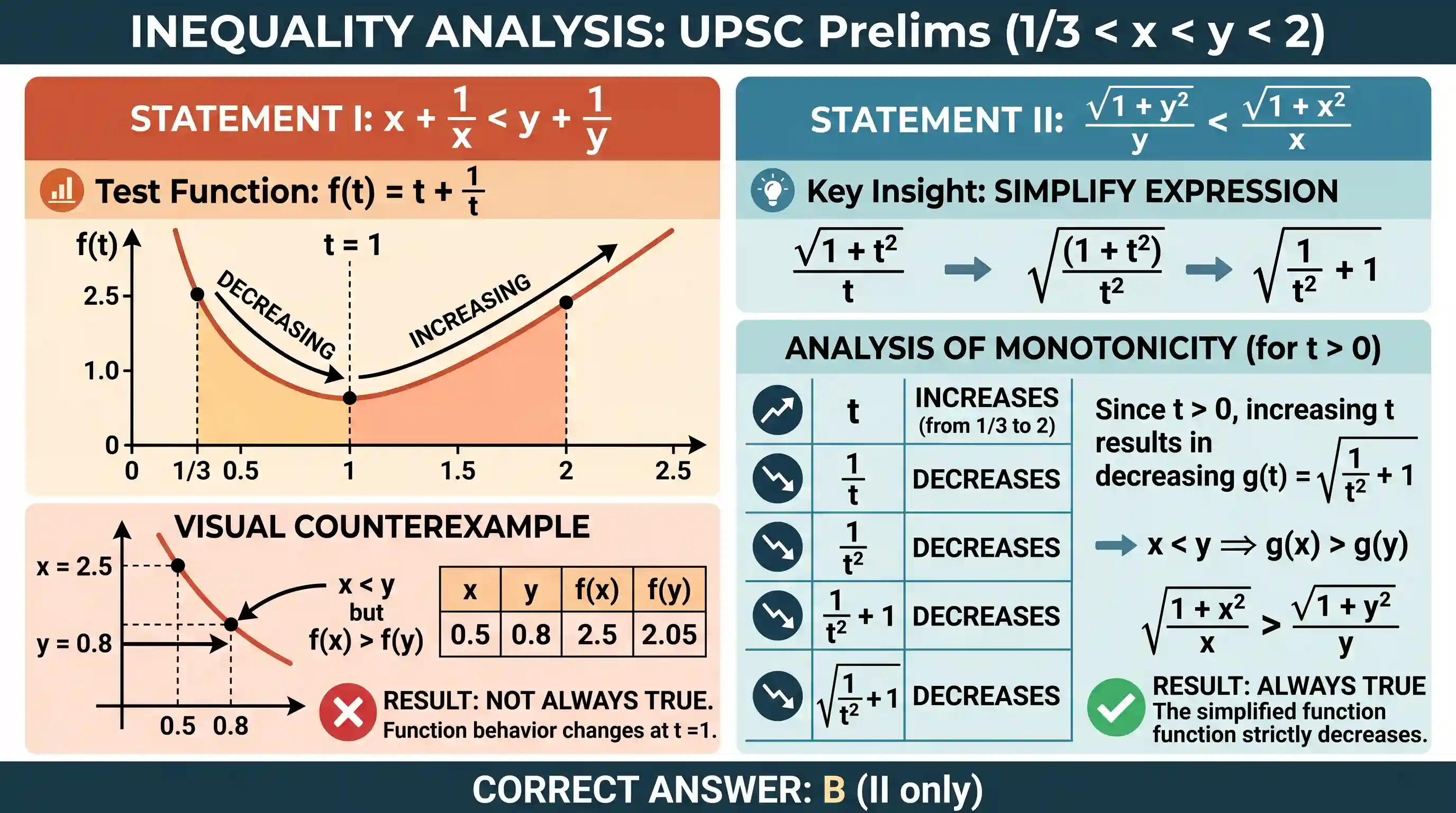
To determine the correct answer, we must analyze the monotonicity (increasing or decreasing nature) of the mathematical functions underlying both statements within the interval t ∈ (⅓, 2).
Why the correct option is correct: Option B is correct because Statement II is universally true for this interval. The expression √(1+t²)/t can be algebraically rewritten as √((1+t²)/t²) = √(1/t² + 1). By the fundamental properties of inequalities, if x 1/y. Squaring both sides yields 1/x² > 1/y², and adding 1 results in 1/x² + 1 > 1/y² + 1. Taking the principal square root proves that √(1/x² + 1) > √(1/y² + 1). Therefore, the expression evaluated for x will always be strictly greater than the expression evaluated for y, confirming Statement II is correct.
Why the wrong options are wrong: Options A and C are incorrect because Statement I assumes uniform behavior for the function f(t) = t + 1/t. Applying the First Derivative Test from calculus, f'(t) = 1 - 1/t². This means the function decreases when t 1. If we take x = 0.5 and y = 0.8 (both valid within the ⅓ f(y), which actively disproves the statement's claim. Option D is incorrect because Statement II is demonstrably true.
Takeaway: When evaluating inequalities over intervals crossing the value of 1, always test fractional values on both sides of 1. Rewriting compound algebraic fractions into segregated forms—like converting √(1+t²)/t to √(1/t² + 1)—greatly simplifies tracing whether a function strictly increases or decreases.
Related questions
More UPSC Prelims practice from the same subject and topic.
- Prelims 2026CSATother
If the product of the HCF and LCM of two distinct numbers is the cube of one of the numbers, then which of the following statements is/are correct? I. The difference of the numbers is an even number. …
- Prelims 2026CSATother
Directions for the next 5 (five) items : Each item in this section contains a question followed by two statements. Answer each item using the following instructions and mark your response on the Answe…
- Prelims 2026CSATother
If 10ᵐ × 1000 × n = 75²⁵ × 25³² × 32⁷⁵, where n is not divisible by 10, then the value of m is
- Prelims 2026GS1other
Which of the following statements with regard to the Grand Slam Tennis Tournaments is/are correct ? 1. The tournaments have a shared governance structure establishing the partnership among the four Gr…
- Prelims 2026GS1other
Ms. X is a mid-level civil service official working in the urban development department of a major city. Recently, she was involved in approving a contract for a public infrastructure project — a new …
- Prelims 2026GS1other
Which one of the following pairs is not correctly matched? (Indian Army Corps) : (Headquarters)