Directions for the next 5 (five) items : Each item in this section contains a question followed by two statements. Answer each item using the following instructions and mark your response on the Answer Sheet accordingly. Question : For two distinct real numbers x and y, which of them is bigger? Statement I : x² < y < 1 Statement II : y < √x < 1

- ASelect this option if the question can be answered using one of these statements alone, but cannot be answered using other statement
- BSelect this option if the question can be answered using either statement alone
- CSelect this option if the question can be answered using both the statements together, but cannot be answered using either statement alone
- DSelect this option if the question cannot be answered even using any of the statementsCorrect
Explanation
Based on the foundational axioms of real analysis (formalized by mathematicians like Richard Dedekind in the late 19th century), solving algebraic inequalities requires evaluating all possible constraints to establish a definitive, unambiguous relationship.
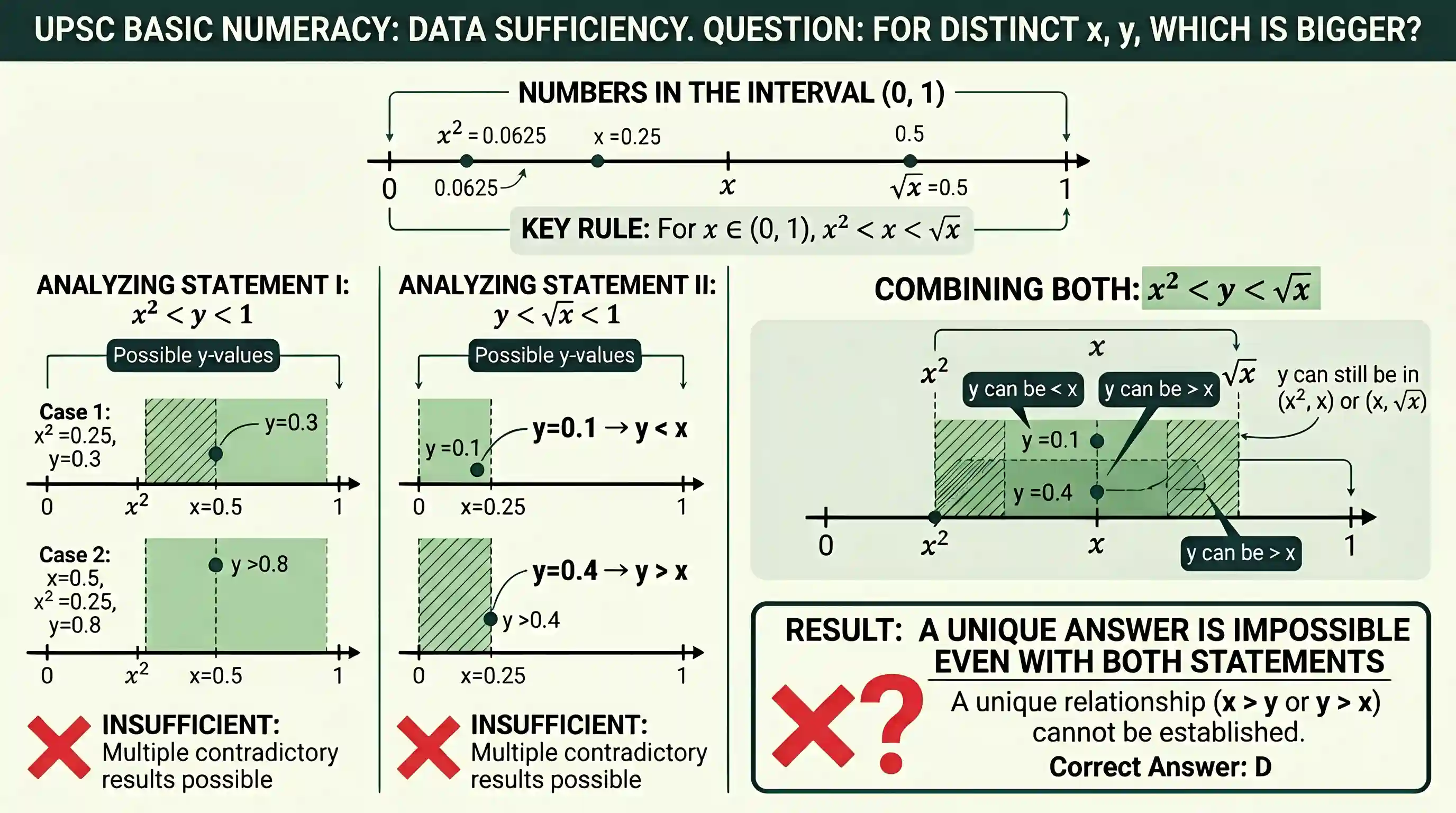
To determine whether x > y or y > x, we evaluate the statements using test values for real numbers.
Statement I: x² y. However, y could also be 0.8, which means y > x. Because it yields multiple contradictory relationships, Statement I alone is insufficient.
Statement II: y y) or y could be 0.4 (y > x). Thus, Statement II alone is also insufficient.
Combining Both Statements: x² y) or y = 0.4 (resulting in y > x). Because a unique mathematical relationship cannot be established even when combining all data, Option D is the correct answer.
- Option A is incorrect because Statement I allows for scenarios where x is larger or smaller than y.
- Option B is incorrect because neither statement independently provides a unique solution.
- Option C is incorrect because synthesizing both statements still leaves an open interval around x, failing to restrict y to just one side of x.
Takeaway: For proper fractions/decimals between 0 and 1, higher powers yield smaller values (x² x). When a variable is bounded by a number's square and root, always test values both above and below the base number itself.
Related questions
More UPSC Prelims practice from the same subject and topic.
- Prelims 2026CSATother
For ⅓ < x < y < 2, which of the following statements is/are always correct? I. x + 1/x < y + 1/y II. √(1 + y²)/y < √(1 + x²)/x Select the answer using the code given below.
- Prelims 2026CSATother
If the product of the HCF and LCM of two distinct numbers is the cube of one of the numbers, then which of the following statements is/are correct? I. The difference of the numbers is an even number. …
- Prelims 2026CSATother
If 10ᵐ × 1000 × n = 75²⁵ × 25³² × 32⁷⁵, where n is not divisible by 10, then the value of m is
- Prelims 2026GS1other
Which of the following statements with regard to the Grand Slam Tennis Tournaments is/are correct ? 1. The tournaments have a shared governance structure establishing the partnership among the four Gr…
- Prelims 2026GS1other
Ms. X is a mid-level civil service official working in the urban development department of a major city. Recently, she was involved in approving a contract for a public infrastructure project — a new …
- Prelims 2026GS1other
Which one of the following pairs is not correctly matched? (Indian Army Corps) : (Headquarters)