If 10ᵐ × 1000 × n = 75²⁵ × 25³² × 32⁷⁵, where n is not divisible by 10, then the value of m is

- A101
- B111Correct
- C121
- D131
Explanation
The correct answer is Option B (111). This problem is governed by the Fundamental Theorem of Arithmetic (formally proven by Carl Friedrich Gauss in his 1801 work 'Disquisitiones Arithmeticae', though rooted in Euclid's 'Elements', c. 300 BC), which establishes that every integer greater than 1 can be represented uniquely as a product of prime numbers.
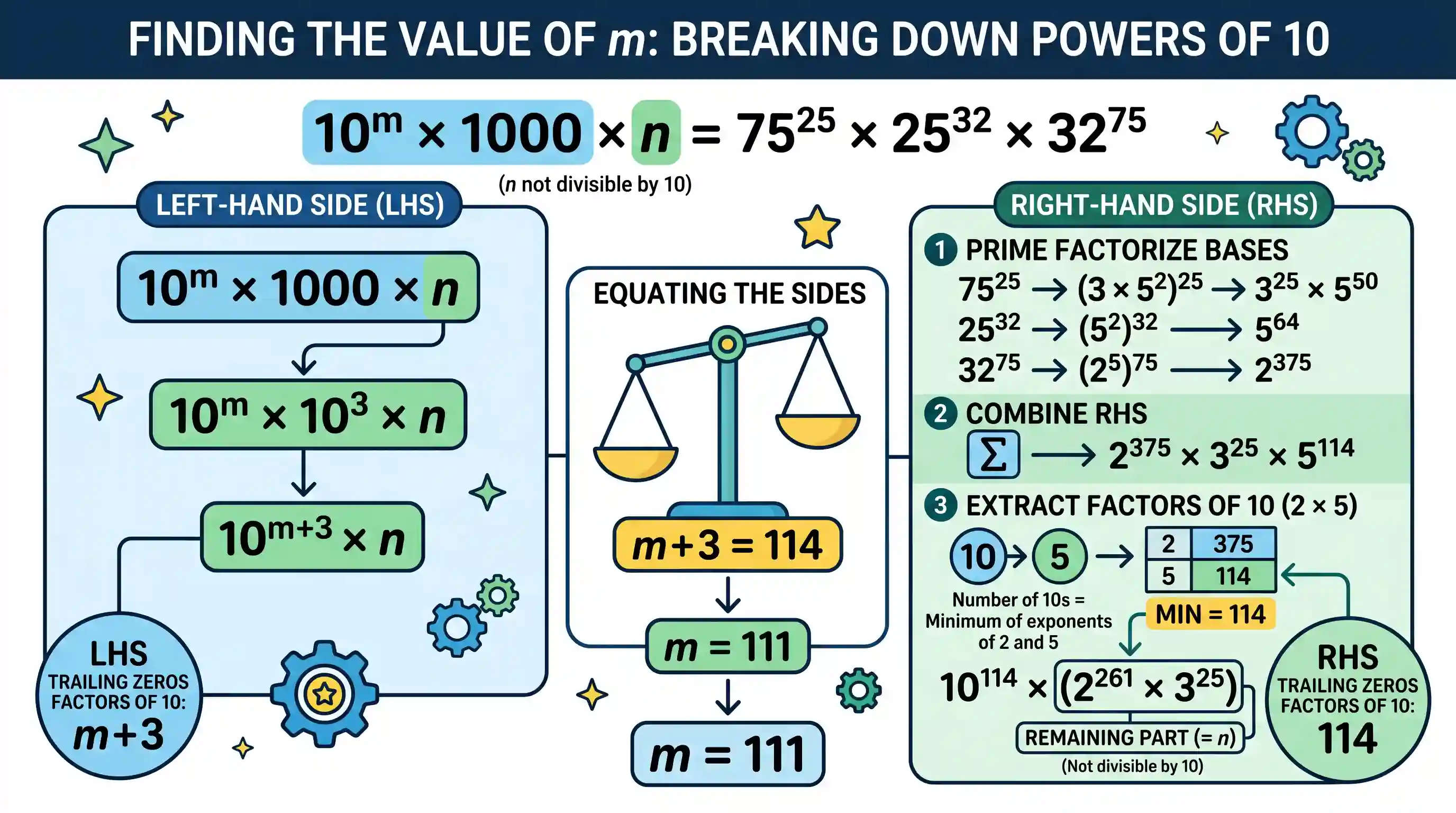
To find the value of m, we must determine the prime factorization of both sides of the given equation: 10ᵐ × 1000 × n = 75²⁵ × 25³² × 32⁷⁵.
The left-hand side (LHS) simplifies to 10ᵐ⁺³ × n. For the right-hand side (RHS), we prime factorize the bases:
- 75²⁵ = (3 × 5²)²⁵ = 3²⁵ × 5⁵⁰
- 25³² = (5²)³² = 5⁶⁴
- 32⁷⁵ = (2⁵)⁷⁵ = 2³⁷⁵
Multiplying these together, the RHS becomes 2³⁷⁵ × 3²⁵ × 5¹¹⁴. A factor of 10 requires exactly one 2 and one 5. The total number of 10s that can be factored out is determined by the minimum of their exponents, min(375, 114) = 114. Thus, the RHS can be rewritten as 10¹¹⁴ × (2²⁶¹ × 3²⁵).
Equating the LHS and RHS yields 10ᵐ⁺³ × n = 10¹¹⁴ × (2²⁶¹ × 3²⁵). Since the problem states n is not divisible by 10, it cannot contain a combined factor of 2 and 5. Thus, n = 2²⁶¹ × 3²⁵, meaning all powers of 10 are strictly accounted for by the 10ᵐ⁺³ term. We set m + 3 = 114, which solves to m = 111.
Regarding the incorrect options:
- Option A (101) is incorrect and typically results from an arithmetic error when isolating m, such as mistakenly subtracting 13 instead of 3.
- Option C (121) is incorrect; it arises from miscalculating the exponent of 5, often by incorrectly adding rather than multiplying exponents during factorization.
- Option D (131) is incorrect and generally stems from misinterpreting the condition for n, leading to improper extraction of base 10 elements.
Takeaway: To find the highest power of 10 (or trailing zeros) in a large product, reduce the expression to its prime factors. The number of 10s is dictated by the smaller exponent between the prime factors 2 and 5.
Related questions
More UPSC Prelims practice from the same subject and topic.
- Prelims 2026CSATother
For ⅓ < x < y < 2, which of the following statements is/are always correct? I. x + 1/x < y + 1/y II. √(1 + y²)/y < √(1 + x²)/x Select the answer using the code given below.
- Prelims 2026CSATother
If the product of the HCF and LCM of two distinct numbers is the cube of one of the numbers, then which of the following statements is/are correct? I. The difference of the numbers is an even number. …
- Prelims 2026CSATother
Directions for the next 5 (five) items : Each item in this section contains a question followed by two statements. Answer each item using the following instructions and mark your response on the Answe…
- Prelims 2026GS1other
Which of the following statements with regard to the Grand Slam Tennis Tournaments is/are correct ? 1. The tournaments have a shared governance structure establishing the partnership among the four Gr…
- Prelims 2026GS1other
Ms. X is a mid-level civil service official working in the urban development department of a major city. Recently, she was involved in approving a contract for a public infrastructure project — a new …
- Prelims 2026GS1other
Which one of the following pairs is not correctly matched? (Indian Army Corps) : (Headquarters)