The speed of a train T is 100 km per hour and the speed of a person P is 4 km per hour. T crosses P in 15 seconds, if P travels along the direction of motion of T. If P travels along the opposite direction of T, then in how much time does T cross P, in seconds, approximately?

- A13.51
- B13.65
- C13.85Correct
- D14.05
Explanation
Correct Option: C (13.85)
The question evaluates foundational principles of one-dimensional kinematics and relative speed, which form a core component of the CSAT aptitude syllabus.
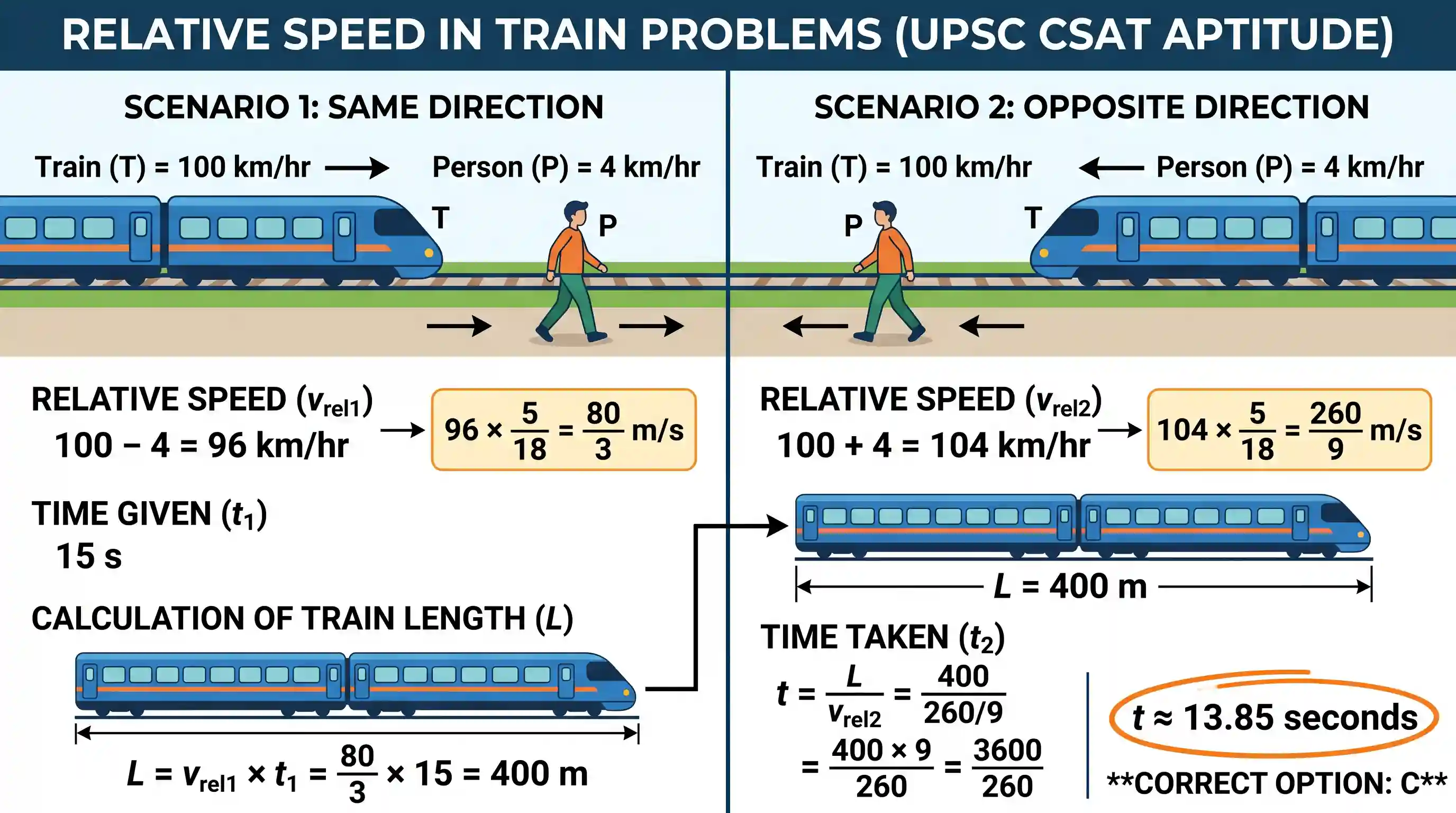
Step 1: Determine the relative speed in the same direction. When two bodies move in the same direction, their relative speed is the difference between their individual speeds. Relative Speed (v_rel1) = Speed of Train (T) - Speed of Person (P) = 100 km/hr - 4 km/hr = 96 km/hr. To standardise units, we must convert this to metres per second (m/s) by multiplying by 5/18: 96 × 5/18 = 80/3 m/s.
Step 2: Calculate the length of the train. The distance the train must cover to cross the person is strictly equal to the length of the train (L). L = v_rel1 × Time = 80/3 m/s × 15 s = 400 meters.
Step 3: Determine the time taken to cross in opposite directions. When bodies move in opposite directions, their relative speed is the sum of their individual speeds. Relative Speed (v_rel2) = 100 km/hr + 4 km/hr = 104 km/hr. Convert to m/s: 104 × 5/18 = 260/9 m/s. Time taken to cross (t) = Distance/Speed = 400/(260/9) = 3600/260 = 180/13 seconds. t ≈ 13.846 seconds, which formally rounds to 13.85 seconds (Option C).
Analysis of Incorrect Options:
- Option A (13.51): Incorrect. This value typically arises from arithmetic errors during unit conversions, leading to an artificially lower time quotient.
- Option B (13.65): Incorrect. This is mathematically invalid and likely derived from miscalculating the fractional division of 3600 ÷ 260.
- Option D (14.05): Incorrect. This represents an overestimation resulting from failing to add the speeds together (perhaps using the initial 96 km/hr relative speed incorrectly).
Concluding Takeaway: To master relative motion problems efficiently, remember the core Galilean framework: always subtract speeds for parallel movement (same direction), add speeds for opposing movement (opposite direction), and ensure strict unit parity before calculating.
Related questions
More UPSC Prelims practice from the same subject and topic.
- Prelims 2026CSATother
A is a 2-digit number with different digits. B is also a 2-digit number and is obtained by reversing the digits of A. If A - B is a multiple of 27, where A > B, how many such different A's are possibl…
- Prelims 2026GS1other
Which of the following statements with regard to the Grand Slam Tennis Tournaments is/are correct ? 1. The tournaments have a shared governance structure establishing the partnership among the four Gr…
- Prelims 2026GS1other
Ms. X is a mid-level civil service official working in the urban development department of a major city. Recently, she was involved in approving a contract for a public infrastructure project — a new …
- Prelims 2026GS1other
Which one of the following pairs is not correctly matched? (Indian Army Corps) : (Headquarters)
- Prelims 2026CSATother
For ⅓ < x < y < 2, which of the following statements is/are always correct? I. x + 1/x < y + 1/y II. √(1 + y²)/y < √(1 + x²)/x Select the answer using the code given below.
- Prelims 2026CSATother
What is the minimum number of times one needs to measure to get 298 litres of water from a tank, if the measuring cylinders have capacities 1 litre, 6 litres, 25 litres and 100 litres?