A is a 2-digit number with different digits. B is also a 2-digit number and is obtained by reversing the digits of A. If A - B is a multiple of 27, where A > B, how many such different A's are possible?

- A6
- B9Correct
- C12
- D18
Explanation
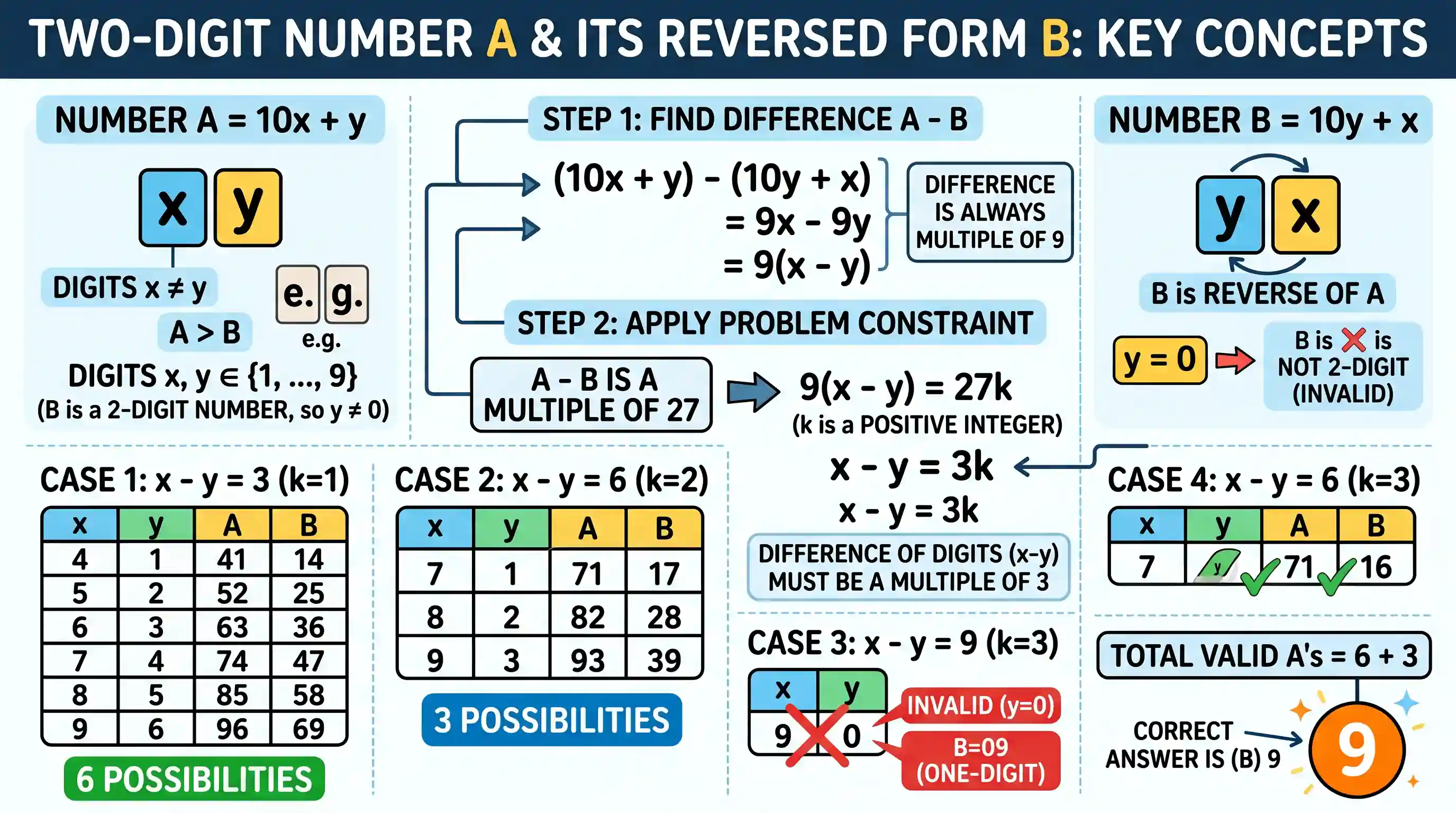
According to the generalized form of numbers outlined in standard curricula such as NCERT Class 8 Mathematics (Playing with Numbers), a two-digit number A is represented algebraically as 10x + y, where x and y are its digits. Reversing its digits yields a new two-digit number B = 10y + x. Since B is strictly a two-digit number, its first digit y cannot be zero (1 ≤ x, y ≤ 9).
The mathematical property for the difference between a two-digit number and its reversed form states that A - B = (10x + y) - (10y + x) = 9(x - y). This shows the difference is always a multiple of 9.
The problem states that A - B is a multiple of 27. Therefore, 9(x - y) = 27k, which simplifies to x - y = 3k. Since A > B, we must have x > y, implying k is a positive integer (k ≥ 1).
Case 1: k = 1 ⇒ x - y = 3. The valid digit pairs (x, y) are (4,1), (5,2), (6,3), (7,4), (8,5), and (9,6). This provides 6 values for A (e.g., A=41, B=14). Case 2: k = 2 ⇒ x - y = 6. The valid digit pairs are (7,1), (8,2), and (9,3). This provides 3 values for A. Case 3: k = 3 ⇒ x - y = 9. The only pair is (9,0), but this makes B a one-digit number (09), violating the mathematical premise that its first digit cannot be zero.
Adding the valid configurations, there are exactly 6 + 3 = 9 possible values for A. Thus, Option B is correct.
Incorrect Options:
- Option A (6): Incorrect. This option only counts pairs where the difference between digits is exactly 3 (Case 1), neglecting pairs where the difference is 6.
- Option C (12): Incorrect. This mathematically flawed option likely overcounts invalid pairs by improperly including cases where y=0.
- Option D (18): Incorrect. This arises from erroneously doubling the combinations, ignoring the strict condition that A > B.
Takeaway: In digit-reversal aptitude problems, remember that the difference between a two-digit number and its reverse is always 9(x-y), while their sum is 11(x+y). Always ensure digits satisfy standard integer constraints.
Related questions
More UPSC Prelims practice from the same subject and topic.
- Prelims 2026CSATother
The speed of a train T is 100 km per hour and the speed of a person P is 4 km per hour. T crosses P in 15 seconds, if P travels along the direction of motion of T. If P travels along the opposite dire…
- Prelims 2026GS1other
Which of the following statements with regard to the Grand Slam Tennis Tournaments is/are correct ? 1. The tournaments have a shared governance structure establishing the partnership among the four Gr…
- Prelims 2026GS1other
Ms. X is a mid-level civil service official working in the urban development department of a major city. Recently, she was involved in approving a contract for a public infrastructure project — a new …
- Prelims 2026GS1other
Which one of the following pairs is not correctly matched? (Indian Army Corps) : (Headquarters)
- Prelims 2026CSATother
For ⅓ < x < y < 2, which of the following statements is/are always correct? I. x + 1/x < y + 1/y II. √(1 + y²)/y < √(1 + x²)/x Select the answer using the code given below.
- Prelims 2026CSATother
What is the minimum number of times one needs to measure to get 298 litres of water from a tank, if the measuring cylinders have capacities 1 litre, 6 litres, 25 litres and 100 litres?