Directions for the next 5 (five) items : Each item in this section contains a question followed by two statements. Answer each item using the following instructions and mark your response on the Answer Sheet accordingly. Question : If x and y are integers, then is x even? Statement I : x²y² is even. Statement II : 1 + x² + y² is odd.

- ASelect this option if the question can be answered using one of these statements alone, but cannot be answered using other statement
- BSelect this option if the question can be answered using either statement alone
- CSelect this option if the question can be answered using both the statements together, but cannot be answered using either statement aloneCorrect
- DSelect this option if the question cannot be answered even using any of the statements
Explanation
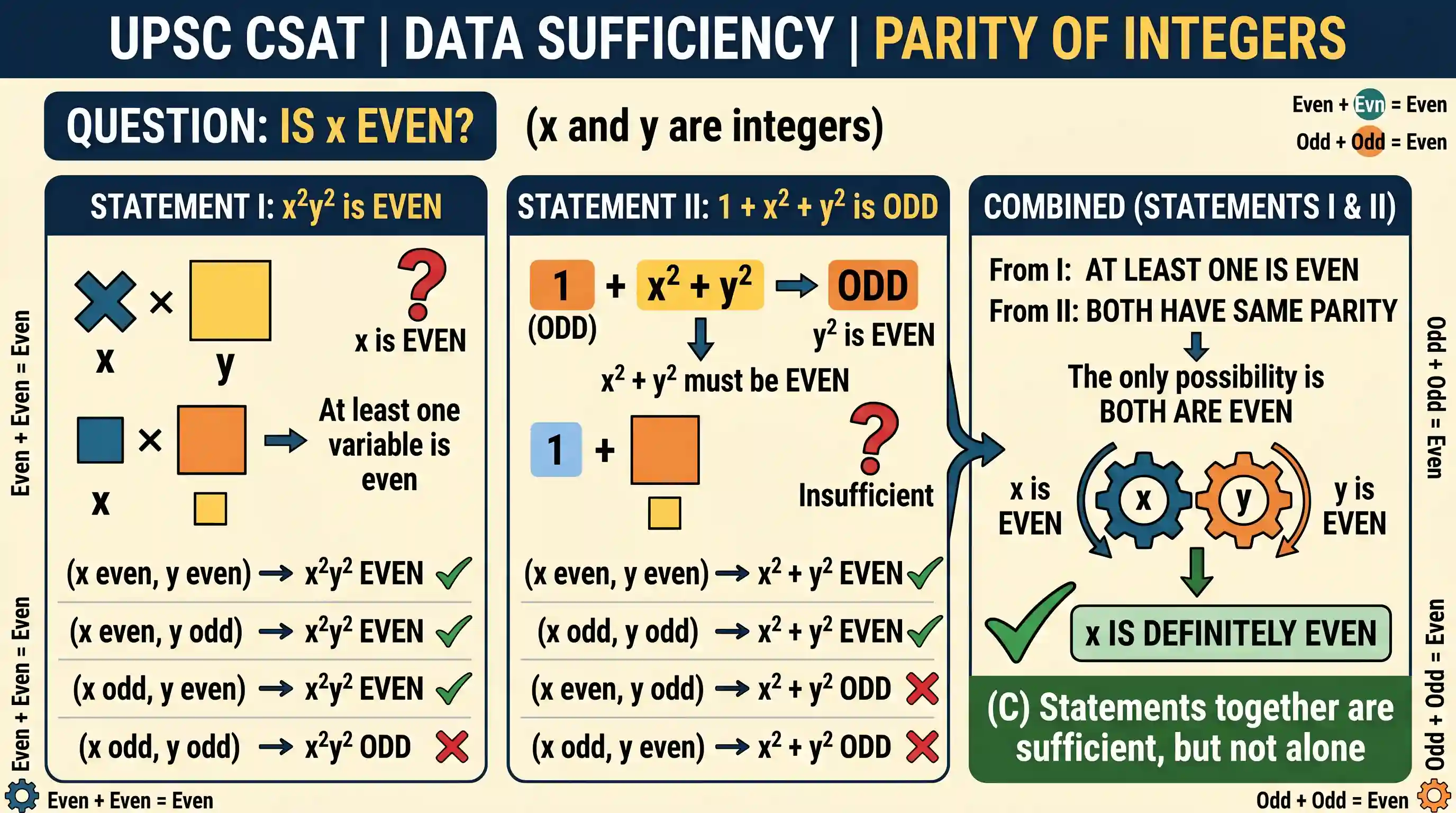
Why the correct option is correct: According to the fundamental rules of parity in number theory, the parity of an integer (whether it is even or odd) determines the parity of its square (x is even if and only if x² is even).
- Evaluating Statement I: The expression x²y² is even. For a product to be even, at least one of its factors must be an even integer. Thus, either x is even, y is even, or both are even. We cannot definitively say if x is even (e.g., if x=3 and y=2, x²y² = 36 which is even, but x is undeniably odd). Thus, Statement I alone is insufficient.
- Evaluating Statement II: The expression 1 + x² + y² is odd. Subtracting the odd number 1 from this expression dictates that the sum x² + y² must be even. The sum of two integers is even if and only if both share the exact same parity (either both are even, or both are odd). Thus, x could still be either even or odd. Statement II alone is insufficient.
- Combining Both Statements: Statement II requires x and y to have identical parity. Statement I mandates that at least one of them must be even. The only mathematical way to satisfy both conditions simultaneously is if both x and y are even integers. Therefore, we can definitively answer the question: "Yes, x is even." Since both statements are required to deduce this, Option C is the correct answer.
Why the wrong options are incorrect:
- Option A is incorrect: Statement I alone cannot determine if x is the even variable; y could be the sole even integer.
- Option B is incorrect: Neither statement independently answers the question, as Statement II alone leaves the possibility that both integers are odd.
- Option D is incorrect: Combining the two statements successfully eliminates all alternative possibilities except x being even, meaning the question can indeed be answered.
Concluding Takeaway: Parity Rules: For UPSC CSAT Data Sufficiency, internalize standard parity rules: Odd + Odd = Even and Even × Odd = Even. Always check if a mathematical operation allows one variable to mask the parity of the other!
Related questions
More UPSC Prelims practice from the same subject and topic.
- Prelims 2026CSATother
How many times does 5 appear in all two-digit positive integers?
- Prelims 2026GS1other
Which of the following statements with regard to the Grand Slam Tennis Tournaments is/are correct ? 1. The tournaments have a shared governance structure establishing the partnership among the four Gr…
- Prelims 2026GS1other
Ms. X is a mid-level civil service official working in the urban development department of a major city. Recently, she was involved in approving a contract for a public infrastructure project — a new …
- Prelims 2026GS1other
Which one of the following pairs is not correctly matched? (Indian Army Corps) : (Headquarters)
- Prelims 2026CSATother
For ⅓ < x < y < 2, which of the following statements is/are always correct? I. x + 1/x < y + 1/y II. √(1 + y²)/y < √(1 + x²)/x Select the answer using the code given below.
- Prelims 2026CSATother
What is the minimum number of times one needs to measure to get 298 litres of water from a tank, if the measuring cylinders have capacities 1 litre, 6 litres, 25 litres and 100 litres?