Directions for the next 5 (five) items : Each item in this section contains a question followed by two statements. Answer each item using the following instructions and mark your response on the Answer Sheet accordingly. Question : X receives three coins of different denominations : 1, 2, 5, 10 and 20. If the total amount received by X is m, does X receive a coin of denomination 5? Statement I : m is not a prime number. Statement II : The sum of the digits of m is greater than 5.

- ASelect this option if the question can be answered using one of these statements alone, but cannot be answered using other statementCorrect
- BSelect this option if the question can be answered using either statement alone
- CSelect this option if the question can be answered using both the statements together, but cannot be answered using either statement alone
- DSelect this option if the question cannot be answered even using any of the statements
Explanation
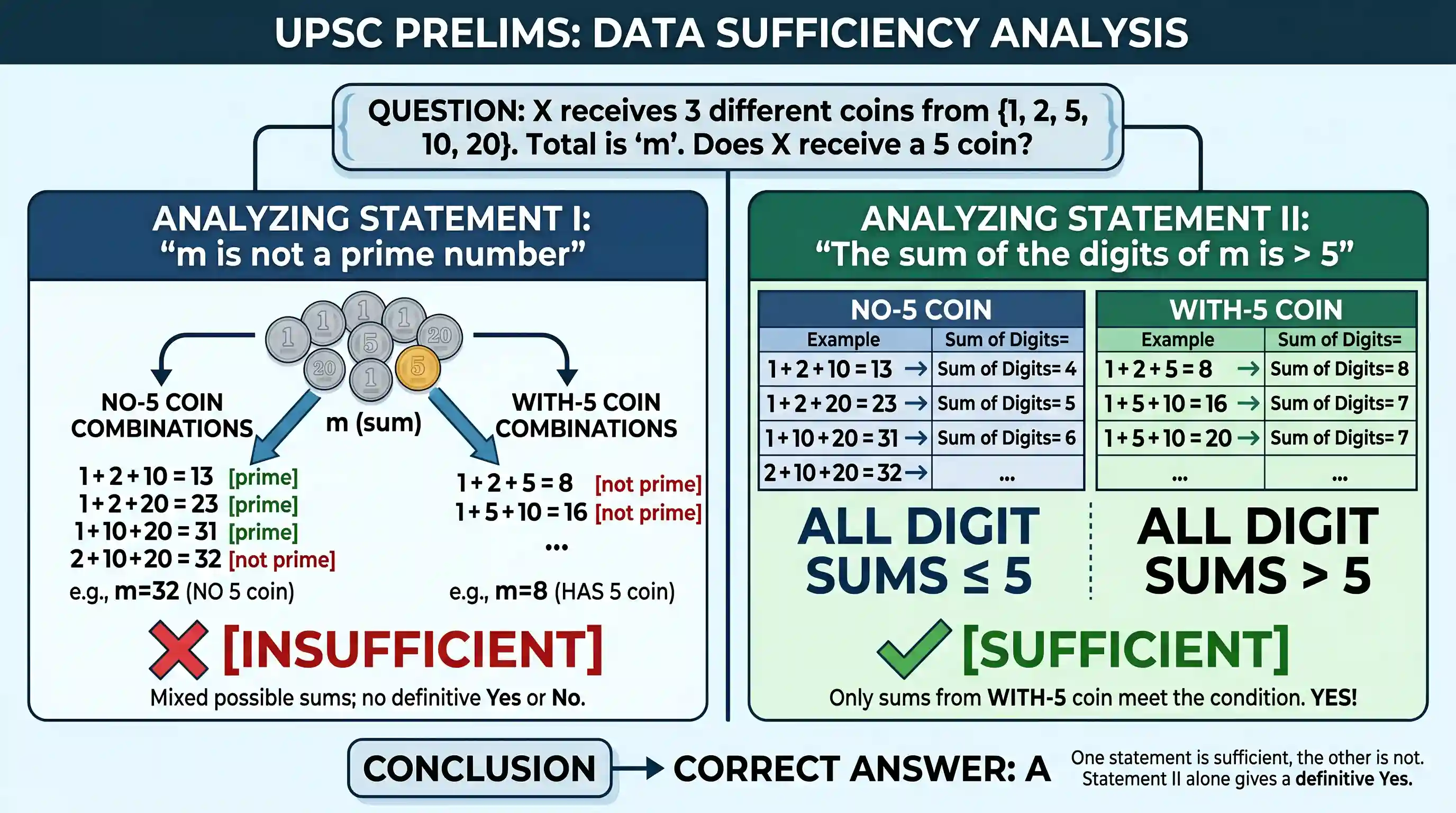
The correct answer is Option A. To determine if X receives a coin of denomination 5, we must evaluate the possible combinations of exactly three different coins chosen from the set {1, 2, 5, 10, 20}. Using the combinations formula (5C3), there are exactly 10 possible sets.
First, let us identify the sums (m) of the 4 combinations that do not contain the 5-rupee coin:
- 1 + 2 + 10 = 13 (Sum of digits: 1+3 = 4)
- 1 + 2 + 20 = 23 (Sum of digits: 2+3 = 5)
- 1 + 10 + 20 = 31 (Sum of digits: 3+1 = 4)
- 2 + 10 + 20 = 32 (Sum of digits: 3+2 = 5)
The remaining 6 sets that do contain the 5-rupee coin yield sums (m) of 8, 16, 17, 26, 27, and 35.
Evaluating Statement I: 'm is not a prime number.' The non-prime sums across all combinations are 8, 16, 26, 27, 32, and 35. This list includes m=32 (which does not contain a 5-rupee coin) and m=8 (which does). Since it yields mixed results, Statement I alone is mathematically insufficient.
Evaluating Statement II: 'The sum of the digits of m is greater than 5.' As calculated above, the combinations lacking a 5-rupee coin have digit sums of 4, 5, 4, and 5. None of these are greater than 5. Consequently, if the sum of the digits is strictly greater than 5, m must correspond to a combination that includes the 5-rupee coin (whose digit sums are 8, 7, 8, 8, 9, and 8). Statement II alone gives a definitive 'Yes' and is entirely sufficient.
Why other options are wrong:
- Option B is incorrect because both statements are not independently sufficient; Statement I fails to give a definitive answer.
- Option C is incorrect because the statements do not need to be combined; Statement II alone is enough.
- Option D is incorrect because the question can indeed be answered using Statement II.
Takeaway: In CSAT Data Sufficiency logic puzzles, comprehensively listing the inverse scenarios (e.g., all sums without the 5 coin) is the fastest way to test conditional boundaries.
Related questions
More UPSC Prelims practice from the same subject and topic.
- Prelims 2026CSATother
Directions for the next 5 (five) items : Each item in this section contains a question followed by two statements. Answer each item using the following instructions and mark your response on the Answe…
- Prelims 2026GS1other
Which of the following statements with regard to the Grand Slam Tennis Tournaments is/are correct ? 1. The tournaments have a shared governance structure establishing the partnership among the four Gr…
- Prelims 2026GS1other
Ms. X is a mid-level civil service official working in the urban development department of a major city. Recently, she was involved in approving a contract for a public infrastructure project — a new …
- Prelims 2026GS1other
Which one of the following pairs is not correctly matched? (Indian Army Corps) : (Headquarters)
- Prelims 2026CSATother
For ⅓ < x < y < 2, which of the following statements is/are always correct? I. x + 1/x < y + 1/y II. √(1 + y²)/y < √(1 + x²)/x Select the answer using the code given below.
- Prelims 2026CSATother
What is the minimum number of times one needs to measure to get 298 litres of water from a tank, if the measuring cylinders have capacities 1 litre, 6 litres, 25 litres and 100 litres?