Directions for the next 5 (five) items : Each item in this section contains a question followed by two statements. Answer each item using the following instructions and mark your response on the Answer Sheet accordingly. Question : If x, y and z are integers, each greater than 1, then is x a prime number? Statement I : xy² = 116 Statement II : xz = 261

- ASelect this option if the question can be answered using one of these statements alone, but cannot be answered using other statementCorrect
- BSelect this option if the question can be answered using either statement alone
- CSelect this option if the question can be answered using both the statements together, but cannot be answered using either statement alone
- DSelect this option if the question cannot be answered even using any of the statements
Explanation
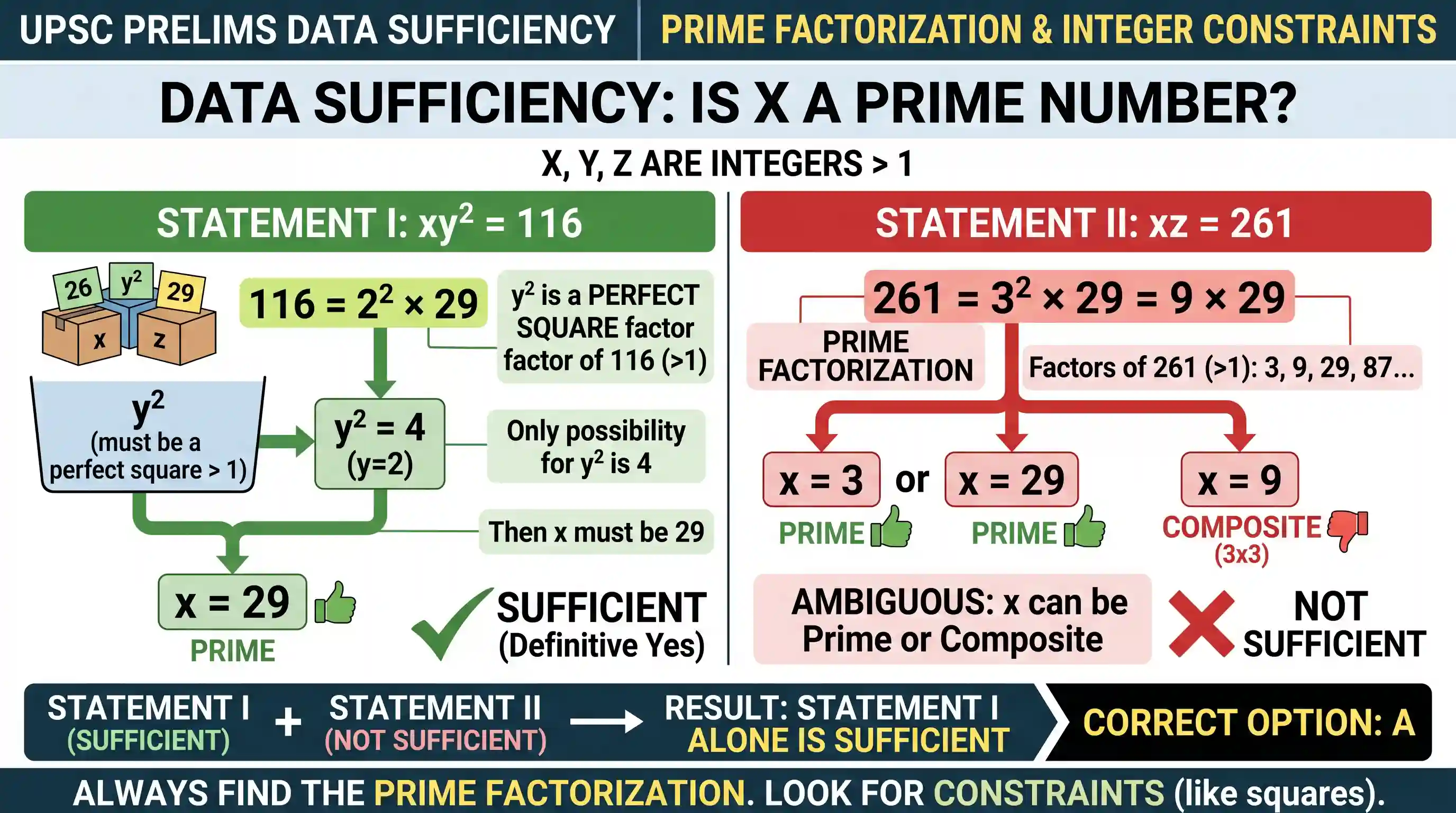
The correct answer is Option A. To determine whether x is a prime number, we evaluate each statement using prime factorization.
Why Option A is correct: Statement I: xy² = 116. The prime factorization of 116 is 29 × 2². The problem states that x and y are integers strictly greater than 1. This means y² must be a perfect square factor of 116 that is greater than 1. The only perfect square satisfying this condition is 4 (where y = 2). Consequently, x must be 116 ÷ 4 = 29. Because 29 is unambiguously a prime number, Statement I alone is sufficient to definitively answer the question "Yes."
Statement II: xz = 261. The prime factorization of 261 is 3² × 29. The integer factors of 261 greater than 1 are 3, 9, 29, and 87. Thus, x could be 3 or 29 (which are prime numbers), or it could be 9 or 87 (which are composite numbers). Because Statement II yields ambiguous results regarding whether x is prime, it is not sufficient on its own.
Why the other options are incorrect:
- Option B: This is incorrect because Statement II cannot answer the question alone due to the multiple composite and prime possibilities for x.
- Option C: This is incorrect because Statement I is fully sufficient on its own; combining the statements is mathematically unnecessary.
- Option D: This is incorrect because Statement I successfully and independently provides a definitive answer to the question.
Takeaway: In Data Sufficiency questions involving integer multiplication, always find the prime factorization of the product. This reveals the exact mathematical constraints on the variables, especially when perfect squares are involved.
Related questions
More UPSC Prelims practice from the same subject and topic.
- Prelims 2026CSATother
Directions for the next 5 (five) items : Each item in this section contains a question followed by two statements. Answer each item using the following instructions and mark your response on the Answe…
- Prelims 2026GS1other
Which of the following statements with regard to the Grand Slam Tennis Tournaments is/are correct ? 1. The tournaments have a shared governance structure establishing the partnership among the four Gr…
- Prelims 2026GS1other
Ms. X is a mid-level civil service official working in the urban development department of a major city. Recently, she was involved in approving a contract for a public infrastructure project — a new …
- Prelims 2026GS1other
Which one of the following pairs is not correctly matched? (Indian Army Corps) : (Headquarters)
- Prelims 2026CSATother
For ⅓ < x < y < 2, which of the following statements is/are always correct? I. x + 1/x < y + 1/y II. √(1 + y²)/y < √(1 + x²)/x Select the answer using the code given below.
- Prelims 2026CSATother
What is the minimum number of times one needs to measure to get 298 litres of water from a tank, if the measuring cylinders have capacities 1 litre, 6 litres, 25 litres and 100 litres?