Passage: ... inspired by iconic temples like the Dakshineshwar Kali Temple and the Brahma Mandir, were treasure troves of regional artistry. Bengal's Pattachitra paintings, Assam's bamboo crafts, Tamil Nadu's Thanjavur paintings, and Madhya Pradesh's tribal sculpture—all were showcased in these living galleries where 230 master artisans breathed life into them using age-old techniques, their hands shaping India's ancient history into creations to behold. Question: Which of the following conclusions are valid? 1. Seven Sanskriti Angans, representing different regions of India, had been showcased in Kalagram. 2. Regional artistry was recognised via the inspiration drawn from iconic temples. 3. India's ancient history had been crafted by the contemporary craftsmanship of 230 artisans into creations to behold. 4. Art forms from all regions of India had been showcased in these living galleries. Select the answer using the code given below.

- A1 and 2 only
- B2, 3 and 4
- C1, 2 and 4
- D1 and 3Correct
Explanation
The provided passage is derived from descriptions of Kalagram, a cultural hub curated by the Ministry of Culture (prominently featured at the Mahakumbh 2025) to celebrate India's artistic heritage [9, 10].
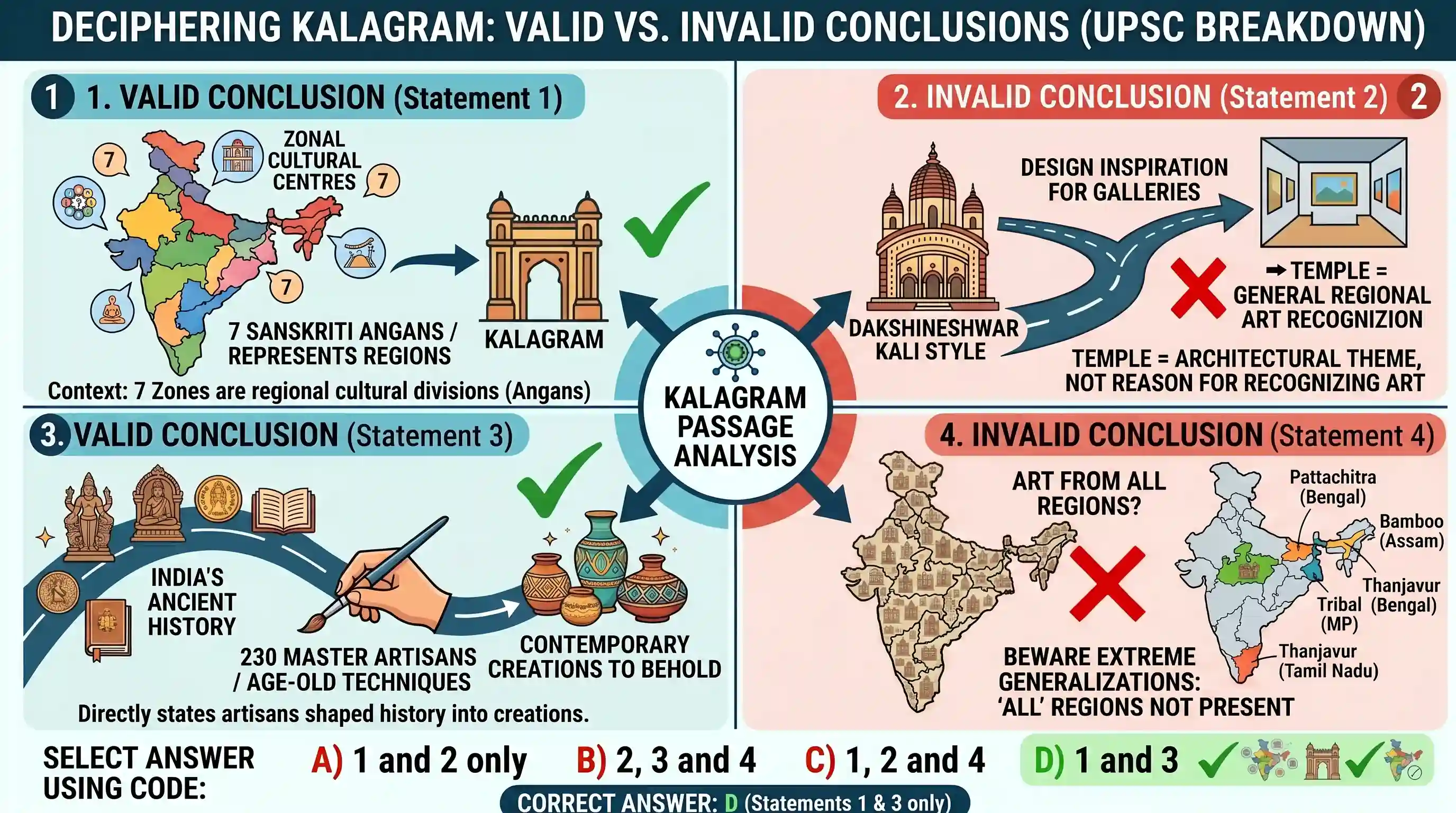
Statement 1 is valid: The broader context of the excerpt refers to the seven Sanskriti Angans (cultural courtyards) established at Kalagram by India's seven Zonal Cultural Centres. These zones represent different regions and serve as the "living galleries" mentioned in the text [9, 11].
Statement 3 is valid: This is a direct conclusion from the passage, which explicitly states: "...where 230 master artisans breathed life into them using age-old techniques, their hands shaping India's ancient history into creations to behold" [10, 11].
Statement 2 is invalid: The statement misinterprets the causal relationship in the text. The passage states that the living galleries (the Sanskriti Angans) were inspired by the architectural and thematic essence of iconic temples (like the Dakshineshwar Kali Temple and the Brahma Mandir) [10]. The temples inspired the design of the exhibition spaces, but they were not the reason the regional artistry itself was "recognised."
Statement 4 is invalid: The statement relies on the extreme generalization "all regions." While the passage lists highly diverse examples—Bengal’s Pattachitra, Assam’s bamboo crafts, Tamil Nadu’s Thanjavur paintings, and Madhya Pradesh’s tribal sculpture—it does not claim that art forms from every single region of India were present without exception.
Since only conclusions 1 and 3 are valid, Option D is the correct answer.
Takeaway: In UPSC Reading Comprehension, beware of causal misattributions (as seen in Statement 2) and extreme absolute words like "all" (as seen in Statement 4), which generally render a conclusion invalid.
Related questions
More UPSC Prelims practice from the same subject and topic.
- Prelims 2026GS1art-culture
What does an empty seat represent in early Buddhist iconography ?
- Prelims 2026GS1art-culture
Which of the following statements on the Amaravati Stupa and its relief sculpture is/are correct ? 1. It was located in the lower Krishna valley. 2. In India, it was next only to the Sanchi Stupa in s…
- Prelims 2026GS1art-culture
Pandit Mallikarjun Mansur, the famous classical singer from Karnataka, represented the :
- Prelims 2026GS1art-culture
Which one of the following Carnatic music ragas is similar to Raga Bilawal in Hindustani music?
- Prelims 2026GS1art-culture
Which of the following temples has/have a Nagara-style shikhara ? 1. Malegitti Shivalaya, Badami 2. Huchimalligudi Temple, Aihole 3. Dashavatara Temple, Deogarh 4. Virupaksha Temple, Pattadakal Select…
- Prelims 2026GS1art-culture
The Hallisalasya painting in the Bagh Caves represents :