Which of the following statements on the Amaravati Stupa and its relief sculpture is/are correct ? 1. It was located in the lower Krishna valley. 2. In India, it was next only to the Sanchi Stupa in size. 3. The Amaravati school of sculpture made a lasting impact on the later South Indian sculpture, and its products were carried to Sri Lanka and South-east Asia. Select the answer using the code given below :

- A1 only
- B1 and 3 onlyCorrect
- C2 and 3 only
- D1, 2 and 3
Explanation
The correct answer is Option B (1 and 3 only).
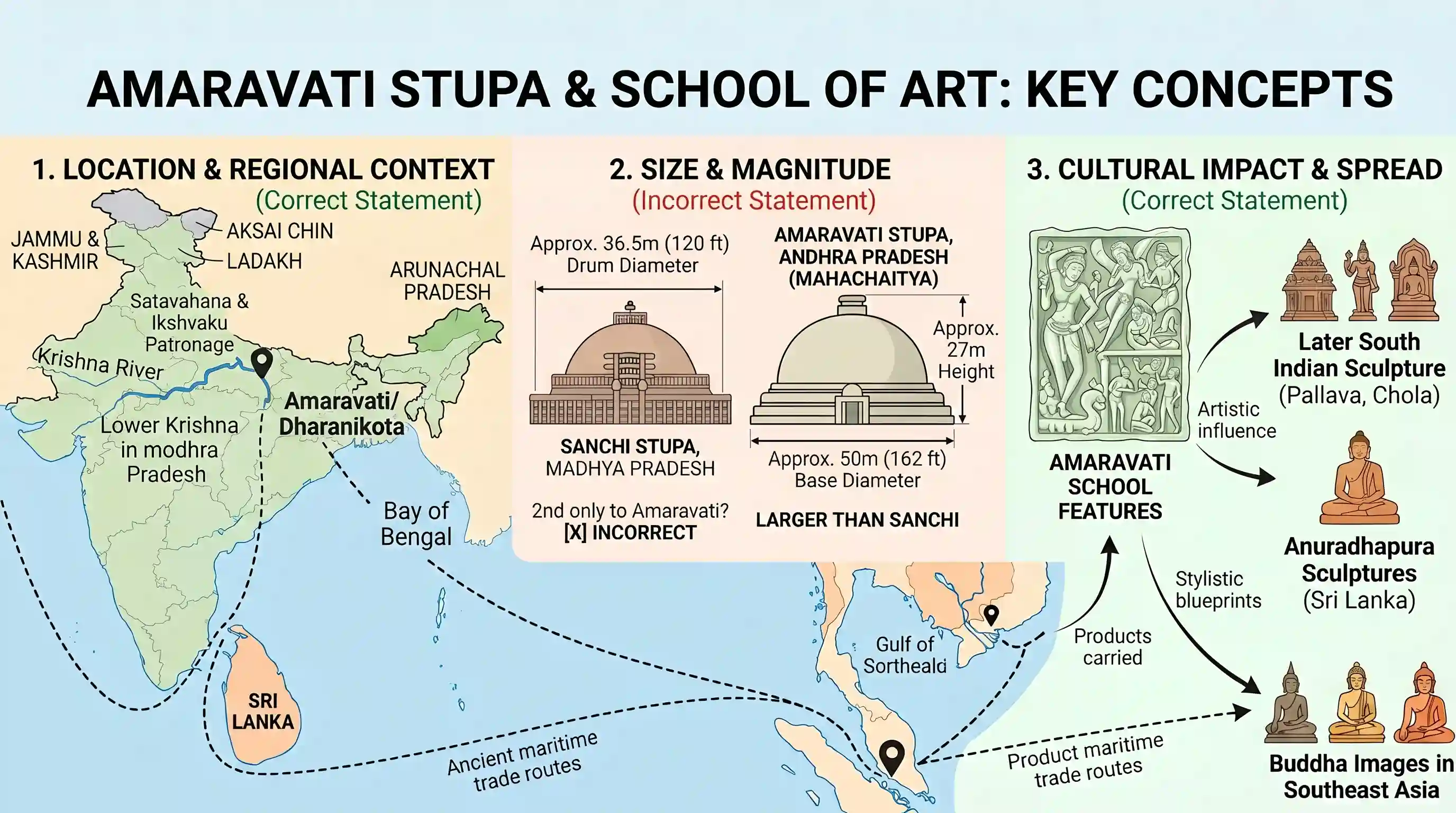
Statement 1 is correct: The Amaravati Stupa, historically known as the Mahachaitya, is located in the lower Krishna valley in modern-day Andhra Pradesh (near Dharanikota). It served as a thriving Buddhist centre from the 3rd century BCE until the 14th century CE, reaching its architectural and artistic zenith under the patronage of the Satavahana and Ikshvaku dynasties.
Statement 3 is correct: The Amaravati School of Art (also known as the Vengi school) had a profound and lasting impact on later South Indian art, laying the aesthetic foundations for later Pallava and Chola sculptures. Because of the region's active maritime trade networks across the Bay of Bengal, Amaravati's sculptural style—characterised by elegant, dynamic figures and intricate narrative reliefs carved in pale greenish-white limestone—spread widely. Its products and stylistic blueprints were carried to Sri Lanka (notably influencing the Anuradhapura sculptures) and various parts of Southeast Asia, where they served as regional prototypes for Buddha images.
Statement 2 is incorrect: The Amaravati Stupa was not second in size to the Sanchi Stupa; it was actually larger. While the Great Stupa at Sanchi has a drum diameter of approximately 36.5 metres, the Amaravati Stupa was significantly more massive, boasting a base diameter of about 50 metres (approx. 162 feet) and a height of nearly 27 metres. It was the largest stupa in South India.
Takeaway: When studying the Amaravati School, associate it with the lower Krishna valley, Satavahana/Ikshvaku patronage, its massive scale (surpassing Sanchi), distinctive white limestone, and its extensive overseas cultural footprint via ancient maritime routes.
Related questions
More UPSC Prelims practice from the same subject and topic.
- Prelims 2026GS1art-culture
What does an empty seat represent in early Buddhist iconography ?
- Prelims 2026GS1art-culture
Pandit Mallikarjun Mansur, the famous classical singer from Karnataka, represented the :
- Prelims 2026GS1art-culture
Which one of the following Carnatic music ragas is similar to Raga Bilawal in Hindustani music?
- Prelims 2026GS1art-culture
Which of the following temples has/have a Nagara-style shikhara ? 1. Malegitti Shivalaya, Badami 2. Huchimalligudi Temple, Aihole 3. Dashavatara Temple, Deogarh 4. Virupaksha Temple, Pattadakal Select…
- Prelims 2026GS1art-culture
The Hallisalasya painting in the Bagh Caves represents :
- Prelims 2026GS1art-culture
Which one of the following statements with regard to the Moidams, built by the Tai-Ahom kingdom and inscribed as a World Heritage Site by UNESCO, is/are correct ? 1. They acted as army fortresses. 2. …