The Hallisalasya painting in the Bagh Caves represents :

- AA joyous folk danceCorrect
- BBuddha in a meditative pose
- CThe depiction of Shiva and Parvati on Kailasha
- DSamudramanthan (Churning of the Ocean)
Explanation
Correct Answer: A
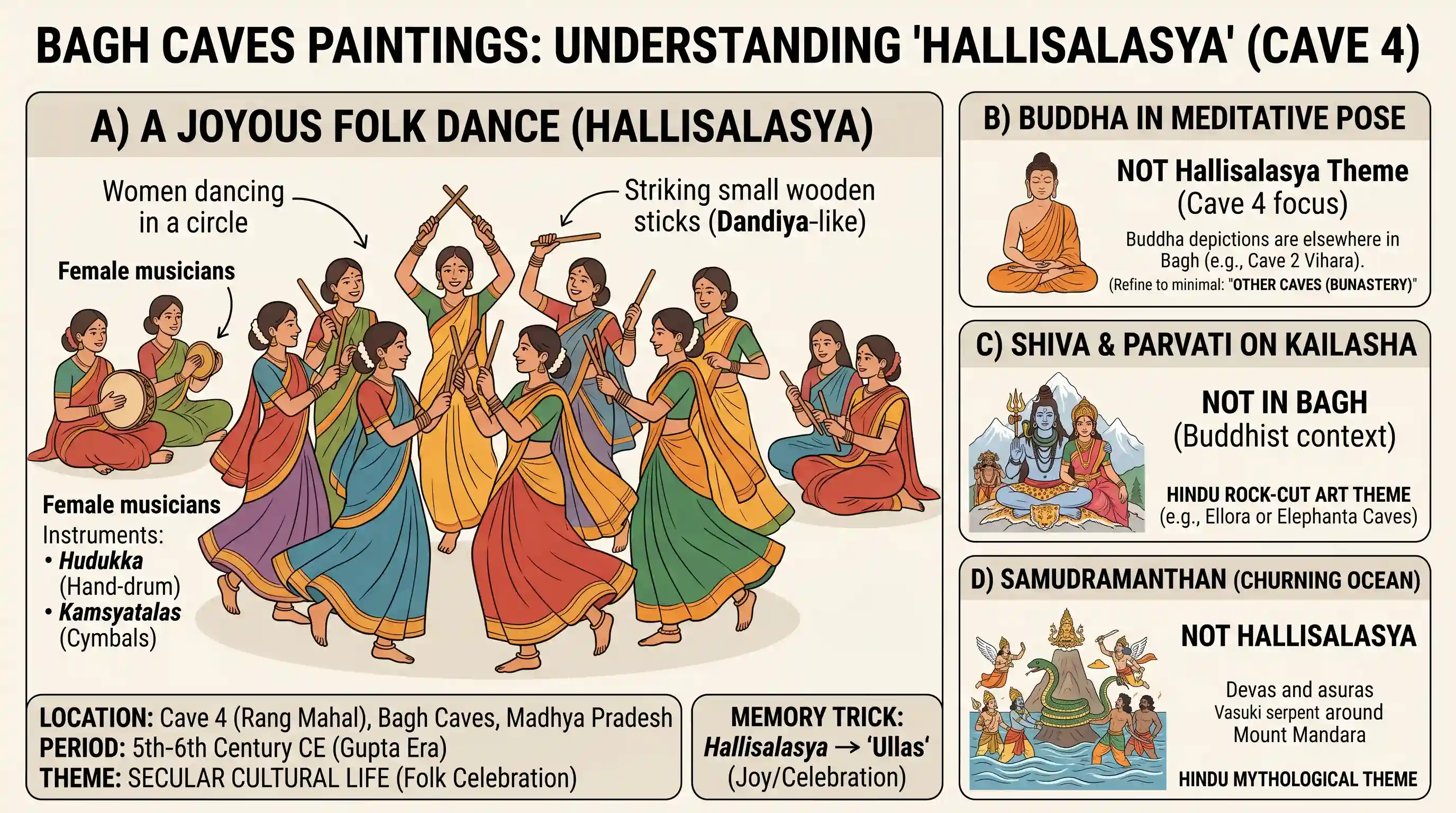
Why Option A is correct: The Hallisalasya painting is a renowned mural located in Cave No. 4 (commonly known as the Rang Mahal or Palace of Colours) of the Bagh Caves in Madhya Pradesh. Dating back to the 5th–6th century CE during the Gupta period, this mural masterfully depicts a joyous, rhythmic folk dance. It illustrates a group of women dancing in a ring and striking small wooden sticks together, closely resembling the modern-day Dandiya or Garba. The dynamic scene is accompanied by female musicians playing traditional instruments such as the hudukka (hand-drum) and kamsyatalas (cymbals). This artwork is celebrated for showcasing the vibrant, secular cultural life of ancient India alongside the spiritual ambiance of the Buddhist caves.
Why the other options are incorrect:
- Option B is incorrect: Although the Bagh Caves are structurally Buddhist rock-cut viharas (monasteries), the Hallisalasya mural specifically represents a secular celebration, not the Buddha in meditation. Sculptures and depictions of the Buddha are found elsewhere in the cave complex (such as Cave 2).
- Option C is incorrect: The depiction of Shiva and Parvati on Mount Kailasha is a classic theme of Hindu rock-cut architecture. It is prominently found in the Rashtrakuta-era Ellora Caves (e.g., the Kailashanath Temple) and the Elephanta Caves, not the Bagh Caves.
- Option D is incorrect: Samudramanthan (Churning of the Ocean) is a major episode from Hindu mythology. It is not the subject of Hallisalasya, a term that specifically denotes a group folk dance.
Concluding Takeaway: To remember this, associate the Bagh Caves' Cave 4 (Rang Mahal) with colorful, secular themes. You can link the word "Hallisalasya" to "Ullas" (Sanskrit for joy or celebration), helping you easily recall it as a joyous folk dance akin to ancient Dandiya.
Related questions
More UPSC Prelims practice from the same subject and topic.
- Prelims 2026CSATart-culture
Passage: ... inspired by iconic temples like the Dakshineshwar Kali Temple and the Brahma Mandir, were treasure troves of regional artistry. Bengal's Pattachitra paintings, Assam's bamboo crafts, Tami…
- Prelims 2026GS1art-culture
What does an empty seat represent in early Buddhist iconography ?
- Prelims 2026GS1art-culture
Which of the following statements on the Amaravati Stupa and its relief sculpture is/are correct ? 1. It was located in the lower Krishna valley. 2. In India, it was next only to the Sanchi Stupa in s…
- Prelims 2026GS1art-culture
Pandit Mallikarjun Mansur, the famous classical singer from Karnataka, represented the :
- Prelims 2026GS1art-culture
Which one of the following Carnatic music ragas is similar to Raga Bilawal in Hindustani music?
- Prelims 2026GS1art-culture
Which of the following temples has/have a Nagara-style shikhara ? 1. Malegitti Shivalaya, Badami 2. Huchimalligudi Temple, Aihole 3. Dashavatara Temple, Deogarh 4. Virupaksha Temple, Pattadakal Select…