Among the four main forms of existence of life recognized in Jainism, which one of the following is not included ?

- ADeva (gods)
- BYaksha (demi-gods)Correct
- CManushya (humans)
- DTiryancha (animals and plants)
Explanation
The correct answer is B) Yaksha (demi-gods).
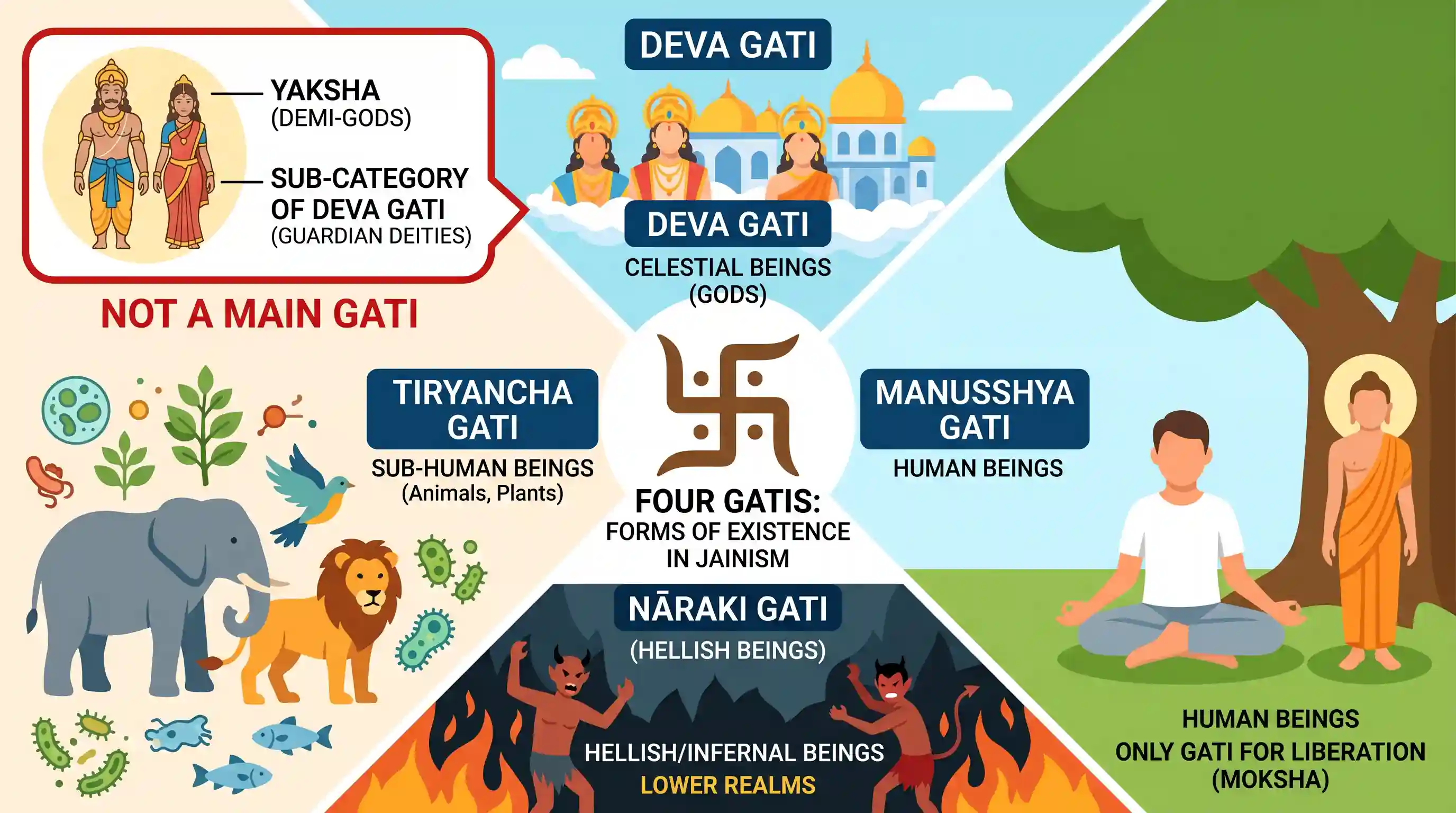
In Jain philosophy and cosmology, the cycle of birth and death (samsara) is governed by a soul's karma, which dictates its rebirth into one of four distinct destinies or realms, known as Gatis. The four foundational forms of existence recognized in Jainism are:
- Deva Gati (Heavenly or celestial beings)
- Manushya Gati (Human beings)
- Tiryancha Gati (Sub-human beings like animals, plants, and microorganisms)
- Nāraki Gati (Infernal or hellish beings)
Option B is correct because Yaksha is not one of the four main Gatis. While Yakshas and Yakshinis are highly venerated in Jainism as guardian deities (Shasana Devatas) who attend to the Tirthankaras, they are not an independent realm of existence. Instead, Jain texts classify them as a subset of celestial beings (Vyantara Devas) within the overarching Deva Gati.
Why the other options are incorrect:
- A) Deva (gods): This is explicitly one of the four Gatis, representing beings who reside in the upper celestial tiers due to past meritorious karma.
- C) Manushya (humans): This is one of the four Gatis. It holds supreme importance in Jainism because it is the only state of existence from which a soul can practice asceticism and attain ultimate liberation (Moksha).
- D) Tiryancha (animals and plants): This is one of the four Gatis, encompassing all flora and fauna, classified further by their number of senses (from single-sensed ekendriyas to five-sensed beings).
Takeaway: A helpful way to remember the four forms of existence is through the Jain Swastika. Its four arms explicitly symbolize the four Gatis (Deva, Manushya, Nāraki, and Tiryancha), serving as a reminder of the endless cycle of rebirth that a soul must escape.
Related questions
More UPSC Prelims practice from the same subject and topic.
- Prelims 2026GS1history
Which of the following pairs of ancient and modern names of rivers is/are correctly matched ? 1. Vitasta : Chenab 2. Asikni : Jhelum 3. Parushni : Ravi 4. Yavyavati : Beas Select the answer using the …
- Prelims 2026GS1history
Which of the following pairs of the king and his dynasty in early historical Tamilakam is/are not correctly matched ? 1. Senguttuvan : Chera 2. Udiyanjeral : Chola 3. Nedunjeliyan : Pandya Select the …
- Prelims 2026GS1history
In which one among the following texts does the term kshetra-patni ('mistress of the field') originate ?
- Prelims 2026GS1history
Consider the following statements : I. Pali texts contain the first definite references to coins, e.g., kahapana, nikkha, kamsa, and kakanika. II. The literary evidence from Pali texts is corroborated…
- Prelims 2026GS1history
Consider the following statements relating to the use of the place-value system in India : 1. The earliest epigraphic use of the place-value system in India is found in the Mankani plates from Gujarat…
- Prelims 2026GS1history
Consider the following statements about the Rigvedic period : I. Irrigation from wells allowed agriculture to expand away from flood plains and strips on river margins into the present Punjab and Hary…