Consider the following statements : I. Pali texts contain the first definite references to coins, e.g., kahapana, nikkha, kamsa, and kakanika. II. The literary evidence from Pali texts is corroborated by archaeological evidence of punch-marked coins from many sites, most of them made of silver. The above statements have been associated with which of the following ? 1. Emergence of urban life 2. Transition to money economy Select the answer using the code given below :

- A1 only
- B2 only
- CBoth 1 and 2Correct
- DNeither 1 nor 2
Explanation
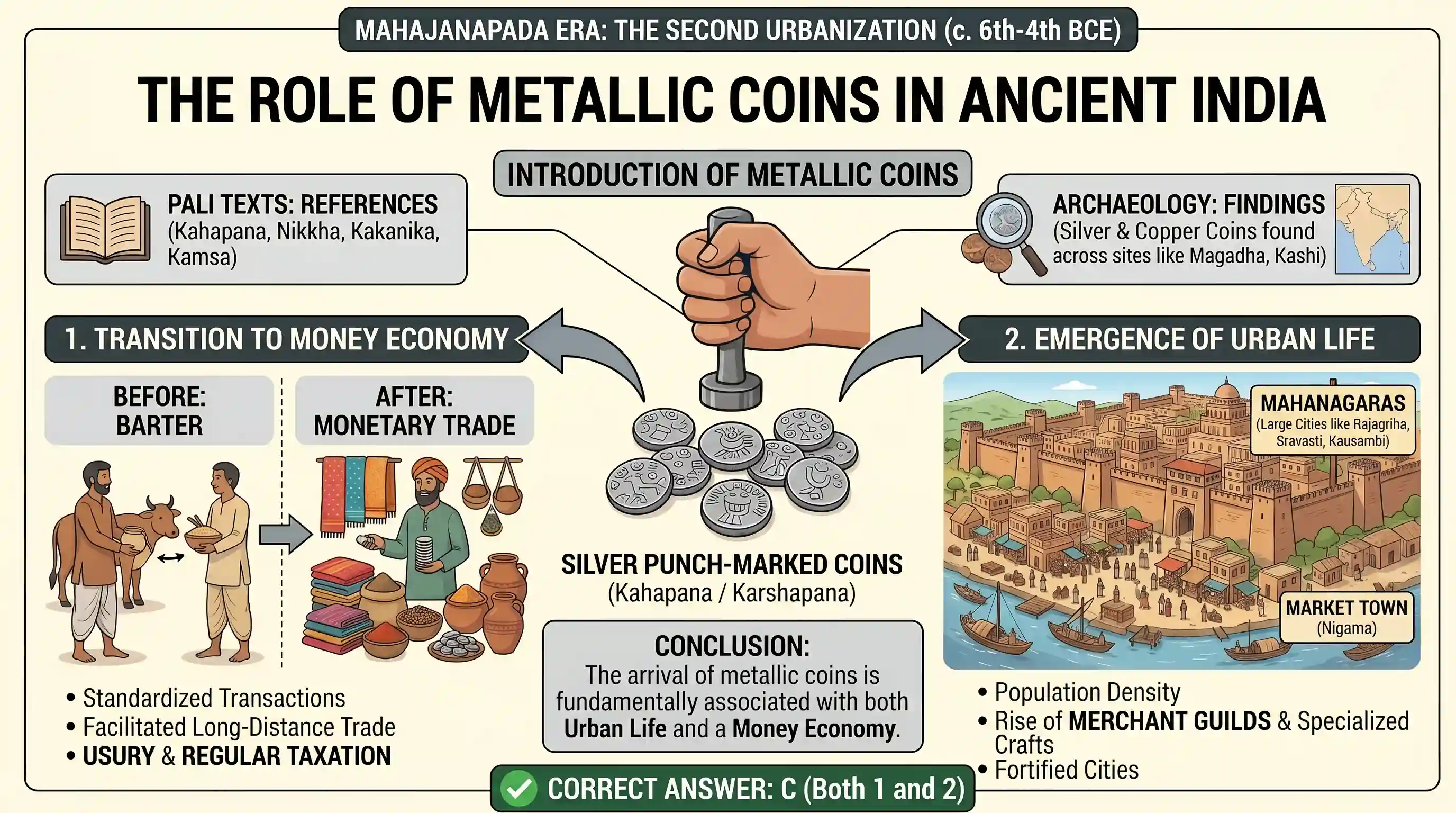
Option C is the correct answer. The introduction of coinage during the 6th century BCE was a watershed moment in ancient Indian history, directly driving both the 'Second Urbanization' and the transition to a monetized economy.
Why Option C is correct: During the era of the Mahajanapadas (c. 600–300 BCE), the Indian subcontinent saw a massive shift in its socio-economic fabric.
- Transition to a money economy: Early Buddhist Pali texts provide the first definite literary references to metallic coins, using terms like kahapana, nikkha, kamsa, masaka, and kakanika. This shift from a pure barter system to a monetary economy facilitated long-distance trade, regularized taxation, and birthed new professions like usury (money-lending).
- Emergence of urban life: This literary evidence is strongly corroborated by the archaeological discovery of punch-marked coins (mostly made of silver, occasionally copper) in regions like Magadha and eastern Uttar Pradesh. The widespread use of these metallic coins supported the growth of commercial market towns (nigamas) and massive fortified cities (mahanagaras like Rajagriha, Sravasti, and Kausambi), marking the Second Urbanization. Because the advent of punch-marked coins was fundamental to both urban expansion and monetary trade, both points 1 and 2 are correct associations.
Why the other options are wrong:
- Option A (1 only) & Option B (2 only): Both are incomplete. The advent of coins cannot be isolated to just urban life or just a money economy. The wealth generated by monetary trade is exactly what sustained the new urban centers, making both phenomena inseparable.
- Option D (Neither 1 nor 2): Incorrect, as both are historically verified consequences of the introduction of coinage.
Takeaway: Remember the 'Second Urbanization' (600 BCE) by associating early Buddhist Pali texts and silver Punch-marked coins with the rise of Prosperous cities and a monetized economy.
Related questions
More UPSC Prelims practice from the same subject and topic.
- Prelims 2026GS1history
Which of the following pairs of ancient and modern names of rivers is/are correctly matched ? 1. Vitasta : Chenab 2. Asikni : Jhelum 3. Parushni : Ravi 4. Yavyavati : Beas Select the answer using the …
- Prelims 2026GS1history
Which of the following pairs of the king and his dynasty in early historical Tamilakam is/are not correctly matched ? 1. Senguttuvan : Chera 2. Udiyanjeral : Chola 3. Nedunjeliyan : Pandya Select the …
- Prelims 2026GS1history
In which one among the following texts does the term kshetra-patni ('mistress of the field') originate ?
- Prelims 2026GS1history
Among the four main forms of existence of life recognized in Jainism, which one of the following is not included ?
- Prelims 2026GS1history
Consider the following statements relating to the use of the place-value system in India : 1. The earliest epigraphic use of the place-value system in India is found in the Mankani plates from Gujarat…
- Prelims 2026GS1history
Consider the following statements about the Rigvedic period : I. Irrigation from wells allowed agriculture to expand away from flood plains and strips on river margins into the present Punjab and Hary…