The artificially fixed rupee-sterling exchange rate prescribed by the Hilton-Young Commission (1926) was adopted by the British Government for which one of the following reasons?

- AAiding the flow of remittances from India and maintaining India's creditworthinessCorrect
- BProviding support to Indian importers
- CEncouraging export of cotton produce from India
- DPreventing depreciation of the Rupee in terms of gold
Explanation
The correct answer is A.
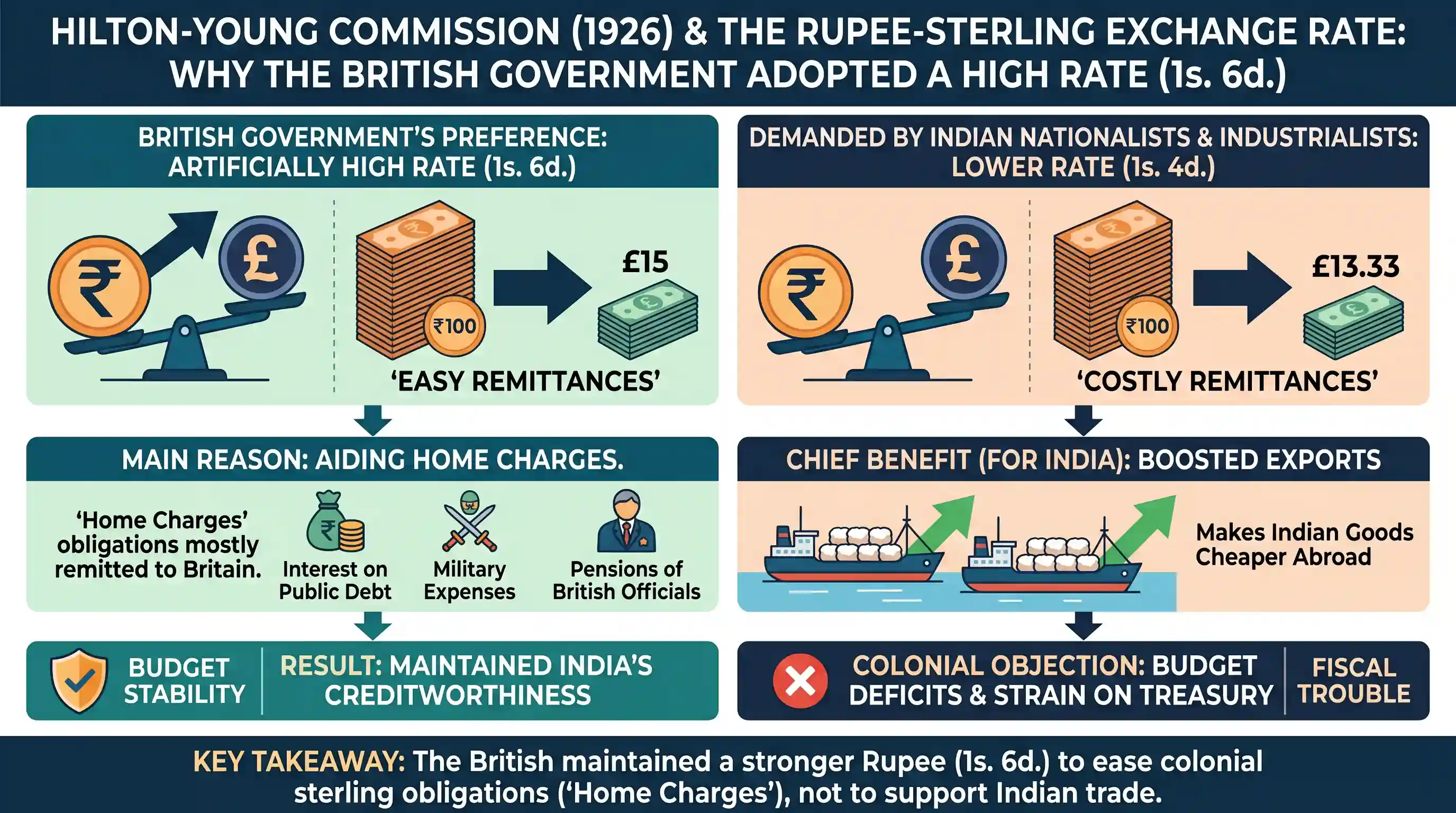
Why the correct option is correct: The Hilton-Young Commission (Royal Commission on Indian Currency and Finance, 1926) recommended an artificially high rupee-sterling exchange rate of 1s. 6d. (one shilling and sixpence) instead of the widely demanded 1s. 4d. The British Government adopted this overvalued peg primarily to ease the burden of the "Home Charges"—massive sterling obligations remitted to Britain that included interest on public debt, military expenses, and British officials' pensions. By artificially maintaining a stronger Rupee, the colonial government required fewer rupees to buy the sterling needed for these remittances. This prevented massive deficits in the colonial budget and guaranteed that the British Indian government could comfortably service its foreign debt, thereby maintaining its international creditworthiness.
Why the other options are wrong:
- Option B is incorrect: While an overvalued currency naturally cheapens imports, the British Government's primary macroeconomic motive for the peg was to secure its own fiscal budget and facilitate Home Charges, rather than to specifically support Indian importers.
- Option C is incorrect: An artificially strong Rupee made Indian goods more expensive abroad, severely discouraging and hurting Indian exports like cotton. This provoked immense backlash from Indian nationalist leaders and industrialists, who argued it harmed domestic agriculture and industry.
- Option D is incorrect: Although the Commission recommended a Gold Bullion Standard to provide general currency stability, the specific choice of the artificially high fixed rate (1s. 6d.) was intentionally selected to aid sterling remittances.
Concluding takeaway: Remember the "Ratio Controversy" of the 1920s: The British enforced a high exchange rate (1s. 6d.) to easily extract Home Charges, while Indian nationalists fiercely demanded a lower rate (1s. 4d.) to protect Indian agricultural exports and domestic industries.
Related questions
More UPSC Prelims practice from the same subject and topic.
- Prelims 2026GS1history
Which of the following factors contributed to the formation of the Forward Bloc by Subhas Chandra Bose in 1939 ? 1. Bose failed to win the confidence of Mahatma Gandhi. 2. The Congress Left was disuni…
- Prelims 2026GS1history
Consider the following statements regarding the British policy in Awadh immediately after its annexation in 1856 : 1. The taluqdars were dispossessed of their estates but allowed to retain their arms …
- Prelims 2026GS1history
Consider the following assertion : The genesis of political alliances based on community lay in the very nature of the Montague-Chelmsford Reforms, 1919. Which of the following statements support/supp…
- Prelims 2026GS1history
Which one of the following statements about the Eka Movement and Bardoli Satyagraha is correct ?
- Prelims 2026GS1history
Which of the following pairs of ancient and modern names of rivers is/are correctly matched ? 1. Vitasta : Chenab 2. Asikni : Jhelum 3. Parushni : Ravi 4. Yavyavati : Beas Select the answer using the …
- Prelims 2026GS1history
Which of the following pairs of the king and his dynasty in early historical Tamilakam is/are not correctly matched ? 1. Senguttuvan : Chera 2. Udiyanjeral : Chola 3. Nedunjeliyan : Pandya Select the …