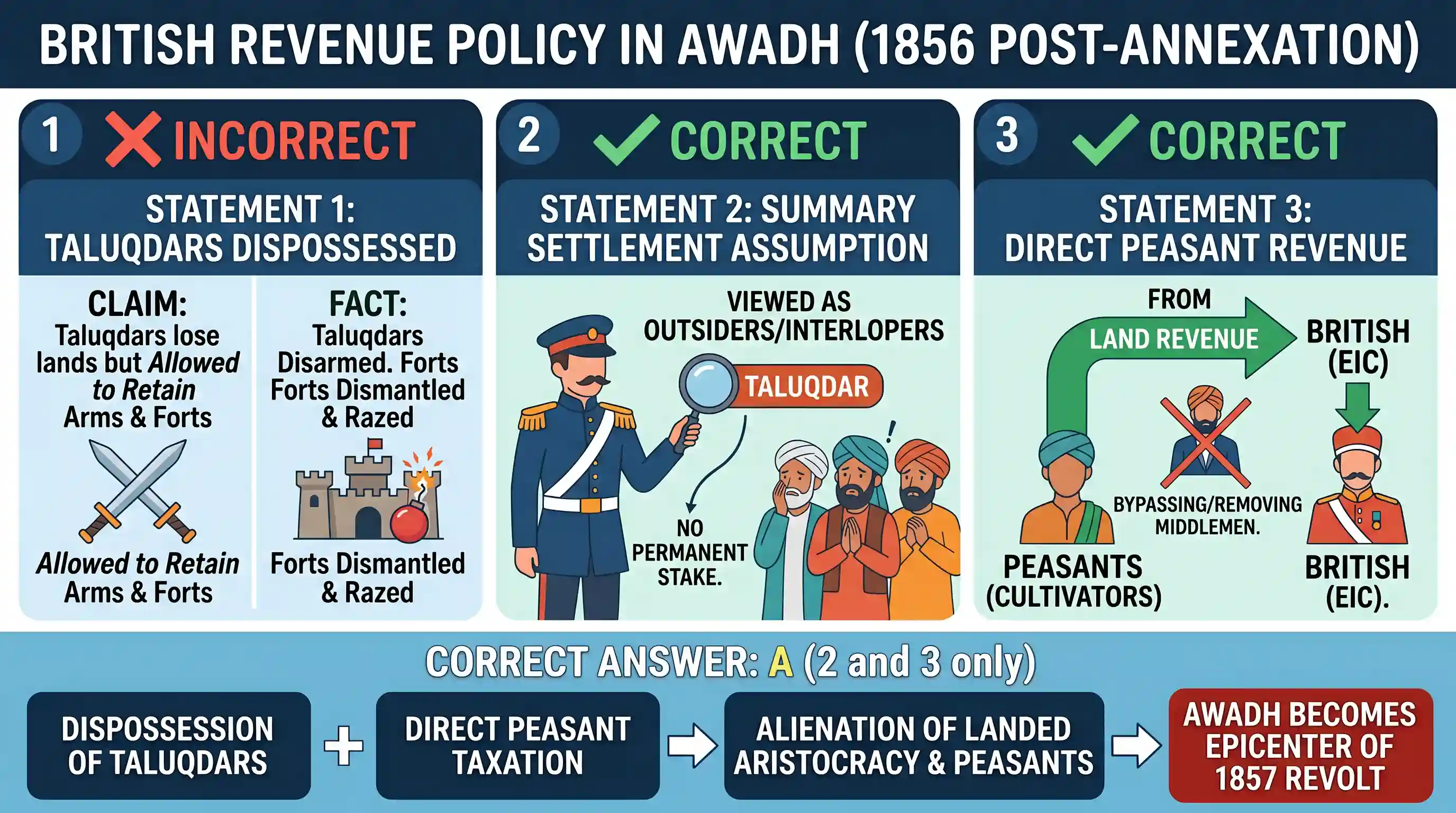
Consider the following statements regarding the British policy in Awadh immediately after its annexation in 1856 : 1. The taluqdars were dispossessed of their estates but allowed to retain their arms and forts. 2. A Summary Revenue Settlement was made in 1856 assuming that the taluqdars were outsiders. 3. The British believed in taking revenue directly from the peasants by removing the taluqdars. Which of the statements given above is/are correct ?

- A2 and 3 onlyCorrect
- B1 and 3 only
- C1, 2 and 3
- D2 only
Explanation
Why Option A is correct: Following the annexation of Awadh in 1856 by Lord Dalhousie, the British administration introduced the Summary Revenue Settlement of 1856.
- Statement 2 is correct: The fundamental assumption of this British settlement was that the taluqdars (powerful landlords) were interlopers or outsiders who had seized control of the land through force and fraud, and therefore had no permanent stakes or rightful claims to the estates.
- Statement 3 is correct: The British aimed to maximize state income by removing these intermediary taluqdars and taking land revenue directly from the actual cultivators or village communities. The administration believed that directly settling with the peasants would bypass oppressive middlemen and increase the East India Company's revenue.
Why Statement 1 is incorrect:
- Statement 1 is incorrect: The British were entirely unwilling to tolerate the dominance of the taluqdars or allow rival centers of power. Upon being dispossessed of their estates, the taluqdars were systematically stripped of their weapons, and their forts were completely razed or dismantled. They were absolutely not allowed to retain their arms or military strongholds.
Concluding Takeaway: The aggressive dispossession of the taluqdars under the 1856 Summary Settlement destroyed Awadh's traditional social fabric. This socio-economic disruption alienated both the landed aristocracy and the peasantry, making Awadh one of the fiercest epicenters of the Revolt of 1857.
Related questions
More UPSC Prelims practice from the same subject and topic.
- Prelims 2026GS1history
Which of the following factors contributed to the formation of the Forward Bloc by Subhas Chandra Bose in 1939 ? 1. Bose failed to win the confidence of Mahatma Gandhi. 2. The Congress Left was disuni…
- Prelims 2026GS1history
Consider the following assertion : The genesis of political alliances based on community lay in the very nature of the Montague-Chelmsford Reforms, 1919. Which of the following statements support/supp…
- Prelims 2026GS1history
The artificially fixed rupee-sterling exchange rate prescribed by the Hilton-Young Commission (1926) was adopted by the British Government for which one of the following reasons?
- Prelims 2026GS1history
Which one of the following statements about the Eka Movement and Bardoli Satyagraha is correct ?
- Prelims 2026GS1history
Which of the following pairs of ancient and modern names of rivers is/are correctly matched ? 1. Vitasta : Chenab 2. Asikni : Jhelum 3. Parushni : Ravi 4. Yavyavati : Beas Select the answer using the …
- Prelims 2026GS1history
Which of the following pairs of the king and his dynasty in early historical Tamilakam is/are not correctly matched ? 1. Senguttuvan : Chera 2. Udiyanjeral : Chola 3. Nedunjeliyan : Pandya Select the …