Which of the following factors contributed to the formation of the Forward Bloc by Subhas Chandra Bose in 1939 ? 1. Bose failed to win the confidence of Mahatma Gandhi. 2. The Congress Left was disunited and failed to support Bose. 3. The Communists did not support Bose in his endeavours. 4. The supporters of M.N. Roy and socialist leaders like Jayaprakash Narayan preferred Congress unity to supporting Bose. Select the answer using the code given below :

- A1, 2 and 3
- B1, 2 and 4Correct
- C1, 3 and 4
- D2 and 4 only
Explanation
The correct answer is Option B (1, 2 and 4).
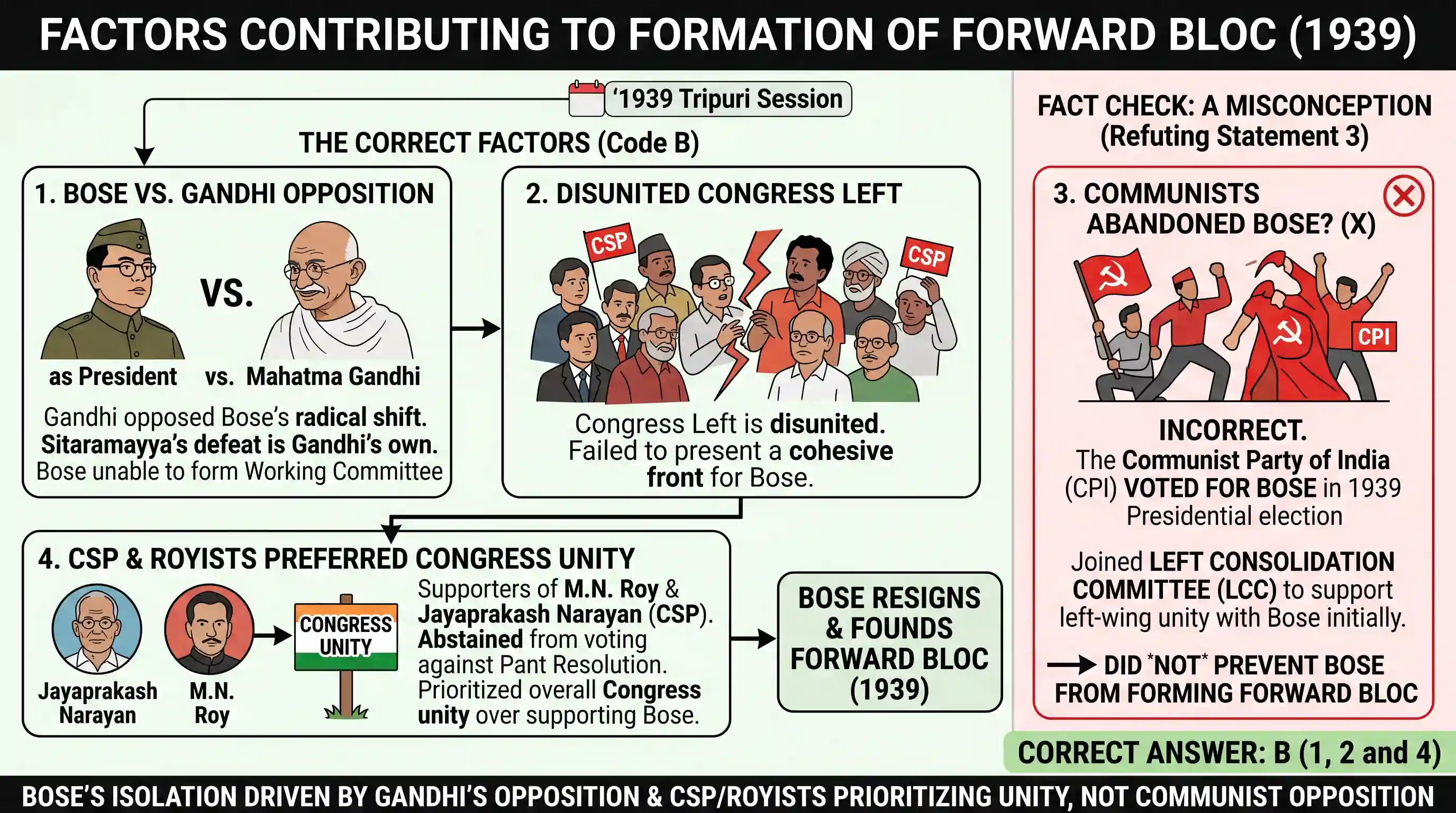
Statement 1 is correct: Subhas Chandra Bose ran for a second term as Congress President at the 1939 Tripuri session, defeating Pattabhi Sitaramayya. However, Mahatma Gandhi opposed this radical shift and famously declared Sitaramayya’s defeat as his own. Failing to win Gandhi's confidence, Bose was crippled by a deadlock, unable to form his Congress Working Committee. He resigned in April 1939 and subsequently founded the Forward Bloc.
Statement 2 is correct: Bose intended to consolidate all anti-imperialist, radical, and left-wing factions. However, the Congress Left was severely disunited and failed to present a cohesive front to back him during his standoff with the moderate 'Old Guard'.
Statement 4 is correct: The disunity peaked when Govind Ballabh Pant moved a resolution requiring Bose to nominate his Working Committee strictly according to Gandhi's wishes. Key left-wing entities, including Jayaprakash Narayan's Congress Socialist Party (CSP) and the followers of M.N. Roy, abstained from voting against this resolution. They prioritized the overarching unity of the Indian National Congress, fearing that supporting Bose would split the national movement.
Why Statement 3 is incorrect: Statement 3 is incorrect because the Communists did support Bose in his initial endeavours. The Communist Party of India (CPI) actively voted for Bose during his 1939 presidential re-election. Furthermore, after Bose formed the Forward Bloc, the Communists collaborated with him by joining the Left Consolidation Committee (LCC) in June 1939 to unite left-wing elements, even though this alliance eventually fractured.
Takeaway: During the 1939 Tripuri Crisis, Bose’s isolation was driven by Gandhi's opposition and the CSP/Royists prioritizing Congress unity. The Communists, conversely, were among the few factions that initially backed Bose’s radical block.
Related questions
More UPSC Prelims practice from the same subject and topic.
- Prelims 2026GS1history
Consider the following statements regarding the British policy in Awadh immediately after its annexation in 1856 : 1. The taluqdars were dispossessed of their estates but allowed to retain their arms …
- Prelims 2026GS1history
Consider the following assertion : The genesis of political alliances based on community lay in the very nature of the Montague-Chelmsford Reforms, 1919. Which of the following statements support/supp…
- Prelims 2026GS1history
The artificially fixed rupee-sterling exchange rate prescribed by the Hilton-Young Commission (1926) was adopted by the British Government for which one of the following reasons?
- Prelims 2026GS1history
Which one of the following statements about the Eka Movement and Bardoli Satyagraha is correct ?
- Prelims 2026GS1history
Which of the following pairs of ancient and modern names of rivers is/are correctly matched ? 1. Vitasta : Chenab 2. Asikni : Jhelum 3. Parushni : Ravi 4. Yavyavati : Beas Select the answer using the …
- Prelims 2026GS1history
Which of the following pairs of the king and his dynasty in early historical Tamilakam is/are not correctly matched ? 1. Senguttuvan : Chera 2. Udiyanjeral : Chola 3. Nedunjeliyan : Pandya Select the …