Consider the following assertion : The genesis of political alliances based on community lay in the very nature of the Montague-Chelmsford Reforms, 1919. Which of the following statements support/supports the above assertion ? 1. Reforms retained and extended the principle of separate electorates. 2. Separate electorates were supposed to counter Indian nationalism, which was growing stronger. 3. Deprived classes rallied around the favours inherent in separate electorates. Select the answer using the code given below :

- A1 only
- B2 and 3 only
- C1 and 2 only
- D1, 2 and 3Correct
Explanation
The correct answer is Option D (1, 2 and 3). The Government of India Act, 1919, based on the Montagu-Chelmsford Reforms, played a pivotal role in institutionalizing community-based political alliances in India.
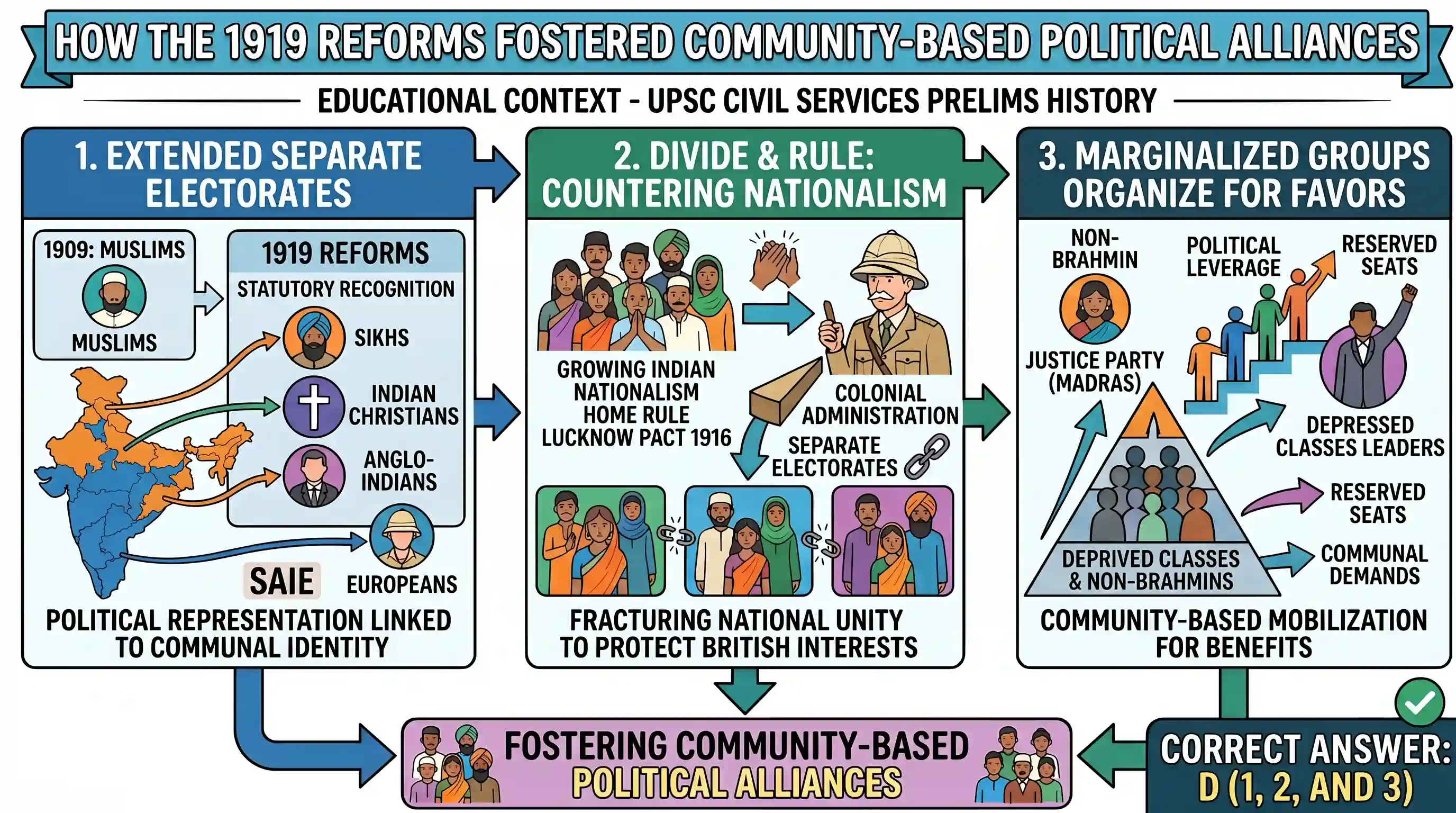
Statement 1 is correct: The Reforms not only retained the separate electorates initially introduced for Muslims by the Morley-Minto Reforms (1909) but officially extended them to other minority communities, including Sikhs, Indian Christians, Anglo-Indians, and Europeans. This statutory backing fundamentally linked political representation to communal and religious identity.
Statement 2 is correct: The British deployed the extension of separate electorates as a calculated "Divide and Rule" strategy. In the backdrop of the historic Hindu-Muslim unity achieved via the Lucknow Pact (1916) and the rising momentum of the Home Rule Movement, the colonial administration recognized the threat of a unified national front. By distributing political leverage along communal lines, they systematically sought to fracture Indian society and counter the growing strength of Indian nationalism.
Statement 3 is correct: Observing that statutory favors and political power were now inextricably tied to communal identity, various deprived and marginalized classes began to organize politically to secure representation. For instance, the Justice Party actively mobilized non-Brahmins in the Madras Presidency to secure reserved seats under the new 1919 framework. Consequently, leaders of the Depressed Classes also recognized that rallying around community-based demands was the most viable mechanism to bargain for political rights and social upliftment.
Why other options are incorrect: Options A, B, and C are incorrect because they are incomplete. Each fails to acknowledge all three historically valid dimensions that fostered community-based political alliances under the 1919 legislative framework.
Key Takeaway: The Montagu-Chelmsford Reforms (1919) deliberately deepened communal divides to protect British interests. You can remember the extension of separate electorates using the mnemonic SAIE: Sikhs, Anglo-Indians, Indian Christians, and Europeans.
Related questions
More UPSC Prelims practice from the same subject and topic.
- Prelims 2026GS1history
Which of the following factors contributed to the formation of the Forward Bloc by Subhas Chandra Bose in 1939 ? 1. Bose failed to win the confidence of Mahatma Gandhi. 2. The Congress Left was disuni…
- Prelims 2026GS1history
Consider the following statements regarding the British policy in Awadh immediately after its annexation in 1856 : 1. The taluqdars were dispossessed of their estates but allowed to retain their arms …
- Prelims 2026GS1history
The artificially fixed rupee-sterling exchange rate prescribed by the Hilton-Young Commission (1926) was adopted by the British Government for which one of the following reasons?
- Prelims 2026GS1history
Which one of the following statements about the Eka Movement and Bardoli Satyagraha is correct ?
- Prelims 2026GS1history
Which of the following pairs of ancient and modern names of rivers is/are correctly matched ? 1. Vitasta : Chenab 2. Asikni : Jhelum 3. Parushni : Ravi 4. Yavyavati : Beas Select the answer using the …
- Prelims 2026GS1history
Which of the following pairs of the king and his dynasty in early historical Tamilakam is/are not correctly matched ? 1. Senguttuvan : Chera 2. Udiyanjeral : Chola 3. Nedunjeliyan : Pandya Select the …