Pandit Mallikarjun Mansur, the famous classical singer from Karnataka, represented the :

- AAgra Gharana
- BGwalior Gharana
- CPatiala Gharana
- DJaipur-Atrauli GharanaCorrect
Explanation
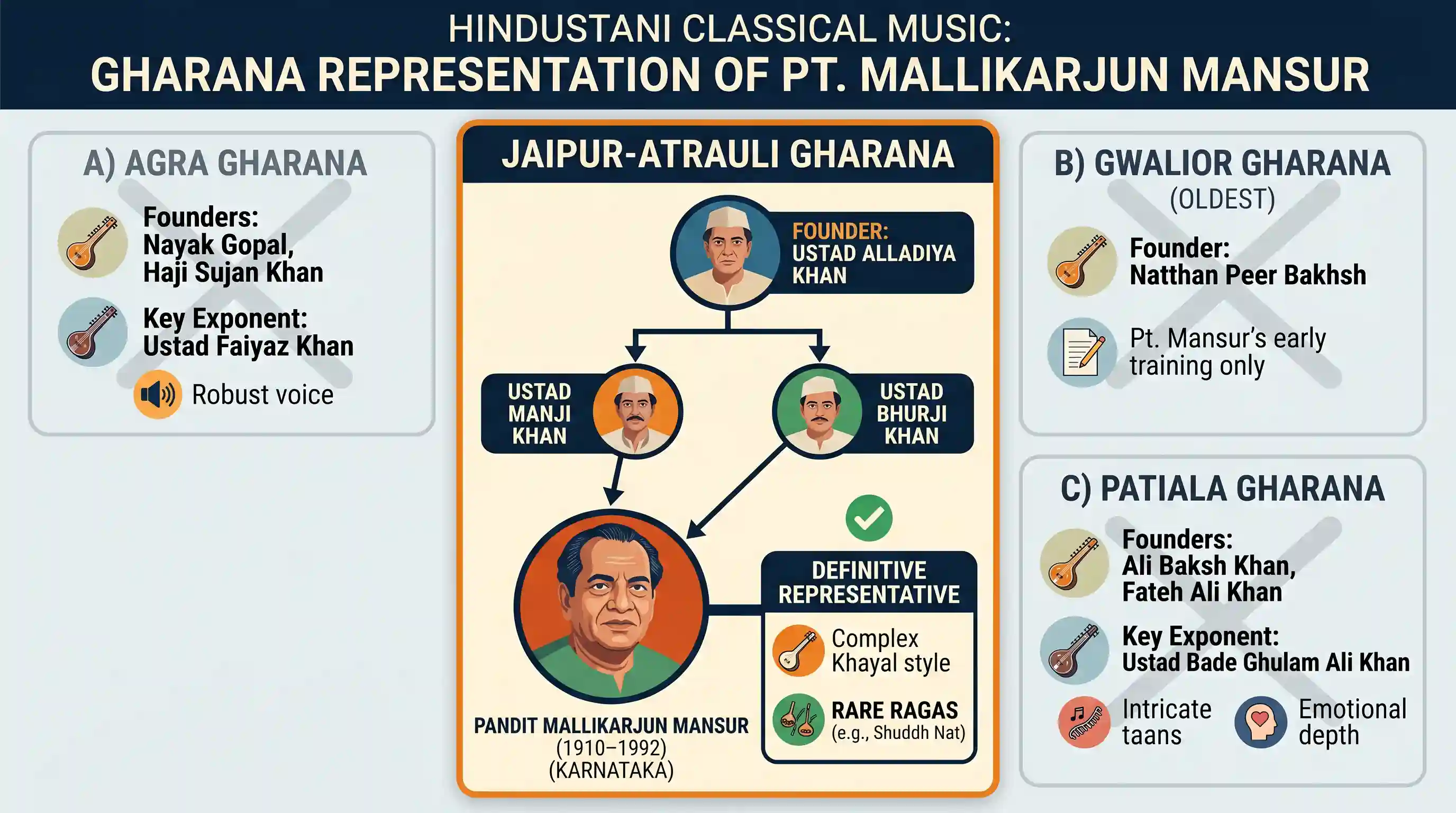
Pandit Mallikarjun Mansur (1910–1992), an eminent Hindustani classical vocalist from Dharwad, Karnataka, is most famously associated with the Jaipur-Atrauli Gharana. Therefore, Option D is correct.
While Mansur received his initial training in Carnatic music and later learned the Gwalior style from Pandit Neelkanth Bua Alurmath, his musical identity was cemented when he became a disciple of Ustad Manji Khan and later Ustad Bhurji Khan. Both were sons of Ustad Alladiya Khan, the illustrious founder of the Jaipur-Atrauli Gharana. Pandit Mansur became a rare and distinguished male exponent of this gharana, mastering its complex, Dhrupad-based Khayal style and its repertoire of rare ragas (such as Shuddh Nat and Hem Nat). He was awarded the Padma Vibhushan in 1992 for his legendary contributions to Hindustani classical music.
Why the other options are incorrect:
- Option A (Agra Gharana): This gharana traces its roots back to Nayak Gopal and Haji Sujan Khan, and is characterized by its powerful, robust voice production and rhythmic play. Its most famous exponent was Ustad Faiyaz Khan, not Mansur.
- Option B (Gwalior Gharana): Often considered the oldest Khayal gharana, founded by Natthan Peer Bakhsh and his grandsons. Although Mansur had early training in this style during his youth, he famously migrated to the Jaipur-Atrauli gharana, which he officially represented in his mature, celebrated career.
- Option C (Patiala Gharana): Founded by Ali Baksh Khan and Fateh Ali Khan, this gharana is renowned for its emotional depth and intricate taans. It was most famously popularized by Ustad Bade Ghulam Ali Khan.
Concluding Takeaway: To remember his lineage, recall that Pandit Mallikarjun Mansur was the definitive 'Jewel of Jaipur-Atrauli' from Karnataka, uniquely bringing the Alladiya Khan legacy to global prominence.
Related questions
More UPSC Prelims practice from the same subject and topic.
- Prelims 2026GS1art-culture
What does an empty seat represent in early Buddhist iconography ?
- Prelims 2026GS1art-culture
Which of the following statements on the Amaravati Stupa and its relief sculpture is/are correct ? 1. It was located in the lower Krishna valley. 2. In India, it was next only to the Sanchi Stupa in s…
- Prelims 2026GS1art-culture
Which one of the following Carnatic music ragas is similar to Raga Bilawal in Hindustani music?
- Prelims 2026GS1art-culture
Which of the following temples has/have a Nagara-style shikhara ? 1. Malegitti Shivalaya, Badami 2. Huchimalligudi Temple, Aihole 3. Dashavatara Temple, Deogarh 4. Virupaksha Temple, Pattadakal Select…
- Prelims 2026GS1art-culture
The Hallisalasya painting in the Bagh Caves represents :
- Prelims 2026GS1art-culture
Which one of the following statements with regard to the Moidams, built by the Tai-Ahom kingdom and inscribed as a World Heritage Site by UNESCO, is/are correct ? 1. They acted as army fortresses. 2. …