What does an empty seat represent in early Buddhist iconography ?

- AThe meditation of the BuddhaCorrect
- BThe Buddha's First Sermon
- CThe Buddha's Mahaparinibbana
- DThe Buddha's Mahabhinishkramana
Explanation
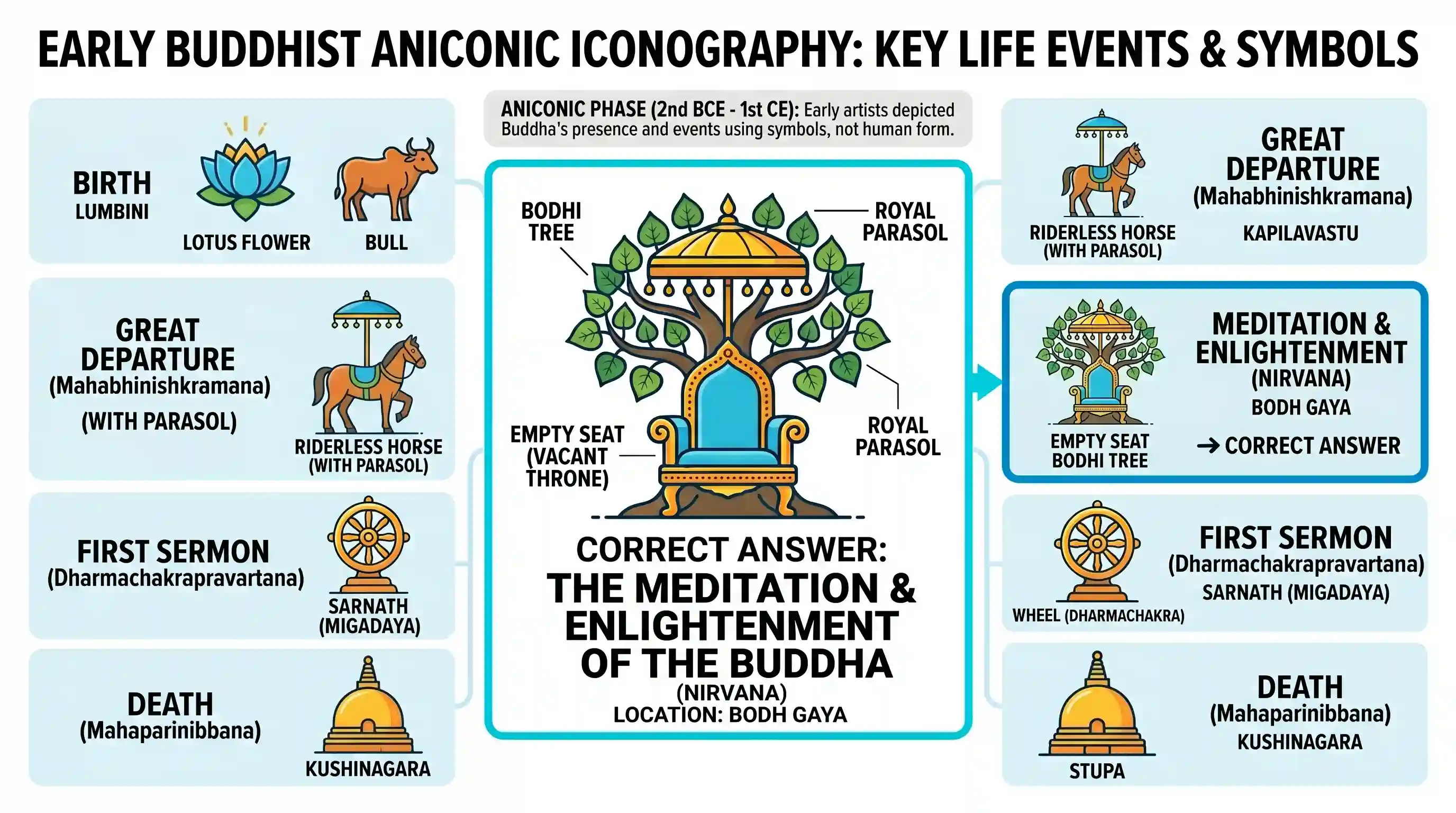
During the early aniconic phase of Buddhist art (approximately 2nd century BCE to 1st century CE), artists at prominent sites like Sanchi and Bharhut avoided depicting the Buddha in human (anthropomorphic) form. According to art historians and NCERT texts, sculptors conveyed his presence and life events through established hagiographical symbols. The empty seat (or vacant throne), frequently placed beneath a Bodhi tree or parasol, specifically represents the meditation of the Buddha and his subsequent attainment of enlightenment at Bodh Gaya.
Here is why the other options are incorrect:
- Option B (The Buddha's First Sermon): This monumental event at Sarnath, known as the Dharmachakrapravartana (turning the wheel of law), is iconographically represented by the Dharmachakra (Wheel), not an empty seat.
- Option C (The Buddha's Mahaparinibbana): The ultimate passing away of the Buddha is represented by the Stupa, which historically served as a reliquary mound containing his physical remains.
- Option D (The Buddha's Mahabhinishkramana): The "Great Departure" or renunciation, when Prince Siddhartha left his palace in search of ultimate truth, is represented by a riderless horse (his royal horse, Kanthaka), often shaded by a royal parasol.
Concluding Takeaway: For UPSC Prelims, memorizing the symbols of the Buddha's life is crucial. Use this quick reference guide:
- Lotus and Bull: Birth
- Riderless Horse: Mahabhinishkramana (Great Departure)
- Empty Seat / Bodhi Tree: Meditation and Enlightenment (Nirvana)
- Wheel (Dharmachakra): First Sermon
- Stupa: Mahaparinibbana (Death)
Related questions
More UPSC Prelims practice from the same subject and topic.
- Prelims 2026GS1art-culture
Which of the following statements on the Amaravati Stupa and its relief sculpture is/are correct ? 1. It was located in the lower Krishna valley. 2. In India, it was next only to the Sanchi Stupa in s…
- Prelims 2026GS1art-culture
Pandit Mallikarjun Mansur, the famous classical singer from Karnataka, represented the :
- Prelims 2026GS1art-culture
Which one of the following Carnatic music ragas is similar to Raga Bilawal in Hindustani music?
- Prelims 2026GS1art-culture
Which of the following temples has/have a Nagara-style shikhara ? 1. Malegitti Shivalaya, Badami 2. Huchimalligudi Temple, Aihole 3. Dashavatara Temple, Deogarh 4. Virupaksha Temple, Pattadakal Select…
- Prelims 2026GS1art-culture
The Hallisalasya painting in the Bagh Caves represents :
- Prelims 2026GS1art-culture
Which one of the following statements with regard to the Moidams, built by the Tai-Ahom kingdom and inscribed as a World Heritage Site by UNESCO, is/are correct ? 1. They acted as army fortresses. 2. …