Consider the following assertion : In the Pleistocene period either the Yamuna once flowed into the Indus, or the Sutlej flowed into the Yamuna and one major tributary of either had shifted from the Ganga to the Indus or vice versa. Which of the following is/are the basis of the above assertion ? 1. The Nadi-Sukta of the Rigveda 2. The explorations of the Sutlej and the Yamuna by Robert Bruce Foote 3. The presence of the same species of dolphins in both the Indus and the Ganga river systems Select the answer using the code given below :

- A1 only
- B2 only
- C1 and 2
- D3Correct
Explanation
Option D (3 only) is the correct answer.
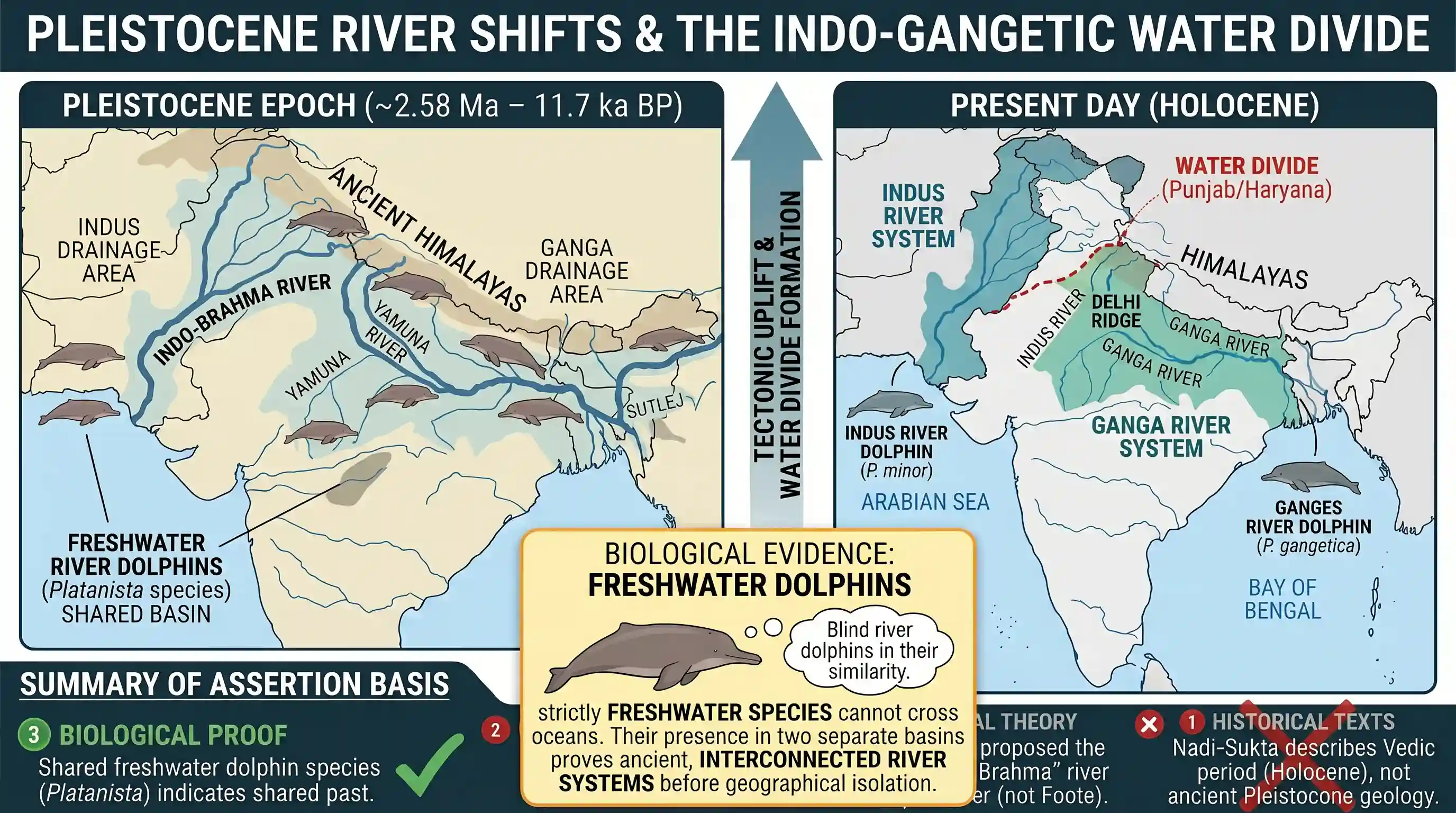
Why Option D is correct: The assertion refers to the geological theory that during the Pleistocene epoch, rivers such as the Yamuna and Sutlej shifted courses, altering the connections between the Indus and Ganges river systems. This is tied to the "Indo-Brahma" river theory proposed by geologists E.H. Pascoe and G.E. Pilgrim. A major biological basis for this assertion is the presence of freshwater river dolphins (Platanista gangetica and Platanista minor) in both the Ganga and Indus basins. Because these dolphins are strictly freshwater species unable to survive marine environments, their presence in two separate river systems indicates that the rivers must have shared a common drainage basin in the geological past before tectonic upheavals separated them.
Why the other statements are incorrect:
- Statement 1 is incorrect: The Nadi-Sukta (Hymn 10.75 of the Rigveda) is a historical text that catalogues rivers as known during the Vedic period (~1500 BCE, Holocene epoch). It is not a geological record of the Pleistocene epoch (which ended ~11,700 years ago) and provides no scientific evidence for prehistoric river shifts.
- Statement 2 is incorrect: Robert Bruce Foote was a British geologist celebrated as the "Father of Indian Prehistory" for discovering the first Paleolithic handaxe at Pallavaram in 1863. The geological theories regarding the ancient shifting of the Sutlej and Yamuna were put forward by Pascoe and Pilgrim, not Foote.
Takeaway: The geographic isolation of strictly freshwater species—like the blind river dolphins of the Indus and Ganges—serves as crucial biological evidence for mapping ancient, interconnected river systems separated by geological events.
Related questions
More UPSC Prelims practice from the same subject and topic.
- Prelims 2026GS1geography
Tungurahua Volcano, which was declared a Global Geopark by UNESCO in 2025, is situated in which one among the following countries ?
- Prelims 2026GS1geography
With reference to the climate of Andaman and Nicobar Islands, which of the following statements is/are correct ? 1. The climate can be defined as a humid, tropical coastal climate. 2. It receives rain…
- Prelims 2026GS1geography
Which of the following geographical features or phenomena is/are associated with the Peninsular Block of India ? 1. Submergence of parts of the western coast due to tectonic activity 2. Presence of re…
- Prelims 2026GS1geography
Which of the following statements with reference to Lake Turkana is/are correct ? 1. It is the largest desert lake in the world. 2. The lake is situated in South Sudan along the eastern fringe of the …
- Prelims 2026GS1geography
Identify the river of the Indian sub-continent on the basis of the following information : 1. It has an antecedent drainage system. 2. It flows through three countries. 3. It originates in the Tibetan…
- Prelims 2026GS1geography
Which of the following with reference to Indian States is/are not correct ? 1. Uttar Pradesh shares its boundary with the highest number of other Indian States. 2. Rajasthan shares the longest interna…