Identify the river of the Indian sub-continent on the basis of the following information : 1. It has an antecedent drainage system. 2. It flows through three countries. 3. It originates in the Tibetan Plateau and is an important river for irrigation. 4. It does not form distributaries. Select the answer from the following :

- ABrahmaputra
- BIndus
- CSutlejCorrect
- DTeesta
Explanation
The correct answer is (C) Sutlej.
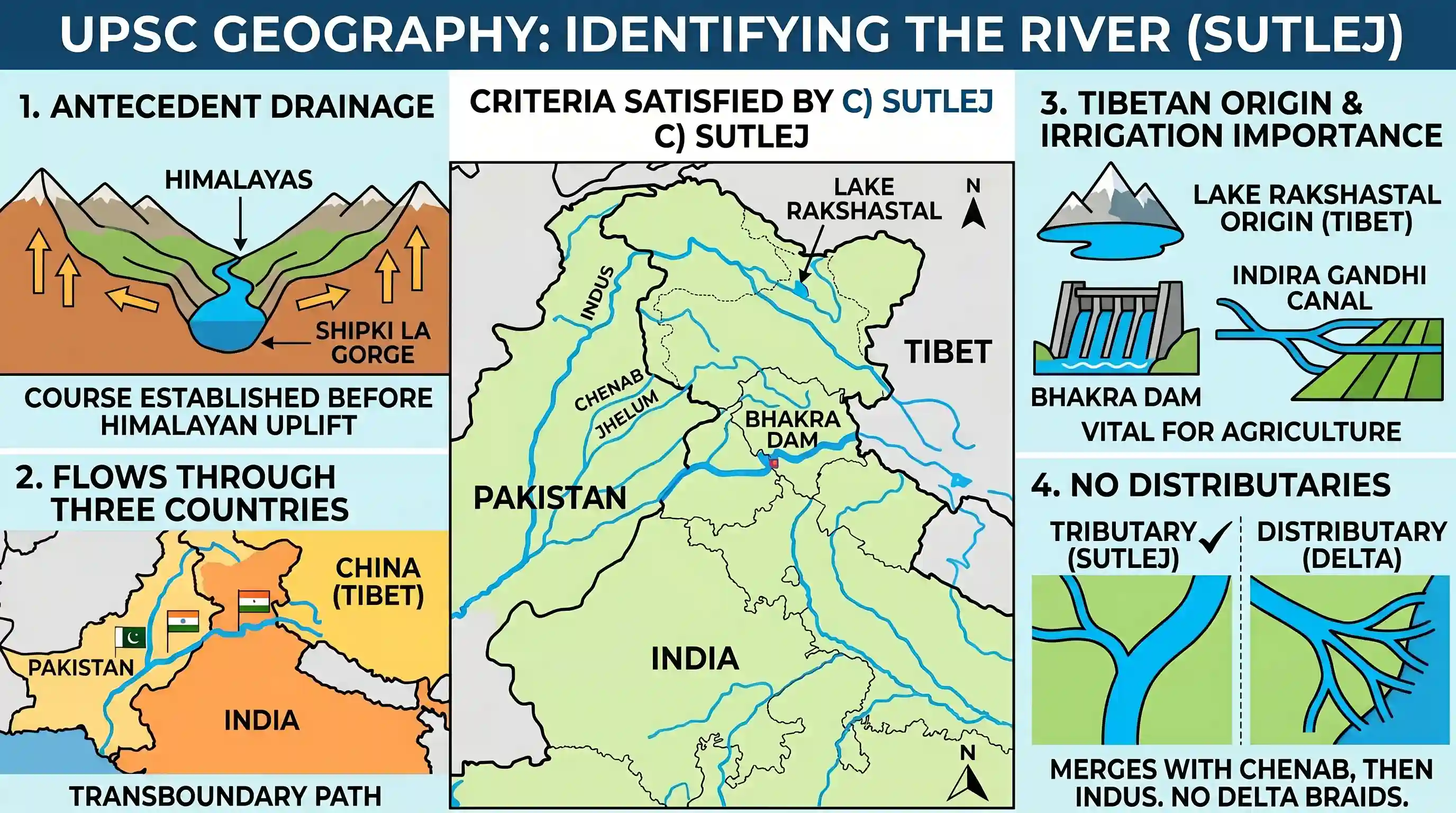
The Sutlej River perfectly satisfies all four characteristics provided in the question:
- Antecedent Drainage: The Sutlej is an antecedent river, meaning its course was established before the tectonic uplift of the Himalayas. As the mountains rose, it maintained its path by carving deep gorges, such as the one at Shipki La.
- Three Countries: It is a transboundary river flowing through China (Tibet), India, and Pakistan.
- Origin and Irrigation: It originates from Lake Rakshastal near Mount Kailash in the Tibetan Plateau. It is highly critical for agricultural irrigation, feeding major infrastructure like the Bhakra-Nangal Dam and the Indira Gandhi Canal, which sustain farming in Punjab, Haryana, and Rajasthan.
- No Distributaries: A distributary is a stream that branches off and flows away from a main river channel, typically in a delta. Because the Sutlej acts solely as a tributary—merging with the Chenab River in Pakistan to form the Panjnad before joining the Indus—it never reaches the sea independently and forms no distributaries.
Why the other options are incorrect:
- (A) Brahmaputra: While antecedent and flowing through three countries (China, India, Bangladesh), it splits into massive distributaries (like the Jamuna) to form the Ganges-Brahmaputra Delta.
- (B) Indus: It flows through three countries and is antecedent, but it forms an extensive delta in Pakistan's Sindh province, branching into multiple distributaries before draining into the Arabian Sea.
- (D) Teesta: The Teesta originates in Sikkim, India (not the Tibetan Plateau) and flows through only two countries (India and Bangladesh).
Takeaway: Remember that a river terminating by joining another river (as a tributary) generally lacks the capacity to form distributary networks, a geomorphological feature usually reserved for rivers creating deltas at a sea or ocean.
Related questions
More UPSC Prelims practice from the same subject and topic.
- Prelims 2026GS1geography
Consider the following assertion : In the Pleistocene period either the Yamuna once flowed into the Indus, or the Sutlej flowed into the Yamuna and one major tributary of either had shifted from the G…
- Prelims 2026GS1geography
Tungurahua Volcano, which was declared a Global Geopark by UNESCO in 2025, is situated in which one among the following countries ?
- Prelims 2026GS1geography
With reference to the climate of Andaman and Nicobar Islands, which of the following statements is/are correct ? 1. The climate can be defined as a humid, tropical coastal climate. 2. It receives rain…
- Prelims 2026GS1geography
Which of the following geographical features or phenomena is/are associated with the Peninsular Block of India ? 1. Submergence of parts of the western coast due to tectonic activity 2. Presence of re…
- Prelims 2026GS1geography
Which of the following statements with reference to Lake Turkana is/are correct ? 1. It is the largest desert lake in the world. 2. The lake is situated in South Sudan along the eastern fringe of the …
- Prelims 2026GS1geography
Which of the following with reference to Indian States is/are not correct ? 1. Uttar Pradesh shares its boundary with the highest number of other Indian States. 2. Rajasthan shares the longest interna…