In what way(s) does the Vizhinjam International Seaport represent a structural shift in India's maritime trade and logistics policy? 1. By functioning exclusively as a domestic cargo hub to reduce reliance on coastal shipping and eliminate the need for foreign collaborations. 2. By focusing primarily on passenger cruise tourism and heritage shipping to increase Kerala's profile as a maritime heritage destination. 3. By leveraging its natural deep draft and strategic location to reduce dependence on foreign trans-shipment ports, enhance revenue retention, and reposition India in regional maritime trade. Select the answer using the code given below :

- A1 only
- B1 and 2
- C2 and 3
- D3 onlyCorrect
Explanation
The correct answer is D) 3 only.
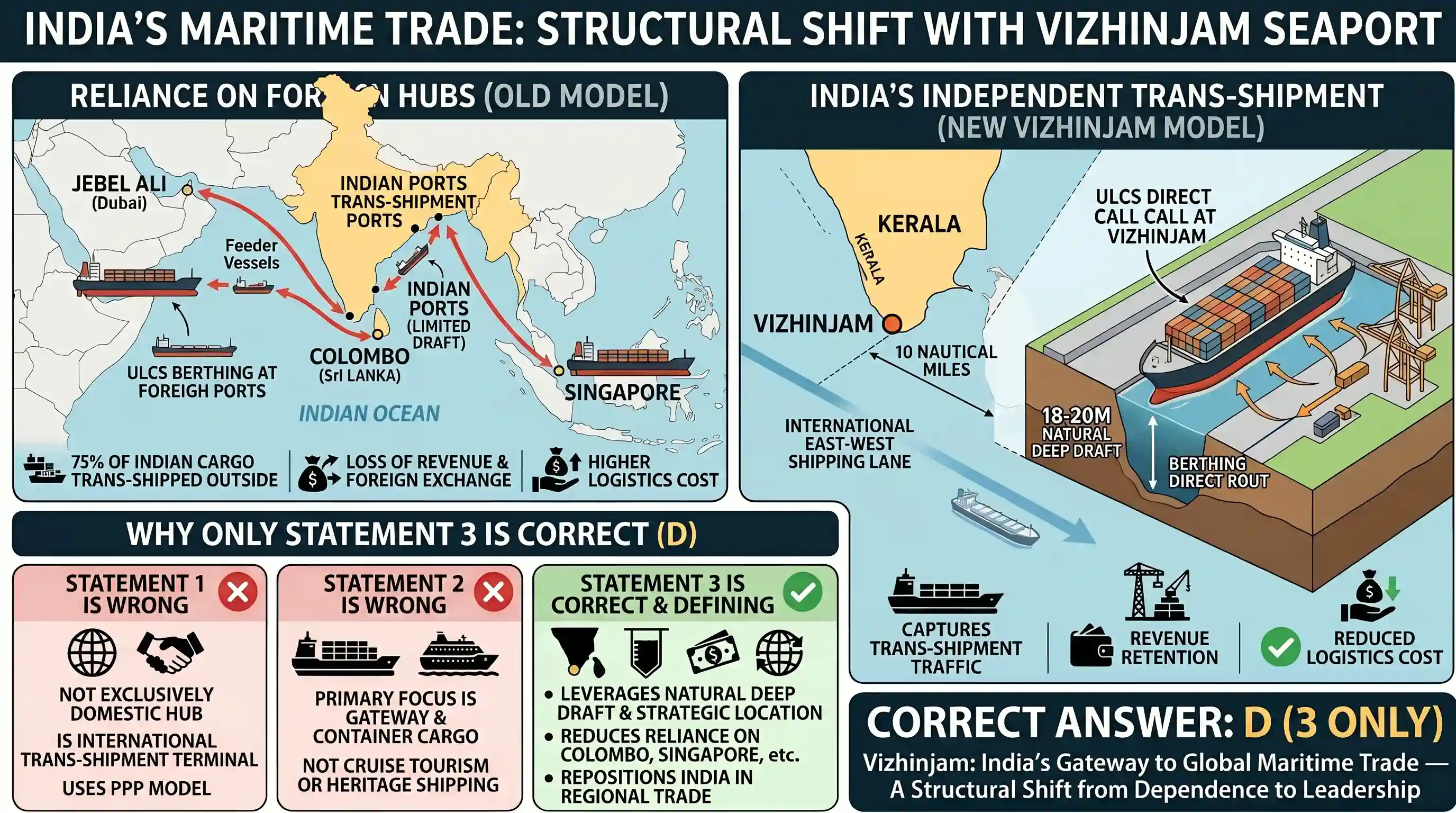
Statement 3 is correct: The Vizhinjam International Seaport, located in Thiruvananthapuram, Kerala, represents a structural shift in India's maritime policy by serving as the country's first deep-water mega container trans-shipment hub. It leverages a natural draft of around 18–20 meters and is strategically located just 10 nautical miles from the busy international East-West shipping channel. This depth enables it to berth Ultra Large Container Ships (ULCS) without the need for extensive capital dredging. Currently, nearly 75% of India's trans-shipped cargo is routed through foreign ports like Colombo, Singapore, and Jebel Ali. Vizhinjam aims to capture this traffic, thereby reducing reliance on foreign hubs, cutting global logistics costs, and retaining revenue and foreign exchange within India.
Statement 1 is incorrect: Vizhinjam is not exclusively a domestic cargo hub. Its primary identity is an international trans-shipment terminal designed to integrate India directly into global supply chains. Furthermore, it does not eliminate collaborations; the port was developed under a Public-Private Partnership (PPP) model with Adani Ports.
Statement 2 is incorrect: While the port's master plan includes provisions for a cruise terminal, its primary and defining focus is on gateway and trans-shipment container cargo, not passenger cruise tourism or heritage shipping.
Takeaway: Remember Vizhinjam as India's "Gateway to Global Maritime Trade." It transitions India from relying heavily on foreign feeder ports (like Colombo) to becoming a direct, deep-water player in global maritime logistics.
Related questions
More UPSC Prelims practice from the same subject and topic.
- Prelims 2026GS1economy
Consider the following statements with reference to the Sagarmala Programme of the Government of India : I. The Sagarmala Programme seeks to achieve port-led economic growth through cost-effective and…
- Prelims 2026GS1economy
An e-commerce revenue model where the seller has control over pricing but doesn't keep products in stock and instead transfers customer orders and shipment details to a third-party supplier, who then …
- Prelims 2026GS1economy
Which one of the following correctly represents the three key sub-indices of the Financial Inclusion Index (FI-Index) of the Reserve Bank of India (RBI) ?
- Prelims 2026GS1economy
Which one of the following best describes the key objective of India's 'Open Network for Digital Commerce' (ONDC) initiative ?
- Prelims 2026GS1economy
Which one of the following statements about Unified Payments Interface (UPI) and Central Bank Digital Currency (Digital Rupee) is not correct ?
- Prelims 2026GS1economy
Which of the following statements about Real-World Assets (RWA) Tokenization are correct? 1. Tokenization is the process of turning real world assets into digital tokens using blockchain technology. 2…