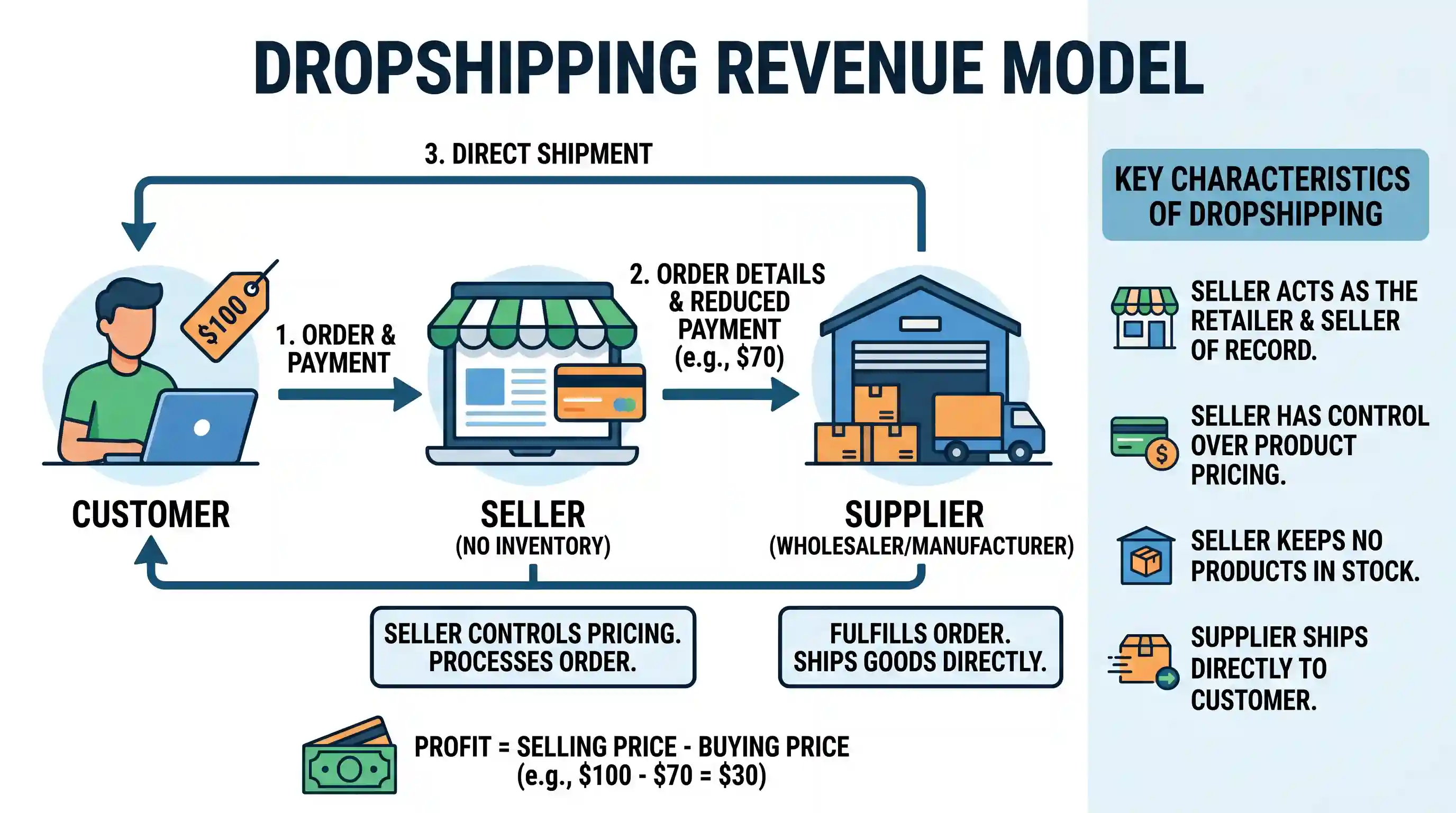
An e-commerce revenue model where the seller has control over pricing but doesn't keep products in stock and instead transfers customer orders and shipment details to a third-party supplier, who then ships the goods directly to the customer, is called :

- ADropshipping ModelCorrect
- BAffiliate Revenue Model
- CTransaction Fee Revenue Model
- DAgency Revenue Model
Explanation
The correct answer is A) Dropshipping Model.
Why the correct option is correct: The Dropshipping Model is defined by e-commerce authorities (such as the Cambridge Dictionary and major platforms like Adobe Commerce and Mailchimp) as a retail fulfillment method where a store does not keep the products it sells in stock [5, 8, 10]. Instead, when a seller makes a sale, they process the order and purchase the item from a third-party supplier—typically a wholesaler or manufacturer—who then packs and ships the goods directly to the customer [5, 10]. Unlike affiliate marketers, a dropshipping merchant acts as the primary storefront and seller of record, maintaining complete control over product pricing and profit margins [5, 7]. Originating conceptually from catalog mail-order businesses in the 1960s and 1970s, it has become a multi-billion dollar pillar of modern digital commerce due to its low overhead costs and lack of inventory risk [5, 9].
Why the other options are incorrect:
- B) Affiliate Revenue Model: In this framework, individuals or businesses earn a commission by promoting another merchant's products (usually via specialized links) [2, 3]. The affiliate simply redirects traffic, does not manage customer orders, and has no control over the product's pricing [2, 7].
- C) Transaction Fee Revenue Model: This model involves an e-commerce platform acting as a facilitator, generating revenue by charging a fee or percentage for processing an exchange between a separate buyer and seller (e.g., payment gateways like PayPal or auction sites like eBay) [4, 6].
- D) Agency Revenue Model: This approach monetizes professional expertise rather than physical goods [4]. Agencies charge clients project-based or continuous fees for specialized business services such as digital marketing, branding, or website development [1, 6].
Concluding Takeaway: To easily remember the concept, think: in Dropshipping, the seller "drops" the burden of inventory and "shipping" onto a third-party supplier, allowing the merchant to focus entirely on marketing and customer acquisition.
Related questions
More UPSC Prelims practice from the same subject and topic.
- Prelims 2026GS1economy
Consider the following statements with reference to the Sagarmala Programme of the Government of India : I. The Sagarmala Programme seeks to achieve port-led economic growth through cost-effective and…
- Prelims 2026GS1economy
In what way(s) does the Vizhinjam International Seaport represent a structural shift in India's maritime trade and logistics policy? 1. By functioning exclusively as a domestic cargo hub to reduce rel…
- Prelims 2026GS1economy
Which one of the following correctly represents the three key sub-indices of the Financial Inclusion Index (FI-Index) of the Reserve Bank of India (RBI) ?
- Prelims 2026GS1economy
Which one of the following best describes the key objective of India's 'Open Network for Digital Commerce' (ONDC) initiative ?
- Prelims 2026GS1economy
Which one of the following statements about Unified Payments Interface (UPI) and Central Bank Digital Currency (Digital Rupee) is not correct ?
- Prelims 2026GS1economy
Which of the following statements about Real-World Assets (RWA) Tokenization are correct? 1. Tokenization is the process of turning real world assets into digital tokens using blockchain technology. 2…