Which one of the following best describes the key objective of India's 'Open Network for Digital Commerce' (ONDC) initiative ?

- ATo allow government control over all digital commerce transactions
- BTo replace private e-commerce players
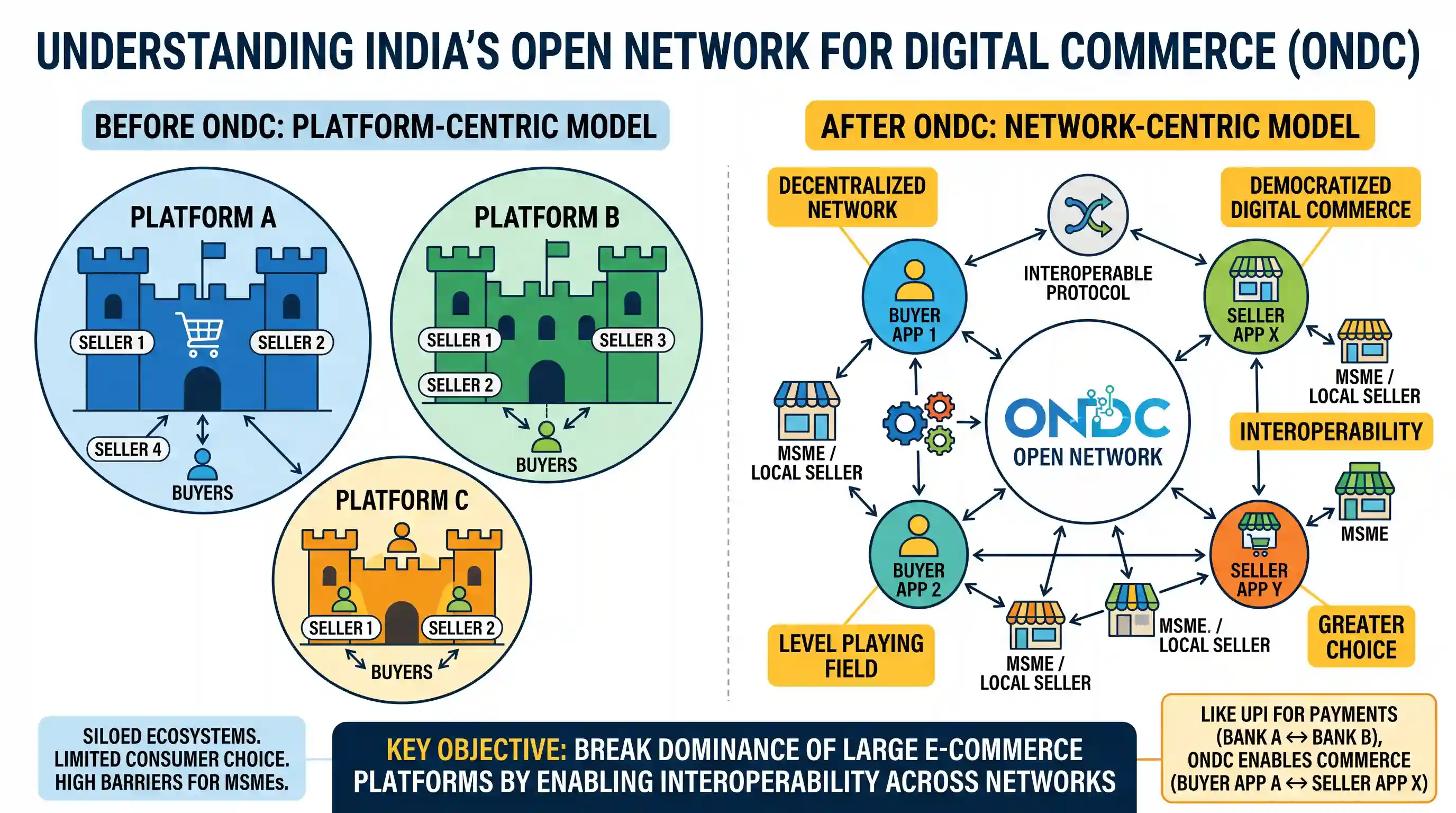
- CTo break the dominance of large e-commerce platforms by enabling interoperability across networksCorrect
- DTo mandate UPI-based payments for all online transactions
Explanation
Correct Answer: C
Why Option C is correct: Launched in April 2022 by the Department for Promotion of Industry and Internal Trade (DPIIT) under the Ministry of Commerce and Industry, the Open Network for Digital Commerce (ONDC) is an open-source initiative designed to democratize India's digital commerce space. Its primary objective is to break the monopoly of large e-commerce platforms by shifting from a platform-centric model to a decentralized, interoperable open network. By standardizing APIs and using open network protocols, ONDC allows buyers and sellers on different applications to seamlessly connect and transact, thereby creating a level playing field for micro, small, and medium enterprises (MSMEs).
Why the other options are incorrect:
- Option A is incorrect: ONDC functions as a set of open protocols for independent platforms to connect, not a centralized platform for the government to monitor or control digital transactions. It facilitates decentralized digital commerce.
- Option B is incorrect: The initiative does not aim to replace private e-commerce players. Instead, it invites private entities, including existing large platforms and local retailers, to join the open network as equal participants (such as buyer apps, seller apps, or logistics providers).
- Option D is incorrect: While ONDC is frequently dubbed the "UPI of e-commerce" because it brings interoperability to online retail, it is fundamentally focused on the discovery and exchange of goods and services, not on payments. It does not mandate UPI for transactions.
Takeaway: Think of ONDC as the "UPI of e-commerce." Just as UPI allows seamless money transfers between different banking apps, ONDC allows consumers to discover and buy products from sellers across completely different e-commerce applications, breaking platform silos and empowering small businesses.
Related questions
More UPSC Prelims practice from the same subject and topic.
- Prelims 2026GS1economy
Consider the following statements with reference to the Sagarmala Programme of the Government of India : I. The Sagarmala Programme seeks to achieve port-led economic growth through cost-effective and…
- Prelims 2026GS1economy
In what way(s) does the Vizhinjam International Seaport represent a structural shift in India's maritime trade and logistics policy? 1. By functioning exclusively as a domestic cargo hub to reduce rel…
- Prelims 2026GS1economy
An e-commerce revenue model where the seller has control over pricing but doesn't keep products in stock and instead transfers customer orders and shipment details to a third-party supplier, who then …
- Prelims 2026GS1economy
Which one of the following correctly represents the three key sub-indices of the Financial Inclusion Index (FI-Index) of the Reserve Bank of India (RBI) ?
- Prelims 2026GS1economy
Which one of the following statements about Unified Payments Interface (UPI) and Central Bank Digital Currency (Digital Rupee) is not correct ?
- Prelims 2026GS1economy
Which of the following statements about Real-World Assets (RWA) Tokenization are correct? 1. Tokenization is the process of turning real world assets into digital tokens using blockchain technology. 2…