Which one of the following correctly represents the three key sub-indices of the Financial Inclusion Index (FI-Index) of the Reserve Bank of India (RBI) ?

- ACredit access, Insurance depth, and Pension coverage
- BBanking access, GDP contribution, and Financial literacy
- CAccess, Usage, and QualityCorrect
- DAccess, Affordability, and Transparency
Explanation
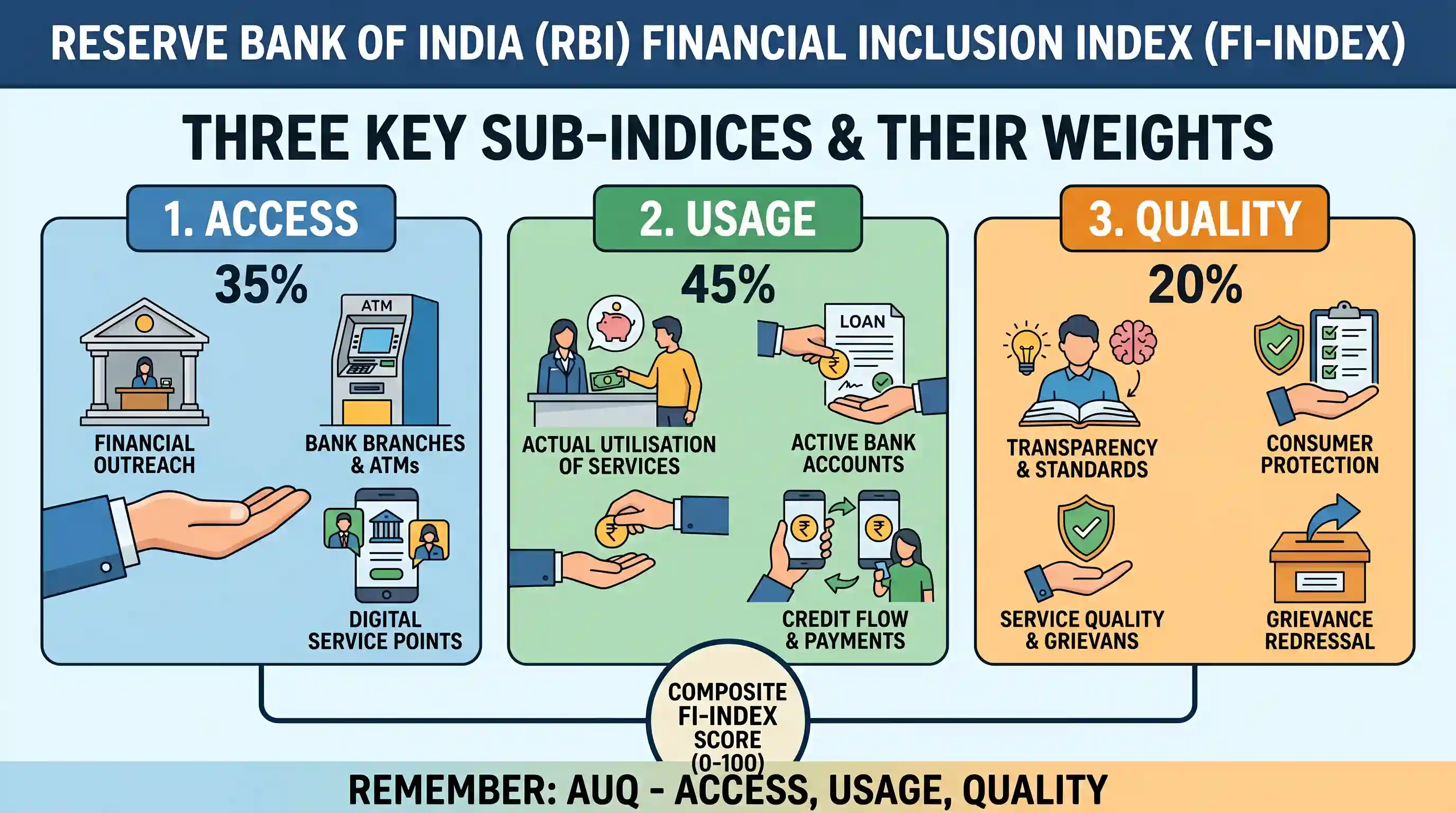
Why the correct option is correct: Option C is correct. In August 2021, the Reserve Bank of India (RBI) introduced the composite Financial Inclusion Index (FI-Index) to capture the extent of financial inclusion across the country. The index is officially constructed using three broad sub-indices: Access (35% weightage), Usage (45% weightage), and Quality (20% weightage). It incorporates details from the banking, investments, insurance, postal, and pension sectors, placing a unique emphasis on the "Quality" parameter, which measures financial literacy, consumer protection, and service deficiencies. The index calculates a single value ranging from 0 (complete exclusion) to 100 (complete inclusion) and notably lacks a base year, reflecting cumulative progress over time.
Why the incorrect options are wrong:
- Option A: While credit, insurance, and pensions are specific dimensions or sectors evaluated within the FI-Index, they are sub-components of the primary parameters (like Usage and Access), not the broad top-level sub-indices themselves.
- Option B: Financial literacy is merely one indicator evaluated under the "Quality" sub-index, not a main sub-index. Additionally, GDP contribution is a macroeconomic output metric, which is not tracked by the FI-Index.
- Option D: Although affordability and transparency are essential goals of a robust financial sector, they are not the official nomenclature used by the RBI for the FI-Index's primary pillars.
Concluding Takeaway: To easily remember the three pillars of the RBI's Financial Inclusion Index, use the mnemonic AUQ—"Always Use Quality" (Access, Usage, Quality).
Related questions
More UPSC Prelims practice from the same subject and topic.
- Prelims 2026GS1economy
Which one of the following statements about Unified Payments Interface (UPI) and Central Bank Digital Currency (Digital Rupee) is not correct ?
- Prelims 2026GS1economy
Which of the following statements about M1xchange's role in Micro, Small & Medium Enterprises (MSMEs) financing is/are correct ? 1. M1xchange provides collateral based loans to MSMEs. 2. M1xchange fac…
- Prelims 2026GS1economy
Consider the following statements with reference to the Sagarmala Programme of the Government of India : I. The Sagarmala Programme seeks to achieve port-led economic growth through cost-effective and…
- Prelims 2026GS1economy
In what way(s) does the Vizhinjam International Seaport represent a structural shift in India's maritime trade and logistics policy? 1. By functioning exclusively as a domestic cargo hub to reduce rel…
- Prelims 2026GS1economy
An e-commerce revenue model where the seller has control over pricing but doesn't keep products in stock and instead transfers customer orders and shipment details to a third-party supplier, who then …
- Prelims 2026GS1economy
Which one of the following best describes the key objective of India's 'Open Network for Digital Commerce' (ONDC) initiative ?