Which of the following best explain(s) the rationale for protecting mangrove ecosystems in the context of climate resilience? 1. Mangroves reduce tidal energy and store freshwater, making them ideal sites for paddy cultivation in saline estuarine belts. 2. Their salt-sensitive roots filter seawater, making mangroves key to converting coastal land into freshwater aquaculture zones. 3. By withstanding tidal surges and offering biomass resources, mangroves function both as natural bio-shields and livelihood bases for rural communities. Select the answer using the code given below :

- A1 only
- B1 and 2
- C2 and 3
- D3 onlyCorrect
Explanation
Correct Option: D (3 only)
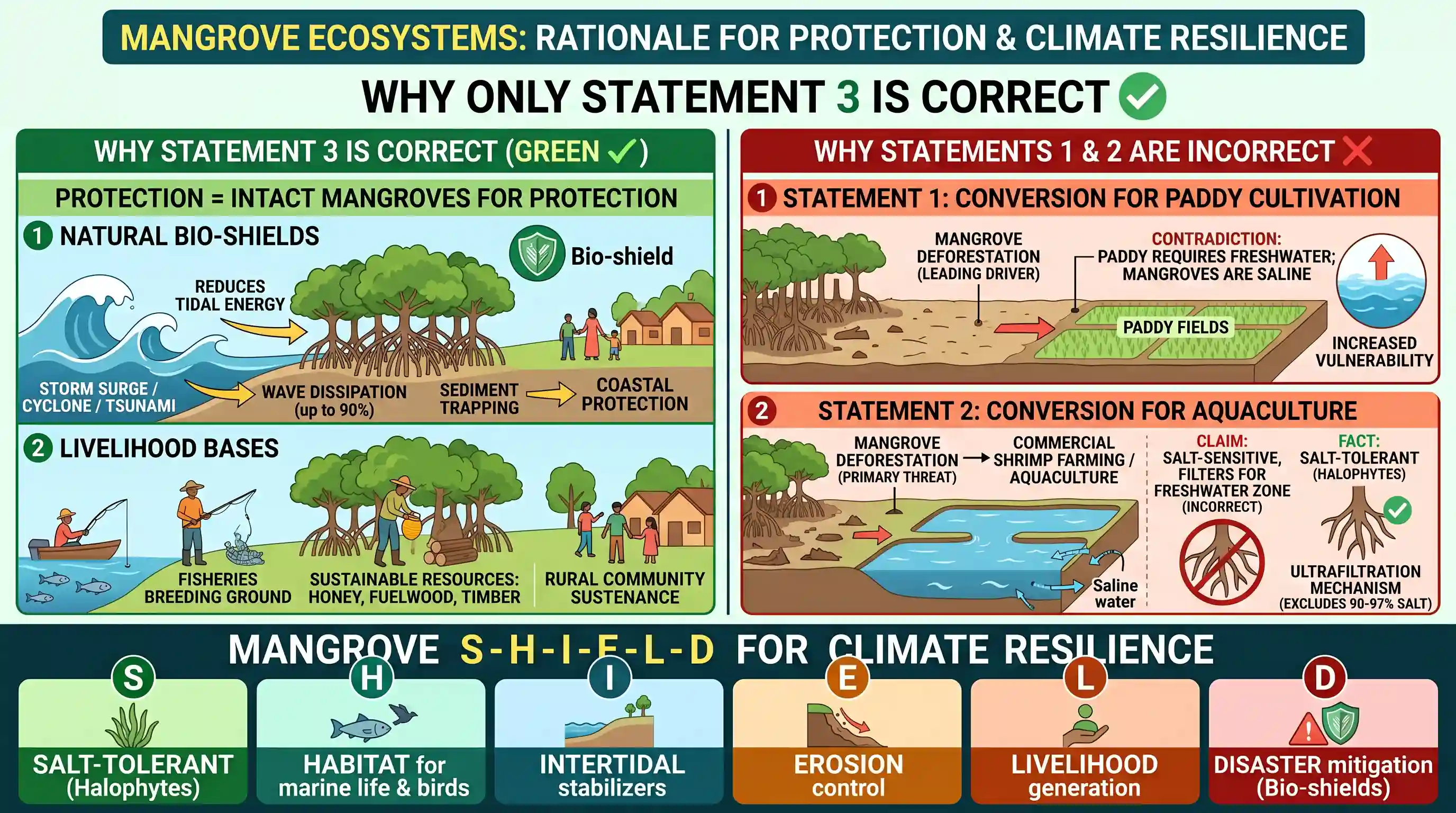
Why Option D is correct: Statement 3 accurately identifies the dual role of mangroves in climate resilience and socio-economic sustenance. Mangroves function as natural bio-shields by dissipating the energy of storm surges, cyclones, and tsunamis. For instance, following the devastating 2004 Indian Ocean Tsunami, reports by the United Nations Environment Programme (UNEP) and the IUCN highlighted that coastlines with intact mangrove forests experienced significantly less structural damage and loss of life. Their dense, interwoven aerial root systems trap sediments and can reduce wave velocity by up to 90%. Furthermore, they provide a vital livelihood base for rural coastal communities by offering biomass resources like timber, fuelwood, tannins, and honey, while serving as breeding grounds for commercial fisheries.
Why the other statements are incorrect:
- Statement 1 is incorrect: Converting mangroves into paddy fields is a leading driver of global mangrove deforestation, not a rationale for their protection. Mangroves are uniquely adapted to highly saline, brackish estuarine environments, whereas traditional paddy cultivation requires freshwater; clearing them for agriculture destroys the ecosystem and increases coastal vulnerability to climate change.
- Statement 2 is incorrect: Mangrove roots are salt-tolerant (halophytic), not salt-sensitive, utilizing advanced ultrafiltration mechanisms to exclude 90-97% of seawater salts at the root level. Additionally, converting coastal mangrove lands into aquaculture zones (such as commercial shrimp farming) is globally recognized by the FAO as the primary anthropogenic threat to mangrove survival, not a conservation strategy.
Takeaway / Mnemonic: Remember S-H-I-E-L-D for Mangroves: Salt-tolerant (halophytes), Habitat for marine life, Intertidal stabilizers, Erosion control, Livelihood generation, and Disaster mitigation (bio-shields). Their ecological value lies in remaining intact, never in being converted for agriculture or aquaculture.
Related questions
More UPSC Prelims practice from the same subject and topic.
- Prelims 2026GS1environment
With reference to Madhav National Park, which of the following statements is/are correct ? 1. It was declared a Tiger Reserve in India in 2025. 2. Sakhya Sagar, which is designated as a Ramsar Site, i…
- Prelims 2026GS1environment
Consider the following statements about Rhynchostylis retusa (Foxtail orchid) : 1. It is an epiphytic orchid. 2. The species is endemic to North-east India. 3. It is the State flower of Arunachal Prad…
- Prelims 2026GS1environment
At the United Nations Ocean Conference (UNOC) held in June, 2025 in France, the Food and Agricultural Organization (FAO) of the United Nations demonstrated its leading voice on marine and ocean issues…
- Prelims 2026GS1environment
Which one of the following is the first Plan Vivo certified Reducing Emissions from Deforestation and Forest Degradation (REDD+) project in India ?
- Prelims 2026GS1environment
Consider the following statements with reference to India's response to climate change : I. India's Long-Term Low Emission Development Strategy (LT-LEDS) is a crucial tool for achieving net-zero emiss…
- Prelims 2026GS1environment
With respect to the Western Hoolock Gibbons, which of the following statements is/are correct? 1. A Sanctuary in North-east India is home to this ape species listed as Endangered in the International …