In which one among the following texts does the term kshetra-patni ('mistress of the field') originate ?

- ARigveda
- BAtharvavedaCorrect
- CAshtadhyayi
- DArthashastra
Explanation
The correct answer is B) Atharvaveda.
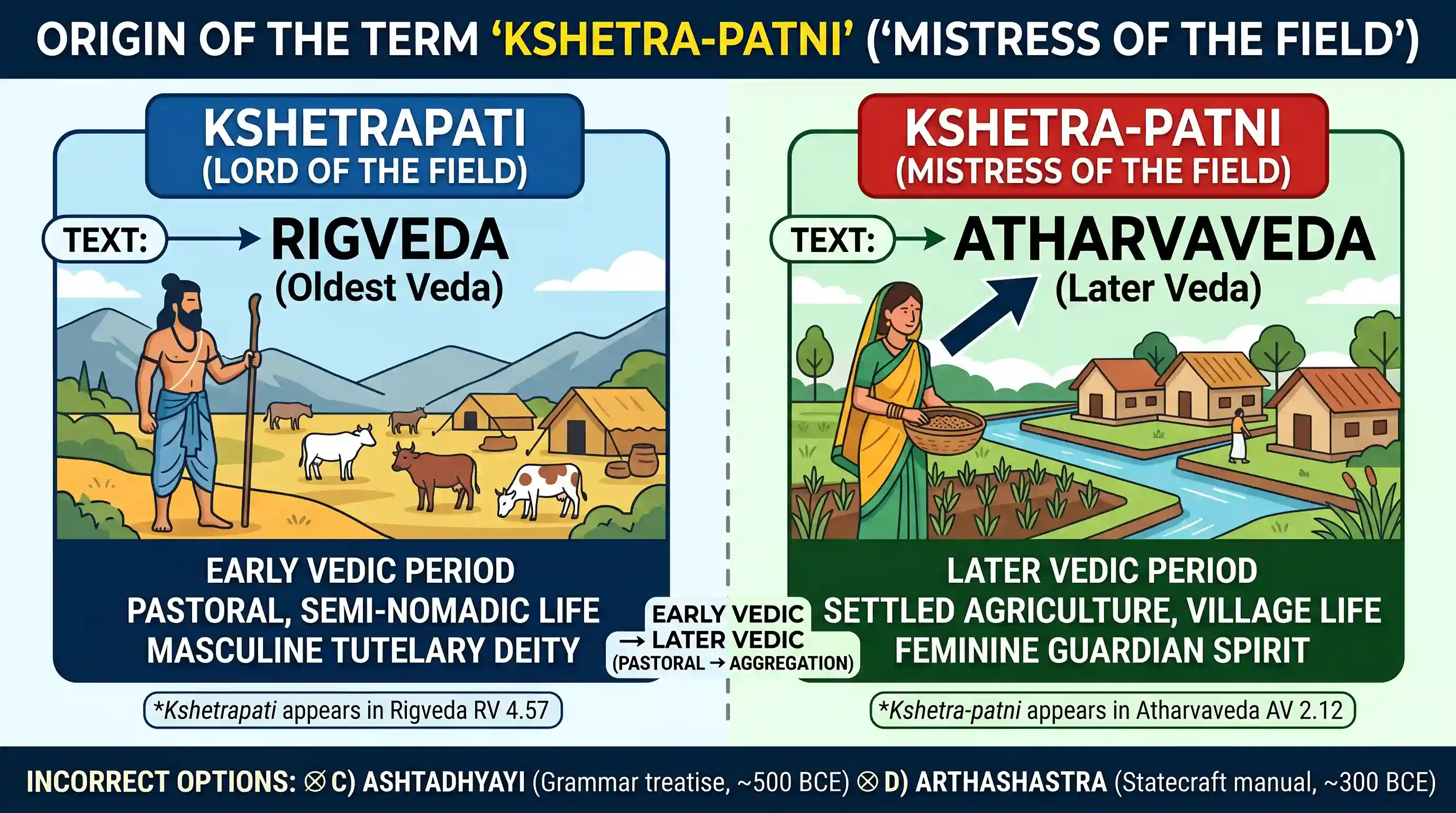
Why the correct option is correct: The term kshetra-patni (translated as 'mistress of the field') originates in the Atharvaveda (e.g., AV 2.12.1). As the early Vedic people transitioned from a primarily pastoral, semi-nomadic lifestyle to settled agriculture during the Later Vedic period, the vocabulary surrounding land and its veneration expanded. The Atharvaveda, which heavily documents the folk-religious practices and daily life of the masses, introduces Kshetra-patni to denote the female guardian spirit or 'mistress' of agricultural land. This term reflects the period's growing emphasis on family possession of agrarian tracts and the evolution of localized feminine earth deities.
Why the incorrect options are incorrect:
- A) Rigveda: Incorrect. Although the Rigveda is the oldest Vedic text and explicitly venerates Kshetrapati (the masculine 'Lord of the Field') as a tutelary agricultural deity in hymns like RV 4.57, it does not contain the feminine counterpart kshetra-patni.
- C) Ashtadhyayi: Incorrect. Authored by the scholar Panini (circa 500 BCE), the Ashtadhyayi is a foundational treatise on Sanskrit grammar and linguistics, not the chronological origin of this ancient Vedic agrarian term.
- D) Arthashastra: Incorrect. Compiled by Kautilya (Chanakya) during the Mauryan era, this treatise on statecraft deals extensively with agriculture and crown lands (using terms like Sitadhyaksha for the Superintendent of Agriculture), but it was written many centuries after the compilation of the Atharvaveda.
Concluding Takeaway: To track the evolution of Vedic agriculture, remember this distinction: the masculine deity Kshetrapati ("Lord of the Field") belongs to the older Rigveda, while the feminine Kshetra-patni ("Mistress of the Field") emerges in the later, more settled agrarian society of the Atharvaveda.
Related questions
More UPSC Prelims practice from the same subject and topic.
- Prelims 2026GS1history
Which of the following pairs of ancient and modern names of rivers is/are correctly matched ? 1. Vitasta : Chenab 2. Asikni : Jhelum 3. Parushni : Ravi 4. Yavyavati : Beas Select the answer using the …
- Prelims 2026GS1history
Which of the following pairs of the king and his dynasty in early historical Tamilakam is/are not correctly matched ? 1. Senguttuvan : Chera 2. Udiyanjeral : Chola 3. Nedunjeliyan : Pandya Select the …
- Prelims 2026GS1history
Consider the following statements : I. Pali texts contain the first definite references to coins, e.g., kahapana, nikkha, kamsa, and kakanika. II. The literary evidence from Pali texts is corroborated…
- Prelims 2026GS1history
Among the four main forms of existence of life recognized in Jainism, which one of the following is not included ?
- Prelims 2026GS1history
Consider the following statements relating to the use of the place-value system in India : 1. The earliest epigraphic use of the place-value system in India is found in the Mankani plates from Gujarat…
- Prelims 2026GS1history
Consider the following statements about the Rigvedic period : I. Irrigation from wells allowed agriculture to expand away from flood plains and strips on river margins into the present Punjab and Hary…