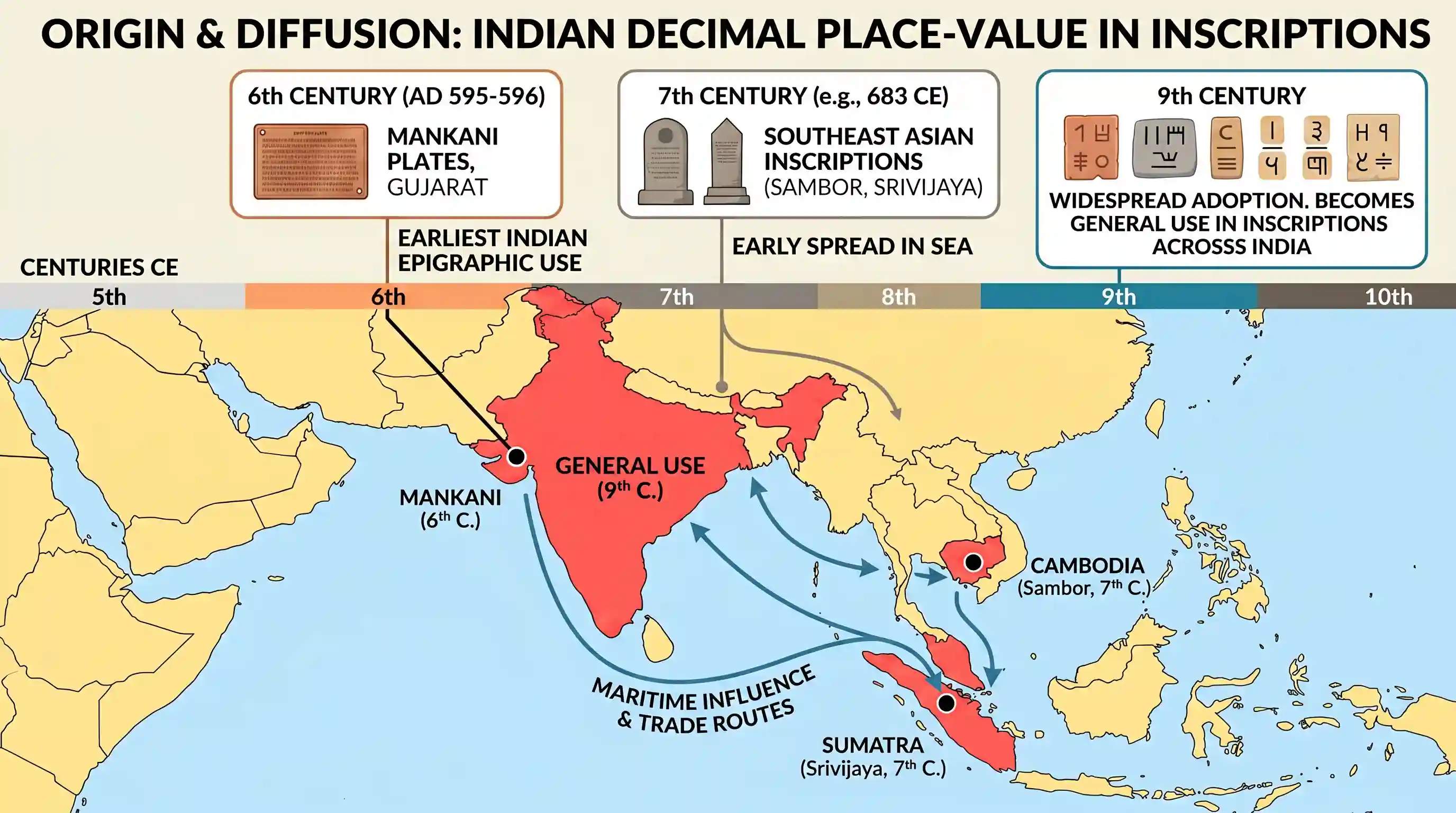
Consider the following statements relating to the use of the place-value system in India : 1. The earliest epigraphic use of the place-value system in India is found in the Mankani plates from Gujarat (AD 595 - 596). 2. In the ninth century, place-values become general in inscriptions all over India. 3. The place-values have been found in Sanskrit inscriptions in South-east Asia as early as the seventh century. Which of the statements given above are correct ?

- A1 and 2 only
- B1 and 3 only
- C2 and 3 only
- D1, 2 and 3Correct
Explanation
The correct answer is Option D (1, 2, and 3).
Statement 1 is correct: The Mankani plates (Sankheda-Mankani plates of Taralasvamin) from Gujarat, dating to the Kalachuri year 346 (594–596 CE), provide the earliest known epigraphic evidence for the use of the decimal place-value system in India. Standard historical consensus, supported by texts like A.L. Basham's The Wonder That Was India, cites this as a foundational milestone for Indian numerals.
Statement 2 is correct: Although the place-value system and zero were conceptualized centuries earlier in literary and mathematical texts, their usage in stone epigraphs and copper-plate grants was initially sporadic. It was not until the 9th century CE that decimal place-value notation became a general, widespread feature in inscriptions across all of India (a famous example being the Gwalior inscription of 876 CE, which explicitly notes a symbol for zero).
Statement 3 is correct: The Indian decimal place-value system spread rapidly through maritime and cultural exchanges. Sanskrit inscriptions found in Southeast Asia, notably the Sambor inscription (Cambodia) and Srivijaya records (Indonesia), demonstrate the use of this numerical system as early as the 7th century (specifically Saka year 605, or 683 CE).
Why the other options are incorrect:
- Option A is incorrect because it misses Statement 3, ignoring the well-documented 7th-century Southeast Asian epigraphic evidence.
- Option B is incorrect because it omits Statement 2, failing to recognize the 9th-century widespread domestic adoption.
- Option C is incorrect because it excludes Statement 1, disregarding the foundational Mankani plates.
Concluding Takeaway: Remember the timeline of the Indian decimal system in epigraphy: 6th Century (Earliest domestic evidence, Mankani) → 7th Century (Spread to Southeast Asia, Sambor) → 9th Century (Universal standard across India).
Related questions
More UPSC Prelims practice from the same subject and topic.
- Prelims 2026GS1history
Which of the following pairs of ancient and modern names of rivers is/are correctly matched ? 1. Vitasta : Chenab 2. Asikni : Jhelum 3. Parushni : Ravi 4. Yavyavati : Beas Select the answer using the …
- Prelims 2026GS1history
Which of the following pairs of the king and his dynasty in early historical Tamilakam is/are not correctly matched ? 1. Senguttuvan : Chera 2. Udiyanjeral : Chola 3. Nedunjeliyan : Pandya Select the …
- Prelims 2026GS1history
In which one among the following texts does the term kshetra-patni ('mistress of the field') originate ?
- Prelims 2026GS1history
Consider the following statements : I. Pali texts contain the first definite references to coins, e.g., kahapana, nikkha, kamsa, and kakanika. II. The literary evidence from Pali texts is corroborated…
- Prelims 2026GS1history
Among the four main forms of existence of life recognized in Jainism, which one of the following is not included ?
- Prelims 2026GS1history
Consider the following statements about the Rigvedic period : I. Irrigation from wells allowed agriculture to expand away from flood plains and strips on river margins into the present Punjab and Hary…