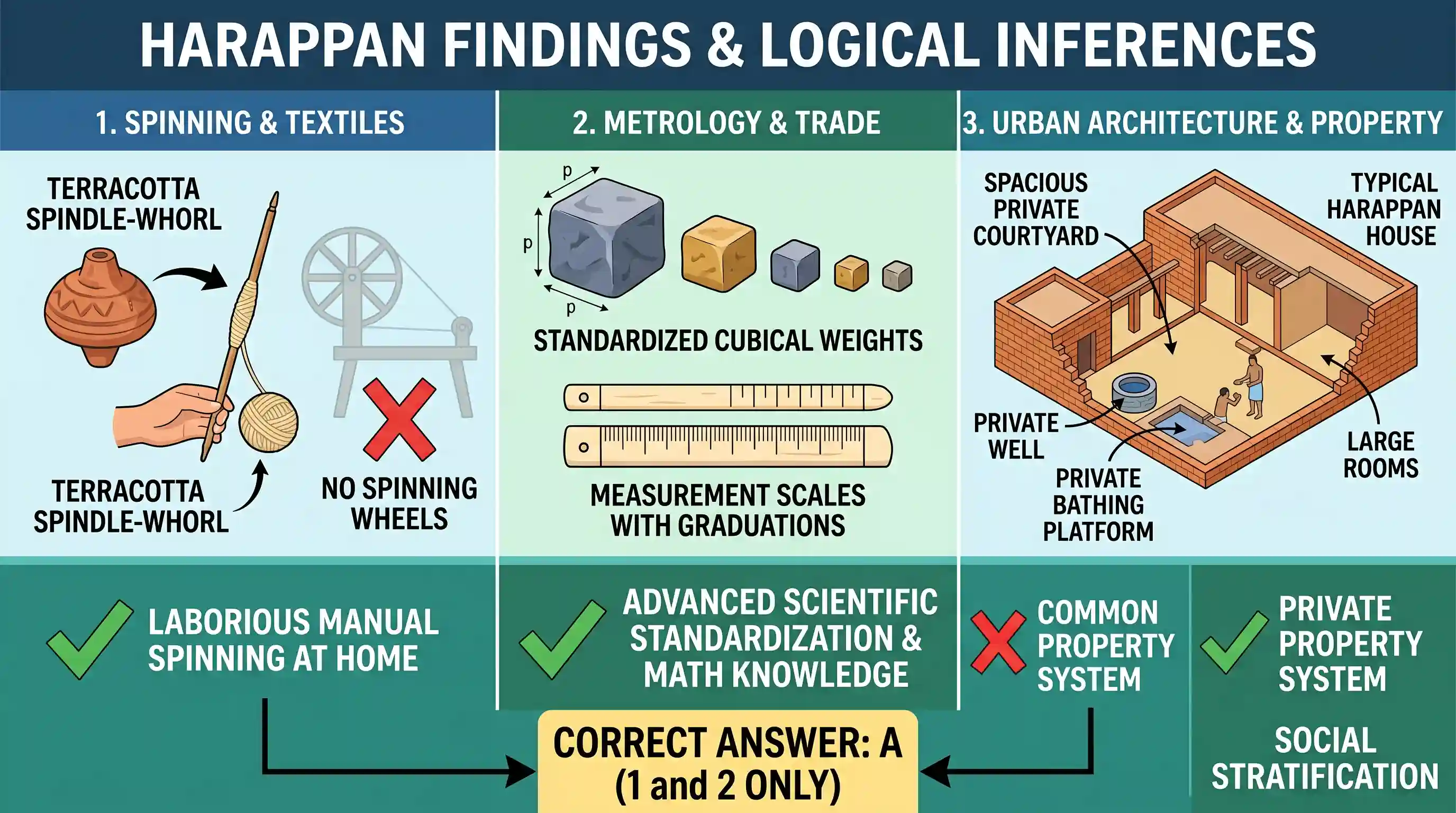
Consider the following statements about the archaeological findings in Harappan towns : I. There is wide occurrence of spindle-whorls in the houses but absence of spinning wheels. II. Weights and measurement scales, complete with graduations have been discovered. III. There are houses built in large part with baked bricks, around relatively spacious courtyards, with their own wells, bathing platforms, and large rooms. Which of the following inferences can be drawn from the above statements ? 1. Statement I suggests that spinning was a laborious activity done at home. 2. Statement II suggests the extent of the scientific knowledge that the Harappans possessed. 3. Statement III suggests the emergence of a common property system. Select the answer using the code given below :

- A1 and 2 onlyCorrect
- B2 and 3 only
- C1 and 3 only
- D1, 2 and 3
Explanation
The correct answer is Option A (1 and 2 only).
Why Option A is correct: Inference 1 logically follows Statement I. In Harappan towns, terracotta and faience spindle-whorls were ubiquitous household items used for textile production. Because the mechanical spinning wheel was invented centuries later, textiles were created using hand-held drop spindles. This confirms that spinning was a widespread, manual, and laborious domestic task. Inference 2 correctly interprets Statement II. The Harappans developed a highly standardized metrology system, including chert cubical weights based on binary and decimal proportions. Furthermore, graduated linear scales—such as the ivory scale at Lothal and the shell scale at Mohenjo-Daro—demonstrate a sophisticated grasp of mathematics, trade standardization, and scientific knowledge.
Why Options B, C, and D are incorrect: These options are incorrect because they either include Inference 3 or omit the correct inferences. Inference 3 is fundamentally flawed. Statement III describes houses featuring their own private wells, individual bathing platforms, and spacious courtyards. These architectural markers strongly indicate a private property system accompanied by social stratification. A common property system relies on shared, communal resources, whereas these Harappan houses were designed for exclusivity, individual wealth, and privacy.
Concluding Takeaway: Harappan artifacts reveal a society with advanced scientific standardization (weights and scales) and manual domestic industries (spindle-whorls), while their residential architecture highlights a distinct framework of private property rather than communal ownership.
Related questions
More UPSC Prelims practice from the same subject and topic.
- Prelims 2026GS1history
Which of the following pairs of ancient and modern names of rivers is/are correctly matched ? 1. Vitasta : Chenab 2. Asikni : Jhelum 3. Parushni : Ravi 4. Yavyavati : Beas Select the answer using the …
- Prelims 2026GS1history
Which of the following pairs of the king and his dynasty in early historical Tamilakam is/are not correctly matched ? 1. Senguttuvan : Chera 2. Udiyanjeral : Chola 3. Nedunjeliyan : Pandya Select the …
- Prelims 2026GS1history
Which of the following factors contributed to the formation of the Forward Bloc by Subhas Chandra Bose in 1939 ? 1. Bose failed to win the confidence of Mahatma Gandhi. 2. The Congress Left was disuni…
- Prelims 2026GS1history
Consider the following statements regarding the British policy in Awadh immediately after its annexation in 1856 : 1. The taluqdars were dispossessed of their estates but allowed to retain their arms …
- Prelims 2026GS1history
Consider the following assertion : The genesis of political alliances based on community lay in the very nature of the Montague-Chelmsford Reforms, 1919. Which of the following statements support/supp…
- Prelims 2026GS1history
In which one among the following texts does the term kshetra-patni ('mistress of the field') originate ?