Consider the following statements about the Rigvedic period : I. Irrigation from wells allowed agriculture to expand away from flood plains and strips on river margins into the present Punjab and Haryana plains having underground water levels reasonably close to the surface. II. Draught-animal power was employed to draw up water out of the wells. Which of the following information support/supports the above statements ? 1. There is evidence in the Rigveda of the use of ashma chakra (stone pulley wheel) and ahava (strapped wooden pails) to draw up water. 2. Mention has been made in the Rigveda of the use of implements like parashu / kulisha (axe) and datra / sreni (sickle). 3. There is a history of the use of ox, even before the Rigveda, for ploughing the land and pulling the carts. Select the answer using the code given below :

- A1 and 2 only
- B1, 2 and 3
- C1 and 3 onlyCorrect
- D3 only
Explanation
The correct answer is C (1 and 3 only).
Why the correct option is correct: The question requires identifying the information that provides evidence for well-irrigation (Statement I) and the use of draught animals to draw water (Statement II) during the Rigvedic period.
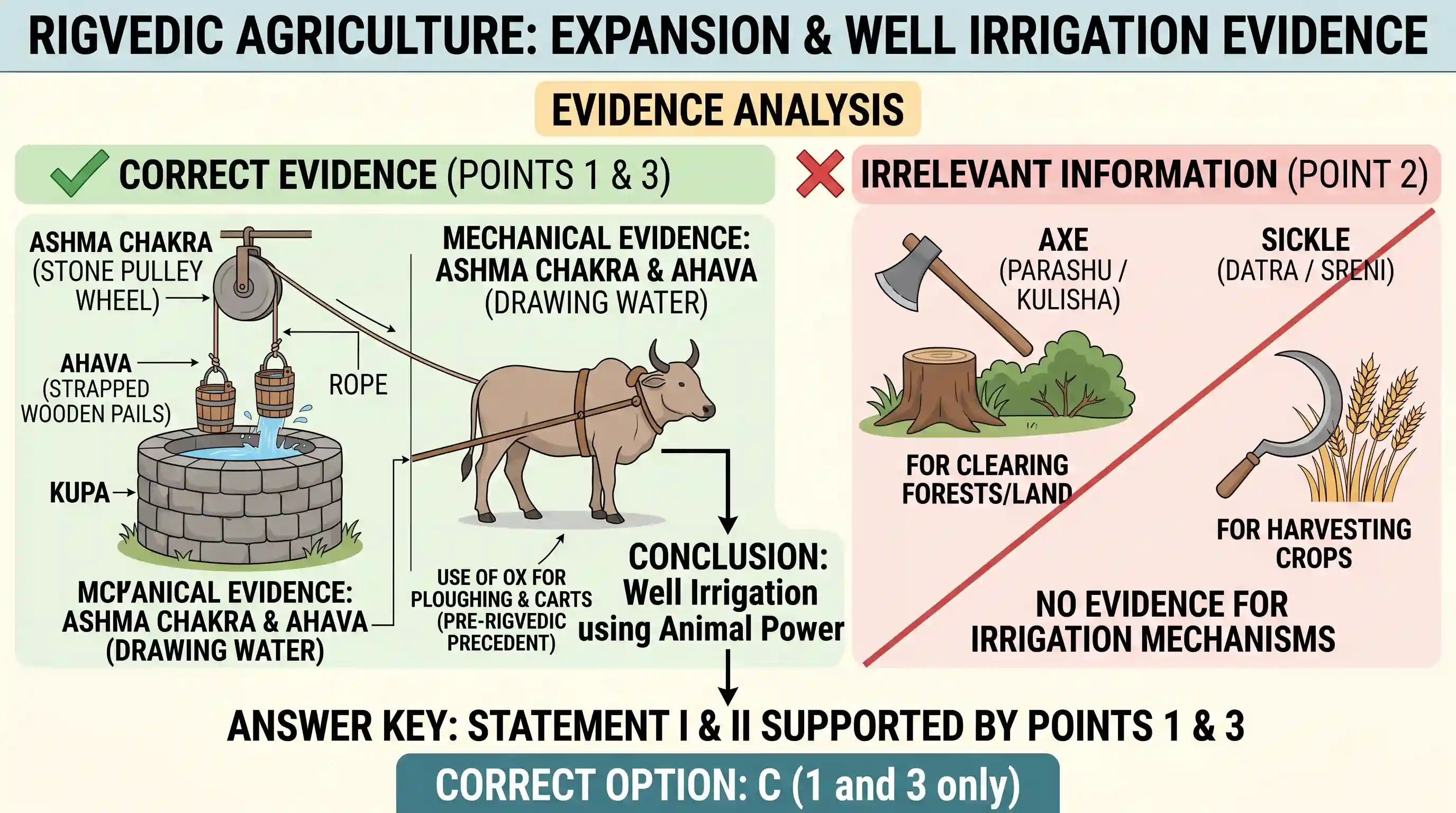
- Point 1 supports the claims: The Rigveda explicitly mentions artificial well-irrigation. The texts refer to the ashma-chakra (a stone pulley wheel) and ahava (wooden pails or buckets) used to lift water from deep wells (kupa). This mechanical evidence directly substantiates Statement I, showing how early Vedic people accessed groundwater to expand agriculture across the Punjab and Haryana plains, away from river margins.
- Point 3 supports the claims: The domestication and use of oxen as draught animals for ploughing fields and pulling carts predate the Rigveda (tracing back to the Indus Valley Civilization). This historical precedent strongly supports Statement II, confirming that draught-animal power was already harnessed by early societies and was logically applied to operate heavy stone pulleys (ashma-chakra) to draw well water.
Why the other options are incorrect:
- Point 2 does not support the statements: While it is factually correct that the Rigveda mentions implements like the parashu / kulisha (axe) and datra / sreni (sickle), these tools were utilized for clearing forests and harvesting crops, respectively. They offer no evidence regarding well-irrigation mechanisms or the lifting of water.
- Because Point 2 is irrelevant to the specific statements provided, Options A and B are incorrect. Option D is incorrect because it excludes the vital mechanical evidence of the ashma-chakra mentioned in Point 1.
Concluding Takeaway: For Vedic agriculture, memorize the specific functions of terminology: ashma-chakra (pulley) and ahava (pail) denote irrigation mechanisms, while parashu (axe) and datra (sickle) denote land clearance and crop harvesting.
Related questions
More UPSC Prelims practice from the same subject and topic.
- Prelims 2026GS1history
Which of the following pairs of ancient and modern names of rivers is/are correctly matched ? 1. Vitasta : Chenab 2. Asikni : Jhelum 3. Parushni : Ravi 4. Yavyavati : Beas Select the answer using the …
- Prelims 2026GS1history
Which of the following pairs of the king and his dynasty in early historical Tamilakam is/are not correctly matched ? 1. Senguttuvan : Chera 2. Udiyanjeral : Chola 3. Nedunjeliyan : Pandya Select the …
- Prelims 2026GS1history
In which one among the following texts does the term kshetra-patni ('mistress of the field') originate ?
- Prelims 2026GS1history
Consider the following statements : I. Pali texts contain the first definite references to coins, e.g., kahapana, nikkha, kamsa, and kakanika. II. The literary evidence from Pali texts is corroborated…
- Prelims 2026GS1history
Among the four main forms of existence of life recognized in Jainism, which one of the following is not included ?
- Prelims 2026GS1history
Consider the following statements relating to the use of the place-value system in India : 1. The earliest epigraphic use of the place-value system in India is found in the Mankani plates from Gujarat…