Passage: ... inspired by iconic temples like the Dakshineshwar Kali Temple and the Brahma Mandir, were treasure troves of regional artistry. Bengal's Pattachitra paintings, Assam's bamboo crafts, Tamil Nadu's Thanjavur paintings, and Madhya Pradesh's tribal sculpture—all were showcased in these living galleries where 230 master artisans breathed life into them using age-old techniques, their hands shaping India's ancient history into creations to behold. Question: Which one of the following statements is not correct?

- APaintings from four States of India have been mentioned.Correct
- BStepping into Kalagram is likened to stepping into another world.
- CThe Angans have been described as living galleries.
- DKalagram is divided into thematic zones, inspired by well-known temples of India.
Explanation
The question requires identifying the statement that is not correct based on the provided passage. (For context, the text describes Kalagram, a major cultural exhibition inaugurated at the Mahakumbh 2025 in Prayagraj).
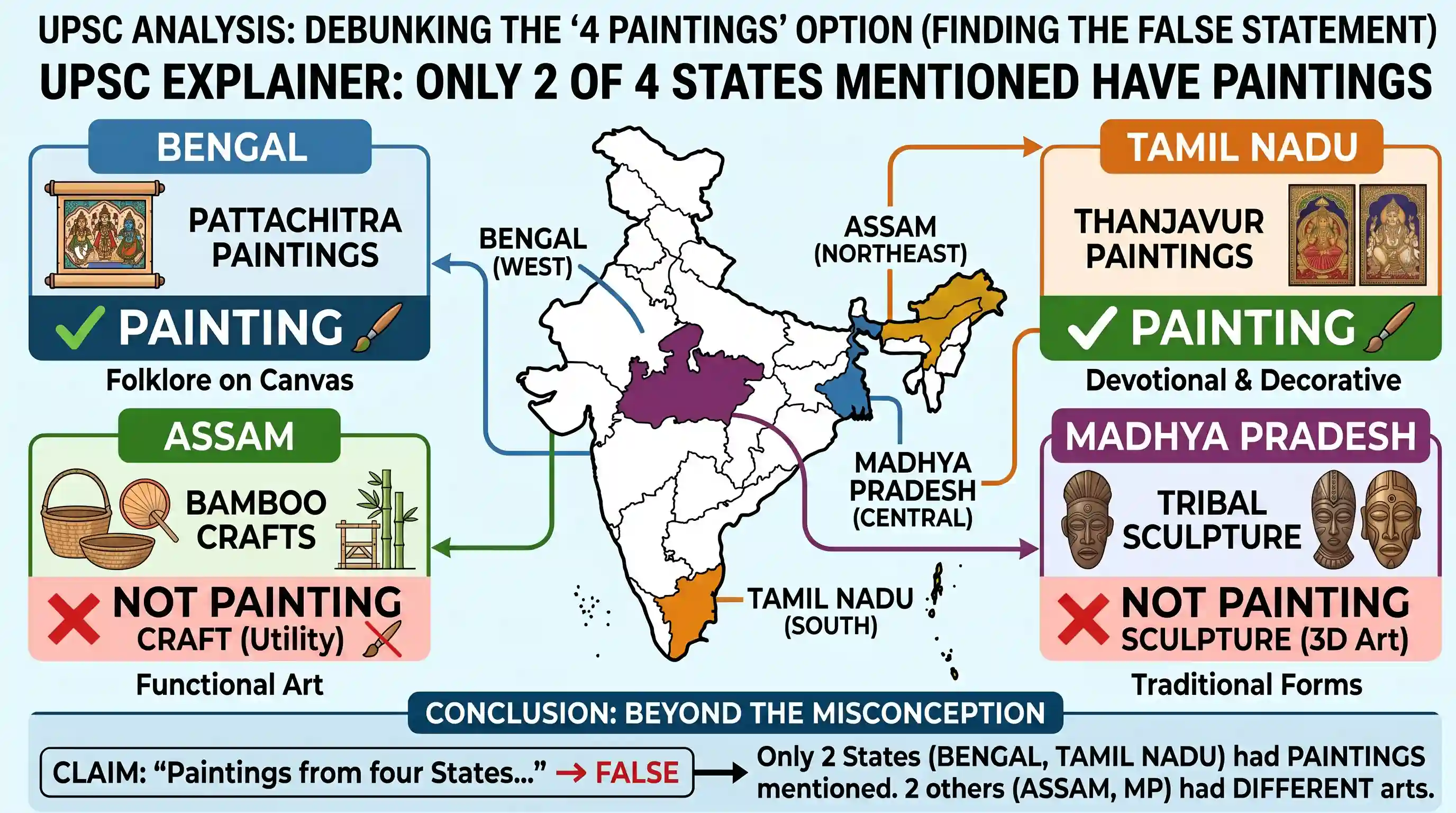
Why Option A is correct (the statement is incorrect): Option A claims that paintings from four Indian states are mentioned. However, a careful reading reveals that while four distinct regional art forms from four states are listed, only two are categorized as paintings: Bengal's Pattachitra paintings and Tamil Nadu's Thanjavur paintings. The remaining two are Assam's bamboo crafts (a utility handicraft) and Madhya Pradesh's tribal sculpture (a three-dimensional art form). Because paintings from only two states are cited, Statement A is factually inaccurate and is therefore the correct answer.
Why the other options are incorrect (these statements are true):
- Option B: Though the beginning of the sentence is truncated in the snippet, the immersive, sensory language of the passage likens entering the Kalagram exhibition to stepping into another world where ancient history is actively brought to life.
- Option C: The passage explicitly uses the phrase "living galleries" to describe the Angans (cultural zones) where 230 master artisans actively demonstrate their age-old techniques.
- Option D: The text directly corroborates this statement by noting that the structural zones were "inspired by iconic temples like the Dakshineshwar Kali Temple and the Brahma Mandir."
Concluding Takeaway: In UPSC Reading Comprehension questions, pay strict attention to categorical nouns. Examiners frequently test observational skills by conflating a broad category (e.g., "art forms") with a specific subset (e.g., "paintings").
Related questions
More UPSC Prelims practice from the same subject and topic.
- Prelims 2026GS1art-culture
The Hallisalasya painting in the Bagh Caves represents :
- Prelims 2026GS1art-culture
What does an empty seat represent in early Buddhist iconography ?
- Prelims 2026GS1art-culture
Which of the following statements on the Amaravati Stupa and its relief sculpture is/are correct ? 1. It was located in the lower Krishna valley. 2. In India, it was next only to the Sanchi Stupa in s…
- Prelims 2026GS1art-culture
Pandit Mallikarjun Mansur, the famous classical singer from Karnataka, represented the :
- Prelims 2026GS1art-culture
Which one of the following Carnatic music ragas is similar to Raga Bilawal in Hindustani music?
- Prelims 2026GS1art-culture
Which of the following temples has/have a Nagara-style shikhara ? 1. Malegitti Shivalaya, Badami 2. Huchimalligudi Temple, Aihole 3. Dashavatara Temple, Deogarh 4. Virupaksha Temple, Pattadakal Select…