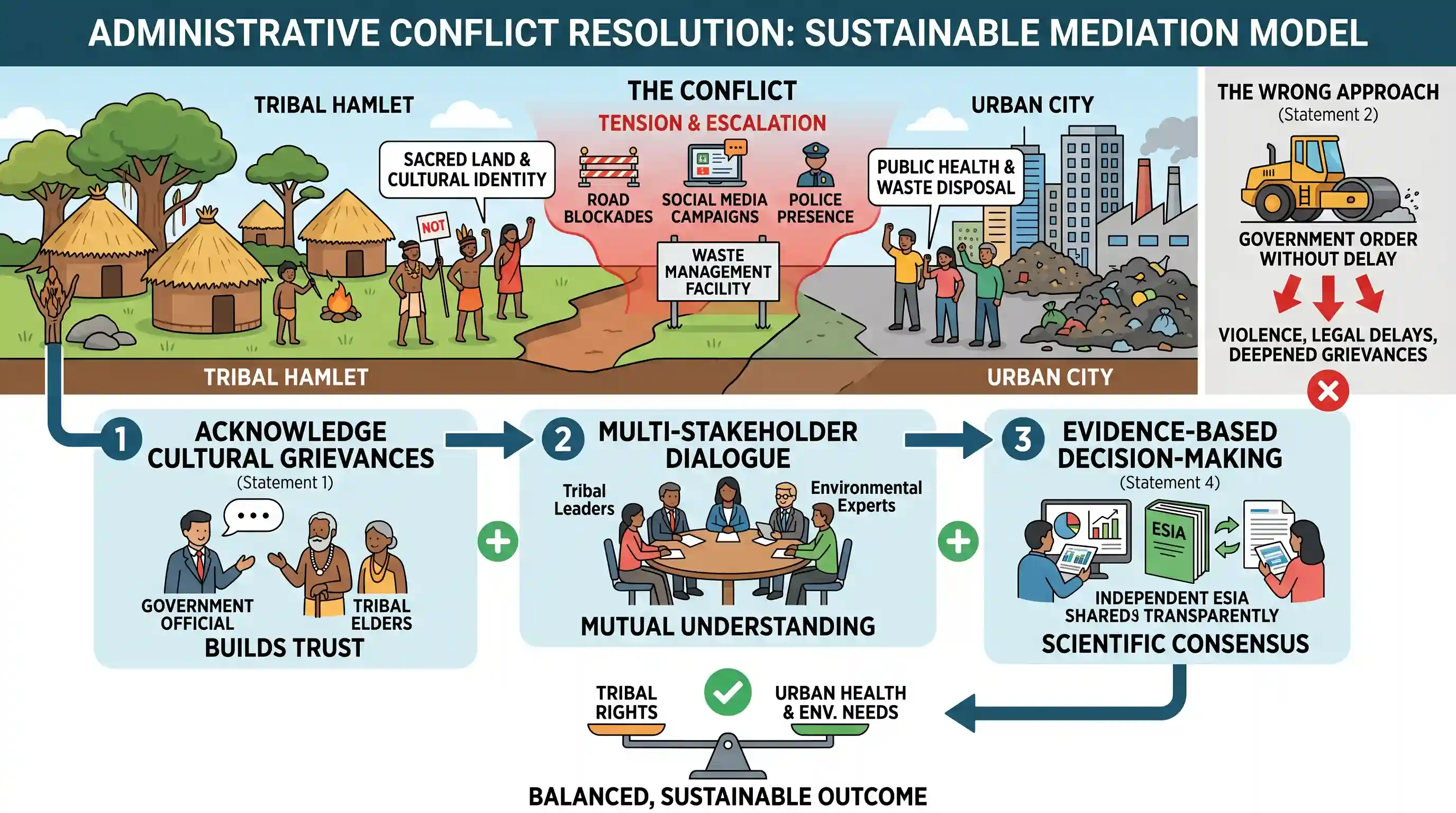
In a multi-ethnic district where both economic competition and historical grievances frequently led to community tensions, a flashpoint has arisen with a Government decision to allocate land for a waste management facility near a tribal hamlet, sparking protests by the tribal community, which claimed that the land was sacred and critical to their cultural identity. At the same time, urban residents and local industries supported the project, citing severe solid waste challenges and health concerns due to lack of a proper disposal site. The conflict has escalated with road blockades, social media campaigns, and allegations of police excesses. As a responsible Government official, you are tasked with resolving the situation through mediation, ensuring a sustainable outcome that balances environmental needs, tribal rights, and urban public health. Consider the following statements with reference to the above : 1. A successful conflict resolution process must begin with acknowledging the cultural concerns of the protesting tribal community before discussing technical alternatives. 2. The Government should move ahead with the project without delay to address urban health concerns, which outweigh the sentiments of a small group. 3. Creating a multi-stakeholder dialogue platform — including tribal leaders, environmental experts, and municipal representatives — to build mutual understanding and help de-escalate tensions. 4. Conducting an independent Environmental and Social Impact Assessment (ESIA) and sharing findings transparently with both sides to facilitate evidence-based decision-making. Which of the statements given above would contribute to the resolution process ?

- A1, 3 and 4 onlyCorrect
- B2, 3 and 4 only
- C1 and 2 only
- D1, 2, 3 and 4
Explanation
Option A is the correct answer.
Statement 1 is correct: In administrative conflict resolution, addressing emotional and historical grievances is a crucial first step. Acknowledging the cultural significance of the land builds trust and de-escalates tension. In India, the cultural and traditional rights of tribal communities over their land, including sacred groves, are legally recognized and protected under frameworks like the Forest Rights Act (FRA), 2006. Validating these concerns makes stakeholders more receptive to subsequent technical discussions.
Statement 3 is correct: Establishing a multi-stakeholder dialogue platform embodies participatory governance. By bringing tribal leaders, municipal representatives, and environmental experts to the same table, the administration ensures all competing interests are heard. This collaborative approach aligns with the democratic decentralization principles enshrined in the PESA Act, 1996, which mandates consultation with local bodies.
Statement 4 is correct: Conducting an independent Environmental and Social Impact Assessment (ESIA) provides objective, scientific data to evaluate the project's viability and mitigation strategies. Transparently sharing these findings satisfies the public consultation mandates of the EIA Notification, 2006, and the social impact requirements of the LARR Act, 2013, facilitating an evidence-based consensus.
Statement 2 is incorrect: A rigid utilitarian approach—arguing that the urban majority's health automatically outweighs a minority's cultural rights—is ethically flawed and legally unsound in this context. Forcible land acquisition ignores the statutory rights of marginalized groups protected under the Constitution (Schedules V/VI) and the FRA, 2006. Bypassing dialogue to "move ahead without delay" would only escalate violence, deepen historical grievances, and likely result in legal stays on the project.
Takeaway: For governance conflicts, remember the PEACE approach: Participation (multi-stakeholder), Empathy (acknowledging grievances), Accountability, Consensus-building, and Evidence-based action (ESIA).
Related questions
More UPSC Prelims practice from the same subject and topic.
- Prelims 2026GS1polity
Mr. X, a senior officer, was overseeing a critical vaccination programme during a pandemic. He found that a private service provider responsible for vaccine distribution was compromising on quality to…
- Prelims 2026GS1polity
'X' was addressing a seminar on the meaning of the term 'law' as provided under Article 13, Part III of the Constitution of India. 'X' explained that the meaning of the term 'law' in the Constitution …
- Prelims 2026GS1polity
Consider the following statements with reference to the Constitution of India : 1. There is no Article in the Constitution of India that specifies that the Constitution of India will be officially cal…
- Prelims 2026GS1polity
Which of the following statements with regard to the persons with disabilities in India is/are correct ? 1. The Rights of Persons with Disabilities Act, an Act passed by the Parliament of India in 201…
- Prelims 2026GS1polity
Consider the following statements about the provisions pertaining to the Scheduled Castes and the Scheduled Tribes in India : 1. Provisions regarding the administration of the Tribal Areas in the Stat…
- Prelims 2026GS1polity
Consider the following statements in respect of questions asked by the Members in the Parliament of India : 1. Unstarred questions are those to which a Member desires an oral answer in the House. 2. S…