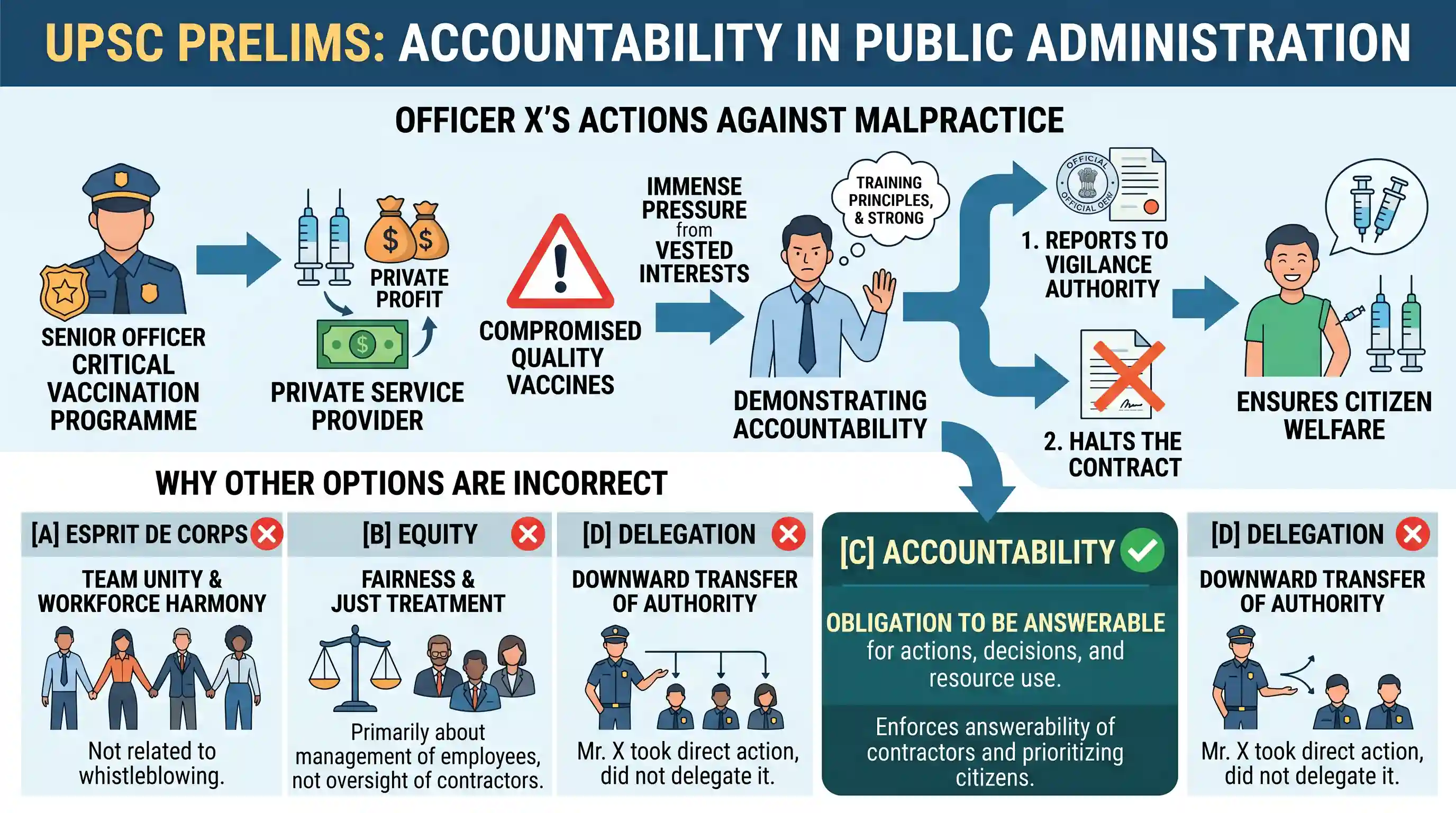
Mr. X, a senior officer, was overseeing a critical vaccination programme during a pandemic. He found that a private service provider responsible for vaccine distribution was compromising on quality to make profits. Despite immense pressure to manage the issue due to vested interests, he raised his voice based on the principles of public administration which he learnt during various training programmes attended across his career. He reported the issue to the appropriate vigilance authority and halted the contract to ensure citizen welfare. Which one among the following principles of public administration was most strongly demonstrated by Mr. X's actions ?

- AEsprit de corps
- BEquity
- CAccountabilityCorrect
- DDelegation
Explanation
The correct option is C) Accountability.
In public administration, accountability refers to the obligation of public officials, agencies, and contracted partners to be answerable for their actions, decisions, and use of public resources. It ensures that administration remains transparent and prioritizes citizen welfare over private profit. By reporting the compromised vaccination programme to the vigilance authority and halting the contract despite pressure from vested interests, Mr. X enforced institutional accountability. He held the private provider answerable for its poor service and demonstrated his own accountability to the public.
Why the other options are incorrect:
- A) Esprit de corps: Formulated in 1916 as one of Henri Fayol's 14 Principles of Management, this principle emphasizes team spirit, unity, and harmony within a workforce. It is entirely unrelated to whistleblowing or enforcing contractual compliance.
- B) Equity: Also one of Fayol's management principles, equity refers to kindness, justice, and impartiality—typically regarding how managers treat employees or how resources are fairly distributed. While Mr. X acted justly, the specific mechanism of reporting a violator to a vigilance authority and halting a contract is a direct exercise of oversight and accountability, not the management principle of equity.
- D) Delegation: This principle involves the downward transfer of authority and responsibility from a superior to a subordinate. Mr. X did not delegate his duties; rather, he took regulatory action and escalated the issue to an appropriate oversight body.
Takeaway: Accountability is the cornerstone of ethical governance. When an officer reports malpractice or terminates a compromised contract, they are actively enforcing the answerability of public and private actors to the citizenry.
Related questions
More UPSC Prelims practice from the same subject and topic.
- Prelims 2026GS1polity
In a multi-ethnic district where both economic competition and historical grievances frequently led to community tensions, a flashpoint has arisen with a Government decision to allocate land for a was…
- Prelims 2026GS1polity
'X' was addressing a seminar on the meaning of the term 'law' as provided under Article 13, Part III of the Constitution of India. 'X' explained that the meaning of the term 'law' in the Constitution …
- Prelims 2026GS1polity
Consider the following statements with reference to the Constitution of India : 1. There is no Article in the Constitution of India that specifies that the Constitution of India will be officially cal…
- Prelims 2026GS1polity
Which of the following statements with regard to the persons with disabilities in India is/are correct ? 1. The Rights of Persons with Disabilities Act, an Act passed by the Parliament of India in 201…
- Prelims 2026GS1polity
Consider the following statements about the provisions pertaining to the Scheduled Castes and the Scheduled Tribes in India : 1. Provisions regarding the administration of the Tribal Areas in the Stat…
- Prelims 2026GS1polity
Consider the following statements in respect of questions asked by the Members in the Parliament of India : 1. Unstarred questions are those to which a Member desires an oral answer in the House. 2. S…