'X' was addressing a seminar on the meaning of the term 'law' as provided under Article 13, Part III of the Constitution of India. 'X' explained that the meaning of the term 'law' in the Constitution of India was very comprehensive. It included ordinances, orders and even rules and regulations. 'Y' pointed out that the term 'law' in Article 13 also included custom or usage having in the territory of India the force of law, to which 'X' was not convinced. Based on the above, select the correct conclusion from the options given below :

- A'X' is correct in the interpretation of law, including the view on non-inclusion of custom.
- BThe view of 'Y' that 'law' included custom is not correct.
- CThe views of both 'X' and 'Y' are correct.
- DThe view of only 'Y' is correct.Correct
Explanation
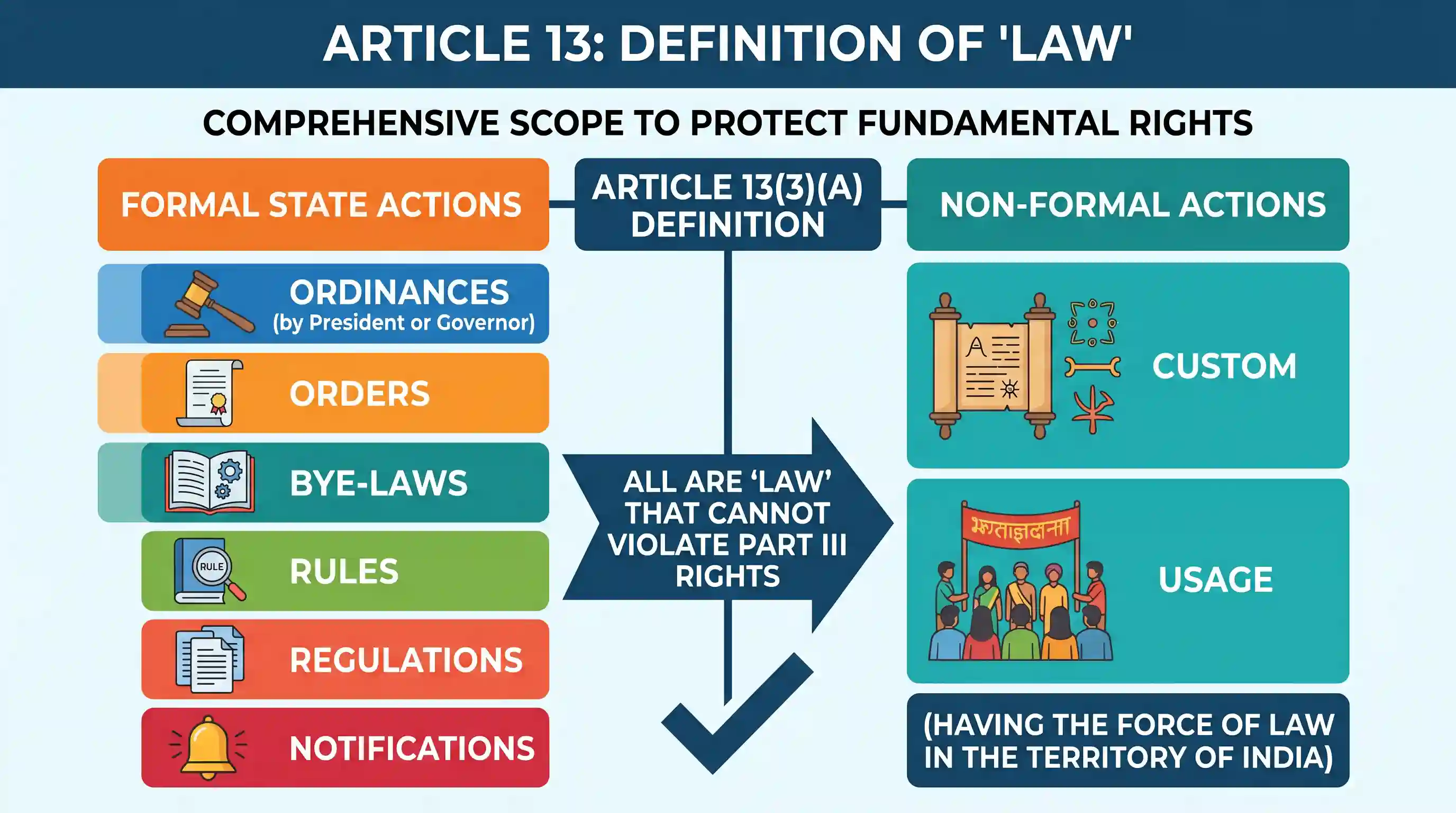
Under Article 13(3)(a) of the Constitution of India (1950), the term 'law' is given an expansive definition to ensure broad protection of Fundamental Rights. According to this provision, 'law' explicitly includes "any Ordinance, order, bye-law, rule, regulation, notification, custom or usage having in the territory of India the force of law".
Why Option D is correct: 'Y' is entirely correct in asserting that custom or usage having the force of law is included in the constitutional definition of 'law' under Article 13.
Why the other options are incorrect:
- Option A: This option is incorrect because 'X' is wrong in rejecting the inclusion of custom. While 'X' correctly identified ordinances and regulations, their view on the non-inclusion of custom directly contradicts the bare text of Article 13(3)(a).
- Option B: This is incorrect because the view of 'Y' is constitutionally accurate; custom and usage are explicitly codified in the text of the Constitution.
- Option C: Both views cannot be correct because they are mutually exclusive regarding custom. Since 'X' refuses to accept a factual constitutional provision that 'Y' rightly points out, 'X' is incorrect.
Concluding Takeaway: When evaluating 'law' under Article 13, remember that it covers both formal state actions (ordinances, rules, orders) and socially recognized practices (customs, usages). This comprehensive scope guarantees that neither the State nor prevailing customary traditions can infringe upon Part III Fundamental Rights.
Related questions
More UPSC Prelims practice from the same subject and topic.
- Prelims 2026GS1polity
Mr. X, a senior officer, was overseeing a critical vaccination programme during a pandemic. He found that a private service provider responsible for vaccine distribution was compromising on quality to…
- Prelims 2026GS1polity
In a multi-ethnic district where both economic competition and historical grievances frequently led to community tensions, a flashpoint has arisen with a Government decision to allocate land for a was…
- Prelims 2026GS1polity
Consider the following statements with reference to the Constitution of India : 1. There is no Article in the Constitution of India that specifies that the Constitution of India will be officially cal…
- Prelims 2026GS1polity
Which of the following statements with regard to the persons with disabilities in India is/are correct ? 1. The Rights of Persons with Disabilities Act, an Act passed by the Parliament of India in 201…
- Prelims 2026GS1polity
Consider the following statements about the provisions pertaining to the Scheduled Castes and the Scheduled Tribes in India : 1. Provisions regarding the administration of the Tribal Areas in the Stat…
- Prelims 2026GS1polity
Consider the following statements in respect of questions asked by the Members in the Parliament of India : 1. Unstarred questions are those to which a Member desires an oral answer in the House. 2. S…