Consider the following statements in respect of questions asked by the Members in the Parliament of India : 1. Unstarred questions are those to which a Member desires an oral answer in the House. 2. Starred questions are those to which a Member desires a written answer. 3. No supplementary question can be asked on an unstarred question. Which one of the following conclusions based on the above statements is correct ?

- AAll the three statements are correct.
- BThere are two correct statements, that include statement 2.
- CThere is only one correct statement.Correct
- DThere is no correct statement.
Explanation
The correct answer is Option C, as only one statement (Statement 3) is correct.
The 'Question Hour' is a crucial mechanism in the Parliament of India, governed by the Rules of Procedure and Conduct of Business in both Houses, enabling members to hold the executive accountable. Questions are classified into different categories based on the nature of the required response.
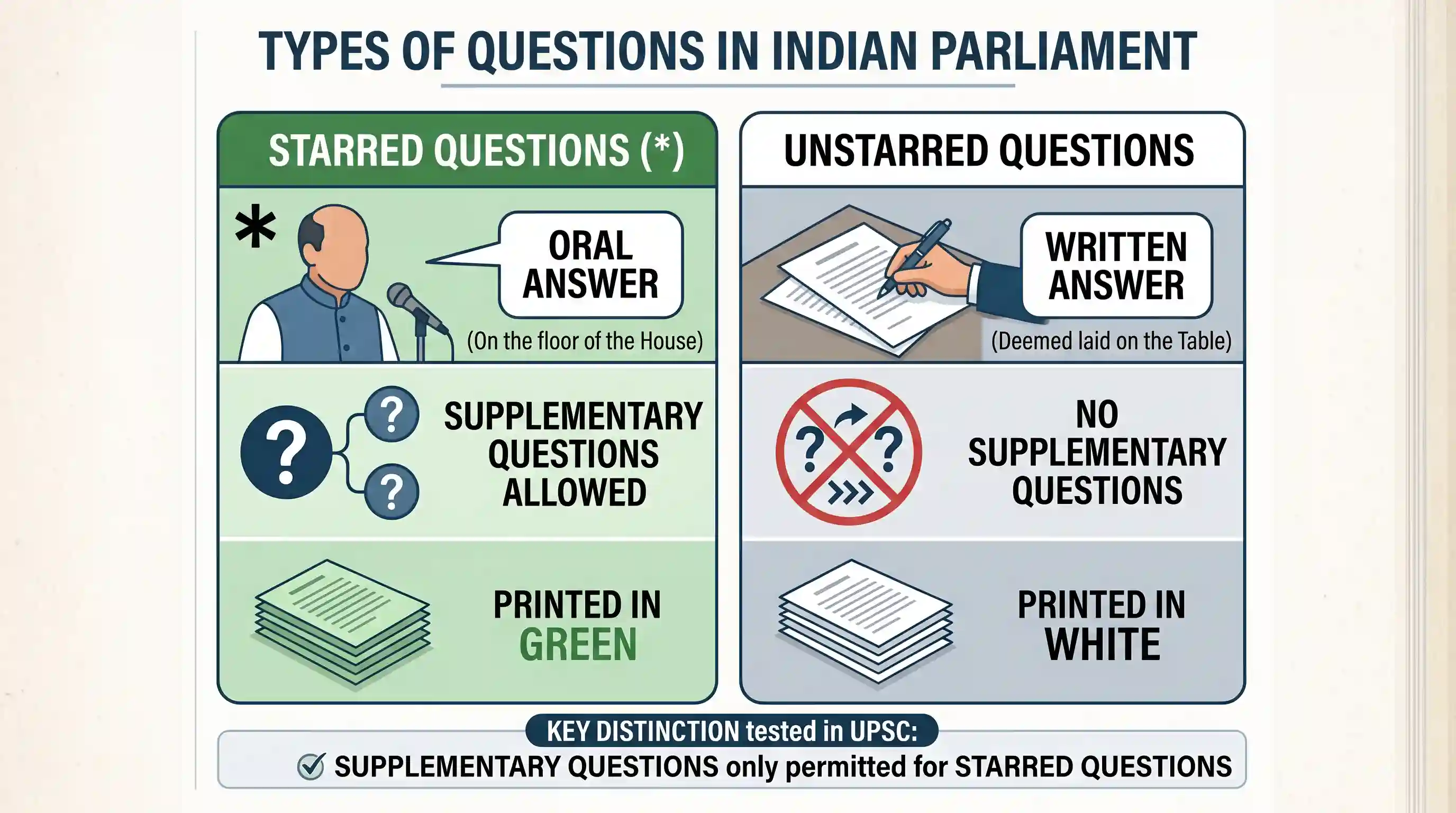
- Statement 1 is incorrect: Unstarred questions are those to which a written answer is desired by the Member. They are not called for oral answers on the floor of the House.
- Statement 2 is incorrect: Starred questions are the ones that require an oral answer in the House. They are distinguished by an asterisk mark (*). Because the Minister-in-charge answers these orally, they are better suited for inquiring about the government's views and policy inclinations.
- Statement 3 is correct: Since an unstarred question receives a written reply that is deemed to be laid on the Table of the House, no supplementary (follow-up) questions can be asked on it. Supplementary questions are exclusively permitted for Starred questions and Short Notice questions (which are also answered orally).
Concluding Takeaway: To easily remember the distinction, use the mnemonic SOW: Starred = Oral (supplementary questions allowed), Unstarred = Written (no supplementary questions allowed). Additionally, the official list of Starred questions is printed in green, while Unstarred questions are printed in white.
Related questions
More UPSC Prelims practice from the same subject and topic.
- Prelims 2026GS1polity
Mr. X, a senior officer, was overseeing a critical vaccination programme during a pandemic. He found that a private service provider responsible for vaccine distribution was compromising on quality to…
- Prelims 2026GS1polity
In a multi-ethnic district where both economic competition and historical grievances frequently led to community tensions, a flashpoint has arisen with a Government decision to allocate land for a was…
- Prelims 2026GS1polity
'X' was addressing a seminar on the meaning of the term 'law' as provided under Article 13, Part III of the Constitution of India. 'X' explained that the meaning of the term 'law' in the Constitution …
- Prelims 2026GS1polity
Consider the following statements with reference to the Constitution of India : 1. There is no Article in the Constitution of India that specifies that the Constitution of India will be officially cal…
- Prelims 2026GS1polity
Which of the following statements with regard to the persons with disabilities in India is/are correct ? 1. The Rights of Persons with Disabilities Act, an Act passed by the Parliament of India in 201…
- Prelims 2026GS1polity
Consider the following statements about the provisions pertaining to the Scheduled Castes and the Scheduled Tribes in India : 1. Provisions regarding the administration of the Tribal Areas in the Stat…