Consider the following statements about the provisions pertaining to the Scheduled Castes and the Scheduled Tribes in India : 1. Provisions regarding the administration of the Tribal Areas in the States of Assam, Meghalaya, Tripura and Mizoram are given in the Fifth Schedule of the Constitution of India. 2. Some tribes of India are entitled to exemption from paying Income Tax on certain incomes. 3. The Constitution of India provides for reservation of seats in Panchayats for women belonging to the Scheduled Castes and the Scheduled Tribes. Which one of the following conclusions based on the above statements is correct ?

- AThere are two correct statements, that include statement 2.Correct
- BThere are two correct statements, that are statements 1 and 3.
- CThere is only one correct statement.
- DAll three statements are correct.
Explanation
Correct Option: (A)
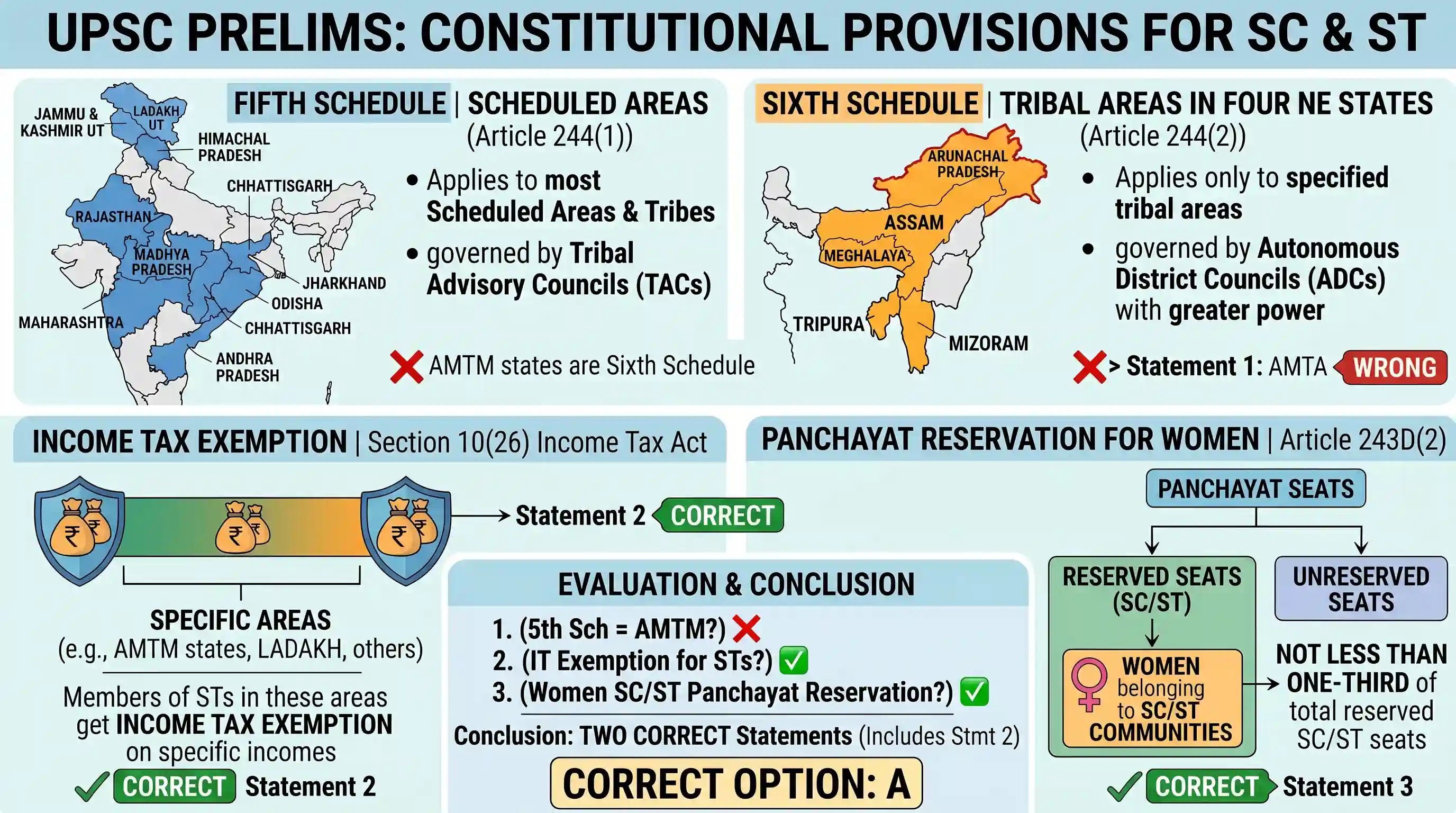
Statement 1 is incorrect. The provisions regarding the administration of the Tribal Areas in the states of Assam, Meghalaya, Tripura, and Mizoram are contained in the Sixth Schedule of the Constitution of India (Article 244(2)). The Fifth Schedule deals with the administration and control of Scheduled Areas and Scheduled Tribes in states other than these four North-Eastern states.
Statement 2 is correct. Under Section 10(26) of the Income Tax Act, 1961, members of Scheduled Tribes residing in specific areas—such as Arunachal Pradesh, Manipur, Mizoram, Nagaland, Tripura, the Sixth Schedule areas, and the Ladakh region—are entitled to exemption from paying income tax on income accruing from sources within those specified areas or by way of dividend and interest.
Statement 3 is correct. The Constitution of India guarantees intersectional representation at the grassroots level. Under Article 243D(2), inserted by the 73rd Constitutional Amendment Act of 1992, it is strictly mandated that not less than one-third of the total number of seats reserved for Scheduled Castes and Scheduled Tribes in every Panchayat shall be reserved for women belonging to those respective communities.
Conclusion: Since Statements 2 and 3 are accurate while Statement 1 is not, there are exactly two correct statements (which includes statement 2). Therefore, Option A is correct. Option B is wrong because it incorrectly claims Statement 1 is true. Options C and D are wrong as they inaccurately count the total number of true statements.
Dalvoy Takeaway Mnemonic: Remember AMTM (Assam, Meghalaya, Tripura, Mizoram) to recall the states exclusively covered by the Sixth Schedule. All other states with Scheduled Areas fall under the Fifth Schedule.
Related questions
More UPSC Prelims practice from the same subject and topic.
- Prelims 2026GS1polity
Mr. X, a senior officer, was overseeing a critical vaccination programme during a pandemic. He found that a private service provider responsible for vaccine distribution was compromising on quality to…
- Prelims 2026GS1polity
In a multi-ethnic district where both economic competition and historical grievances frequently led to community tensions, a flashpoint has arisen with a Government decision to allocate land for a was…
- Prelims 2026GS1polity
'X' was addressing a seminar on the meaning of the term 'law' as provided under Article 13, Part III of the Constitution of India. 'X' explained that the meaning of the term 'law' in the Constitution …
- Prelims 2026GS1polity
Consider the following statements with reference to the Constitution of India : 1. There is no Article in the Constitution of India that specifies that the Constitution of India will be officially cal…
- Prelims 2026GS1polity
Which of the following statements with regard to the persons with disabilities in India is/are correct ? 1. The Rights of Persons with Disabilities Act, an Act passed by the Parliament of India in 201…
- Prelims 2026GS1polity
Consider the following statements in respect of questions asked by the Members in the Parliament of India : 1. Unstarred questions are those to which a Member desires an oral answer in the House. 2. S…