There are four types of weights, namely 1 kg, 2 kg, 5 kg and 10 kg. What is the maximum number of different ways one can measure 20 kg, if at least eight but not more than eleven weights of 1 kg are to be used while measuring?

- A7
- B8Correct
- C9
- D10
Explanation
The question asks for the maximum number of combinations of 1 kg, 2 kg, 5 kg, and 10 kg weights that can exactly measure a total of 20 kg, subject to the condition that between 8 and 11 (inclusive) 1 kg weights are used. This is a classic integer partition problem involving linear Diophantine equations, a staple of the UPSC CSAT aptitude syllabus.
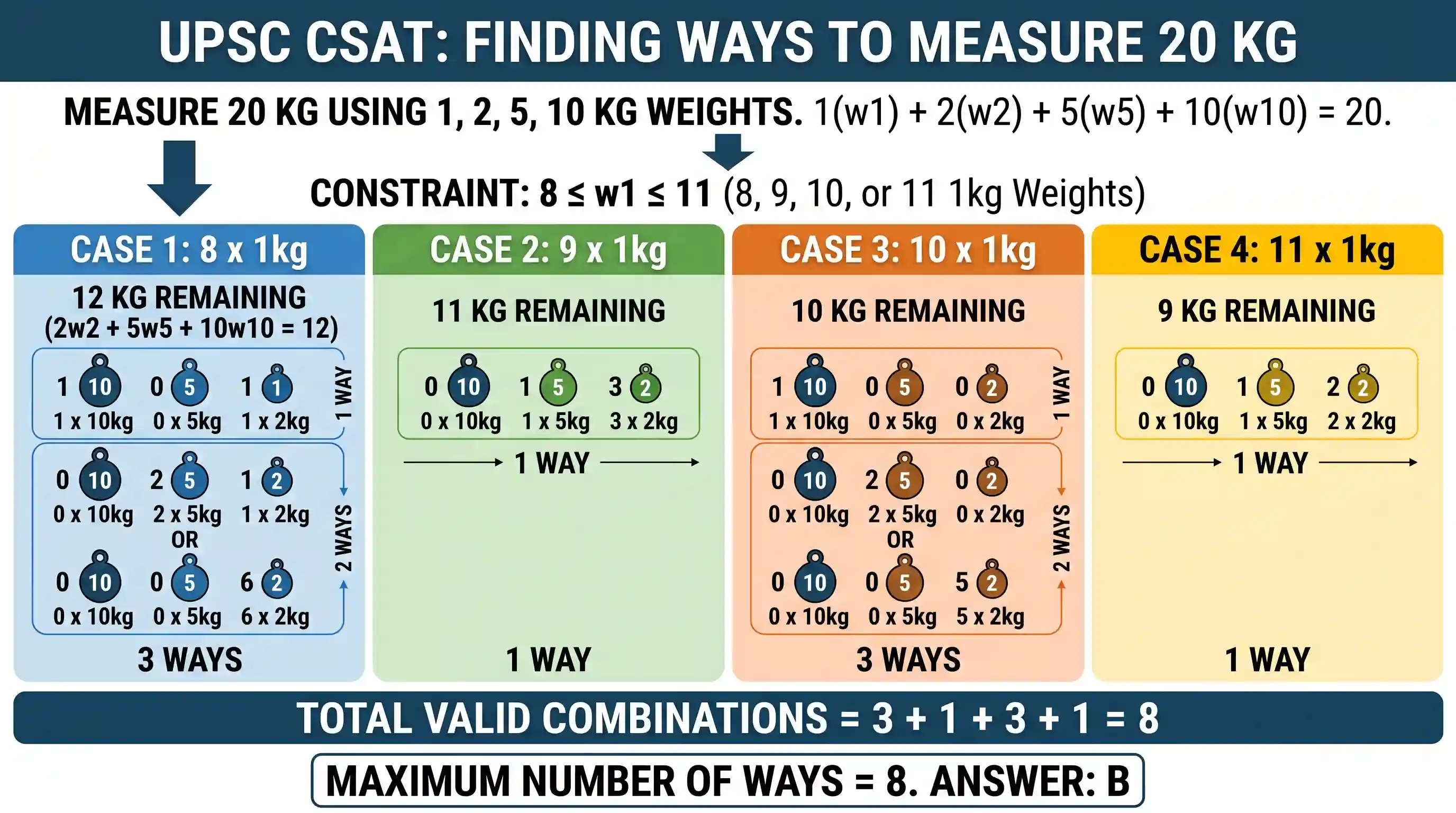
Let w1, w2, w5, and w10 represent the quantity of 1 kg, 2 kg, 5 kg, and 10 kg weights used. We must satisfy the equation: 1(w1) + 2(w2) + 5(w5) + 10(w10) = 20, constrained by 8 ≤ w1 ≤ 11.
Case 1: w1 = 8 (Remaining weight = 12 kg) We solve 2(w2) + 5(w5) + 10(w10) = 12.
- If w10 = 1, then w5 = 0 and w2 = 1 (1 way).
- If w10 = 0, the 12 kg can be formed by (w5 = 2, w2 = 1) or (w5 = 0, w2 = 6) (2 ways). Total = 3 ways.
Case 2: w1 = 9 (Remaining weight = 11 kg) We solve 2(w2) + 5(w5) + 10(w10) = 11. Since 11 is odd and 2(w2) is even, w5 must be an odd integer. The only valid solution is w5 = 1 and w2 = 3. Total = 1 way.
Case 3: w1 = 10 (Remaining weight = 10 kg) We solve 2(w2) + 5(w5) + 10(w10) = 10.
- If w10 = 1, then w5 = 0 and w2 = 0 (1 way).
- If w10 = 0, the 10 kg can be formed by (w5 = 2, w2 = 0) or (w5 = 0, w2 = 5) (2 ways). Total = 3 ways.
Case 4: w1 = 11 (Remaining weight = 9 kg) We solve 2(w2) + 5(w5) + 10(w10) = 9. Because 9 is odd, w5 must be odd. The only valid combination is w5 = 1 and w2 = 2. Total = 1 way.
Total valid combinations = 3 + 1 + 3 + 1 = 8. Thus, Option B is correct.
- Option A (7) is incorrect because it misses a valid configuration, likely due to overlooking a possible combination when the 10 kg weight is utilized.
- Option C (9) is incorrect because it mathematically overstates the integer combinations, often by falsely assuming the odd remainders (9 kg or 11 kg) yield multiple valid arrangements.
- Option D (10) is incorrect as it significantly overestimates the rigid integer partition solutions constrained by these specific weights.
Takeaway: When faced with constrained linear combinations, always anchor the problem around the most restricted variable (in this case, the 1 kg weights) and sequentially test its permissible values to ensure exhaustive and accurate counting.
Related questions
More UPSC Prelims practice from the same subject and topic.
- Prelims 2026CSATother
A toy T jumps forward or backward. In each forward jump, it moves 5' forward whereas in each backward jump, it moves 2' backward. If in 31 jumps, T moves exactly 15' forward, then what is the differen…
- Prelims 2026GS1other
Which of the following statements with regard to the Grand Slam Tennis Tournaments is/are correct ? 1. The tournaments have a shared governance structure establishing the partnership among the four Gr…
- Prelims 2026GS1other
Ms. X is a mid-level civil service official working in the urban development department of a major city. Recently, she was involved in approving a contract for a public infrastructure project — a new …
- Prelims 2026GS1other
Which one of the following pairs is not correctly matched? (Indian Army Corps) : (Headquarters)
- Prelims 2026CSATother
For ⅓ < x < y < 2, which of the following statements is/are always correct? I. x + 1/x < y + 1/y II. √(1 + y²)/y < √(1 + x²)/x Select the answer using the code given below.
- Prelims 2026CSATother
What is the minimum number of times one needs to measure to get 298 litres of water from a tank, if the measuring cylinders have capacities 1 litre, 6 litres, 25 litres and 100 litres?