A cut on a solid object divides the object into two parts where the new surfaces thus produced are plane. On the other hand, one single cut can be used to cut more than one object at a time. In an experiment, the total number of pieces produced by applying n cuts is denoted by xₙ. The experiment is performed on a solid cube where pieces remain unmoved after each cut. In this experiment, if after the third cut, the pieces are identical, then which of the following is *not* a possible value for x₄?

- A16Correct
- B12
- C8
- D5
Explanation
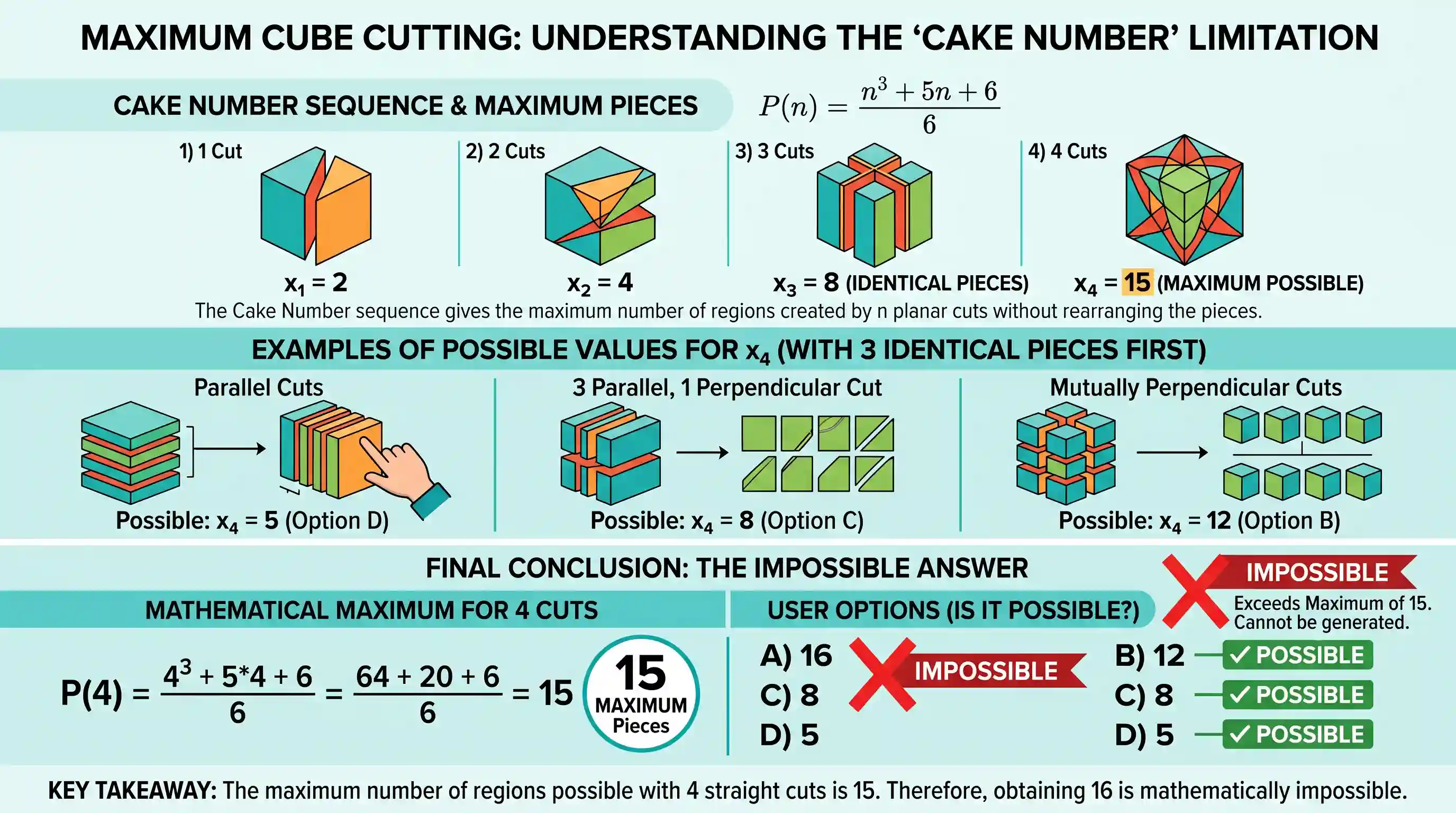
The correct option is A (16) because it is mathematically impossible to produce 16 pieces with 4 straight planar cuts on a solid cube without rearranging the pieces.
In discrete geometry, the maximum number of regions a 3-dimensional solid can be partitioned into by n planar cuts is described by the "Cake Number" sequence, a concept rooted in space-partitioning formulas developed by mathematician Jacob Steiner in 1826. The maximum number of pieces P is given by the formula P = (n³ + 5n + 6)/6. By substituting n=4, we find that the absolute maximum number of pieces is (64 + 20 + 6) / 6 = 15. Since the maximum possible number of pieces with 4 cuts is 15, obtaining 16 pieces is mathematically impossible for x₄.
The other options represent possible values for x₄, fulfilling the condition that the first 3 cuts produce identical pieces:
- Option B (12) is incorrect because 12 is a possible value: If the first 3 cuts are mutually perpendicular (one along the x, y, and z axes), they create 2 × 2 × 2 = 8 identical smaller cubes. A 4th cut parallel to one of the existing planes will cleanly slice exactly 4 of these cubes, adding 4 new pieces to yield 12 pieces total.
- Option C (8) is incorrect because 8 is a possible value: If the first 3 cuts are all parallel, they form 4 identical flat slices. A 4th cut perpendicular to them intersects all 4 slices, yielding 4 × 2 = 8 pieces.
- Option D (5) is incorrect because 5 is a possible value: If the first 3 cuts are parallel (yielding 4 identical slices), a 4th cut parallel to the first three adds an additional slice, yielding 4 + 1 = 5 pieces.
Takeaway: When solving 3D solid cutting puzzles where pieces remain unmoved, use the Cake Number sequence. The absolute maximum number of pieces for 1, 2, 3, and 4 planar cuts is 2, 4, 8, and 15, respectively.
Related questions
More UPSC Prelims practice from the same subject and topic.
- Prelims 2026CSATother
P, Q, R, S and T are ranked 1 to 5 (not necessarily in that order). The rank of P is 4, the rank of Q is not 5, the rank of R is 1, the rank of S is not 2, the rank of T is not 3. Then which of the fo…
- Prelims 2026GS1other
Which of the following statements with regard to the Grand Slam Tennis Tournaments is/are correct ? 1. The tournaments have a shared governance structure establishing the partnership among the four Gr…
- Prelims 2026GS1other
Ms. X is a mid-level civil service official working in the urban development department of a major city. Recently, she was involved in approving a contract for a public infrastructure project — a new …
- Prelims 2026GS1other
Which one of the following pairs is not correctly matched? (Indian Army Corps) : (Headquarters)
- Prelims 2026CSATother
For ⅓ < x < y < 2, which of the following statements is/are always correct? I. x + 1/x < y + 1/y II. √(1 + y²)/y < √(1 + x²)/x Select the answer using the code given below.
- Prelims 2026CSATother
What is the minimum number of times one needs to measure to get 298 litres of water from a tank, if the measuring cylinders have capacities 1 litre, 6 litres, 25 litres and 100 litres?