P, Q, R, S and T are ranked 1 to 5 (not necessarily in that order). The rank of P is 4, the rank of Q is not 5, the rank of R is 1, the rank of S is not 2, the rank of T is not 3. Then which of the following is/are correct? I. If the rank of S is 3, then that of T is 2. II. If the rank of Q is 3, then that of T is 5. Select the answer using the code given below.

- AI only
- BII only
- CBoth I and II
- DNeither I nor IICorrect
Explanation
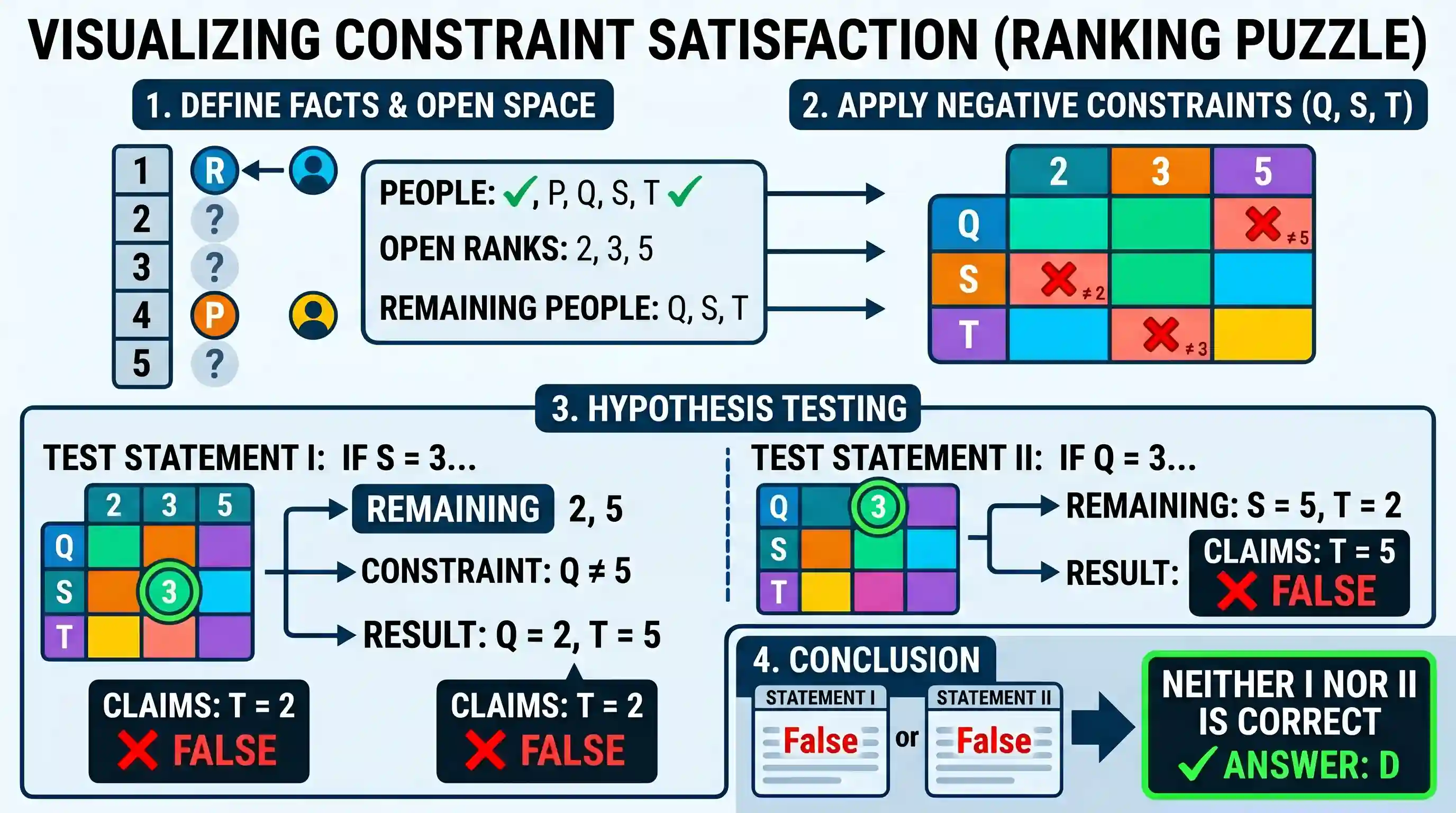
This question is a classic constraint satisfaction problem commonly found in the Analytical Reasoning section of the civil services aptitude test. To solve it, we evaluate the definite assignments and systematically apply the negative constraints to the remaining variables.
Initial Analysis: According to the premises, the available ranks are 1 to 5.
- Fixed Assignments: R = 1 and P = 4.
- The remaining ranks to be filled are 2, 3, and 5.
- The remaining persons to be ranked are Q, S, and T.
- Negative Constraints: Q ≠ 5, S ≠ 2, and T ≠ 3.
Evaluating Statement I: If the rank of S is 3, then that of T is 2.
- Assume S = 3. The available ranks for Q and T are now 2 and 5.
- Given the constraint Q ≠ 5, Q must take rank 2.
- Consequently, T must take the only remaining rank, which is 5.
- Statement I claims T is 2, which mathematically contradicts our deduction (T is 5). Thus, Statement I is incorrect.
Evaluating Statement II: If the rank of Q is 3, then that of T is 5.
- Assume Q = 3. The available ranks for S and T are now 2 and 5.
- Given the constraint S ≠ 2, S must take rank 5.
- Consequently, T must take the only remaining rank, which is 2.
- Statement II claims T is 5, which contradicts our deduction (T is 2). Thus, Statement II is incorrect.
Option Analysis:
- Option A (I only): Incorrect, because assuming S = 3 logically results in T = 5, not 2.
- Option B (II only): Incorrect, because assuming Q = 3 logically results in T = 2, not 5.
- Option C (Both I and II): Incorrect, as both conditional statements are proven invalid.
- Option D (Neither I nor II): Correct, since neither statement holds true under the given constraints.
Takeaway: When solving negative constraint puzzles, mapping variables on a 'Possibility Matrix' helps eliminate choices efficiently and prevents overlapping logic errors.
Related questions
More UPSC Prelims practice from the same subject and topic.
- Prelims 2026CSATother
A cut on a solid object divides the object into two parts where the new surfaces thus produced are plane. On the other hand, one single cut can be used to cut more than one object at a time. In an exp…
- Prelims 2026GS1other
Which of the following statements with regard to the Grand Slam Tennis Tournaments is/are correct ? 1. The tournaments have a shared governance structure establishing the partnership among the four Gr…
- Prelims 2026GS1other
Ms. X is a mid-level civil service official working in the urban development department of a major city. Recently, she was involved in approving a contract for a public infrastructure project — a new …
- Prelims 2026GS1other
Which one of the following pairs is not correctly matched? (Indian Army Corps) : (Headquarters)
- Prelims 2026CSATother
For ⅓ < x < y < 2, which of the following statements is/are always correct? I. x + 1/x < y + 1/y II. √(1 + y²)/y < √(1 + x²)/x Select the answer using the code given below.
- Prelims 2026CSATother
What is the minimum number of times one needs to measure to get 298 litres of water from a tank, if the measuring cylinders have capacities 1 litre, 6 litres, 25 litres and 100 litres?