Two identical straight rods are painted in five distinct colours so that each of them gets divided into five equal parts along the length. In one of them, the portions are marked P1, P2, P3, P4 and P5 (not necessarily in that order) whereas in the other, they are marked Q1, Q2, Q3, Q4 and Q5 (not necessarily in that order). When the rods are kept parallel to each other side by side, P1 and Q3 match, P4 matches Q1 or Q2, and Q4 matches P3 or P5. If Q3 and Q5 are adjacent, which of the following is/are possible? I. Q3 is marked at the middle portion of the straight rod. II. P2 is marked at one of the extreme portions of the straight rod. Select the answer using the code given below.

- AI only
- BII only
- CBoth I and IICorrect
- DNeither I nor II
Explanation
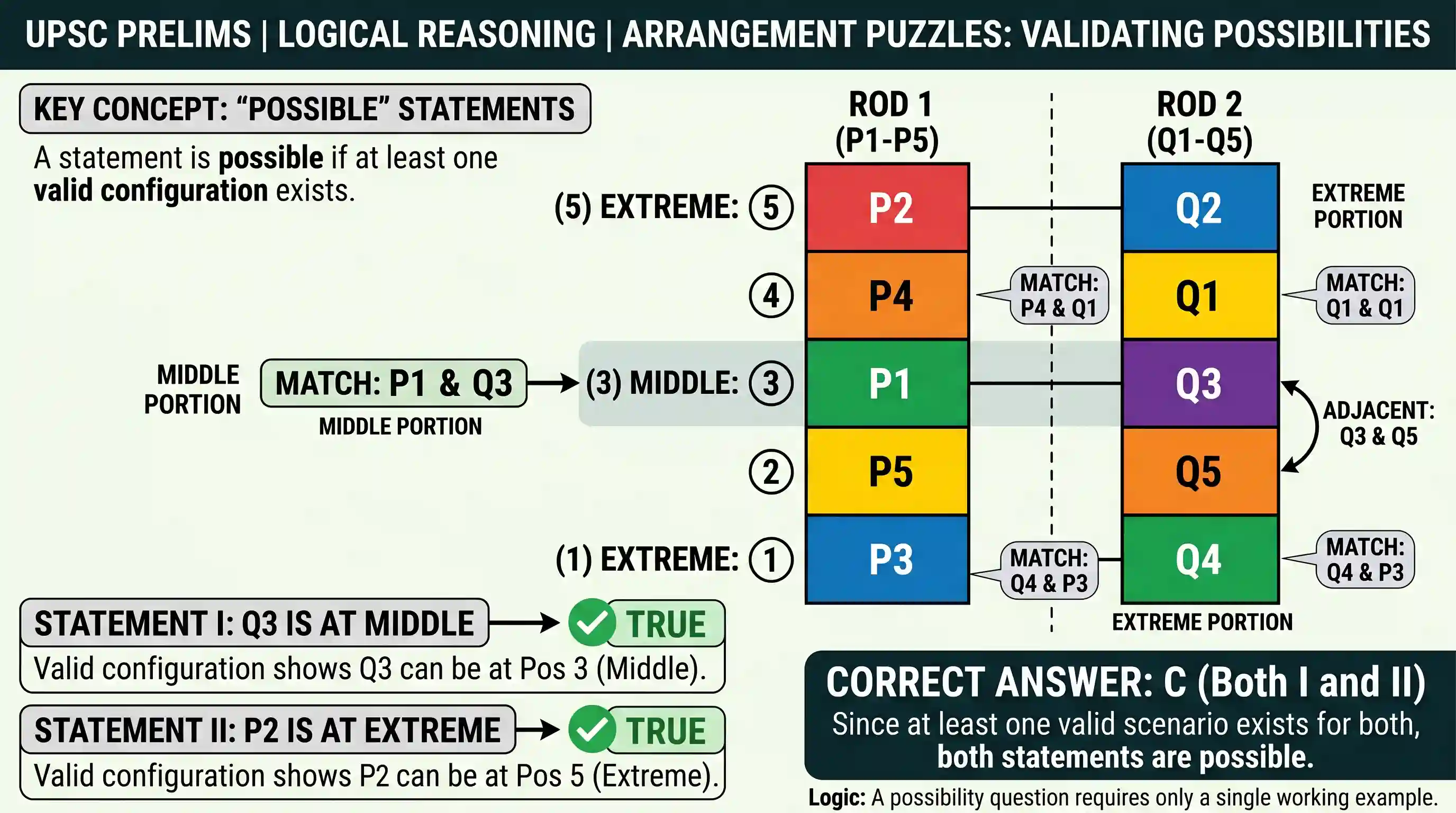
To solve this logical arrangement puzzle, we represent the five equal parts of the parallel rods as five positions (1 to 5). The problem asks whether certain arrangements are possible, meaning we only need to find at least one valid configuration that satisfies all given constraints.
The constraints are:
- P1 and Q3 share the same position (they "match").
- P4 matches either Q1 or Q2.
- Q4 matches either P3 or P5.
- Q3 and Q5 are adjacent.
Let us build a configuration to test if Statement I (Q3 is at the middle, i.e., Position 3) and Statement II (P2 is at an extreme, i.e., Position 1 or 5) can be possible.
- Let Q3 be at Position 3. By Constraint 1, P1 is also at Position 3.
- Since Q5 is adjacent to Q3, let us place Q5 at Position 2.
- We need P4 to match Q1 or Q2. Let us place P4 and Q1 at Position 4.
- We need Q4 to match P3 or P5. Let us place P3 and Q4 at Position 1.
- The remaining parts for Rod 1 (P1-P5) are P2 and P5. Let us place P5 at Position 2 and P2 at Position 5.
- The remaining part for Rod 2 (Q1-Q5) is Q2, which goes to Position 5.
This yields the following arrangement from Position 1 to 5: Rod 1: P3, P5, P1, P4, P2 Rod 2: Q4, Q5, Q3, Q1, Q2
Checking the rules:
- P1 and Q3 match (Pos 3).
- P4 matches Q1 (Pos 4).
- Q4 matches P3 (Pos 1).
- Q3 and Q5 are adjacent (Pos 3 and 2).
In this valid configuration, Q3 is in the middle portion (proving Statement I is possible) and P2 is at an extreme portion (proving Statement II is possible). Thus, the correct option is C.
- Option A is incorrect because it implies Statement II is impossible, yet we proved P2 can reside at an extreme.
- Option B is incorrect because it implies Statement I is impossible, whereas Q3 can validly occupy the middle.
- Option D is incorrect because both statements are demonstrably possible.
Takeaway: In logical deduction questions asking what is "possible," you do not need to derive a definitive universal sequence. Constructing just one valid matrix that satisfies all prompt conditions is mathematically sufficient to validate a statement.
Related questions
More UPSC Prelims practice from the same subject and topic.
- Prelims 2026CSATother
Seven persons A, B, C, D, E, F and G travel by three cars X, Y, Z. A and another two of them travel by X. Only E travels with G. C travels by Z, but B does not travel by Y. Besides, A and B do not tra…
- Prelims 2026CSATother
There are four statements X, Y, Z and W. Their relations are as follows : If X is incorrect, then so is Z; if Y is incorrect, then W is correct; if W is correct, then X is incorrect. Which of the foll…
- Prelims 2026CSATother
Consider the following statements : Every red is blue. Every blue is green. Every green is yellow. Which of the following statements denoted by P, Q and R are correct? P. Every blue is yellow. Q. Ever…
- Prelims 2026CSATother
Seven cubes are identical in shape. Out of these, the weight of each of the six cubes is equal and the weight of the remaining cube is less than the weight of any other cube. A balance is used to iden…
- Prelims 2026CSATother
A person facing the East travels 4 km straight and then turns right and travels 3 km, then further turns left and travels 2 km and finally turns left and travels 3 km. The minimum distance between the…
- Prelims 2026CSATother
Eight persons P, Q, R, S, T, U, V and W sit around a round table in eight different seats placed with equal distance between any two consecutive seats. Both P and R are adjacent to Q. Both T and R are…