Seven cubes are identical in shape. Out of these, the weight of each of the six cubes is equal and the weight of the remaining cube is less than the weight of any other cube. A balance is used to identify the lightest cube. What is the minimum number of attempts required to distinguish the odd cube with certainty?

- A2Correct
- B3
- C4
- D1
Explanation
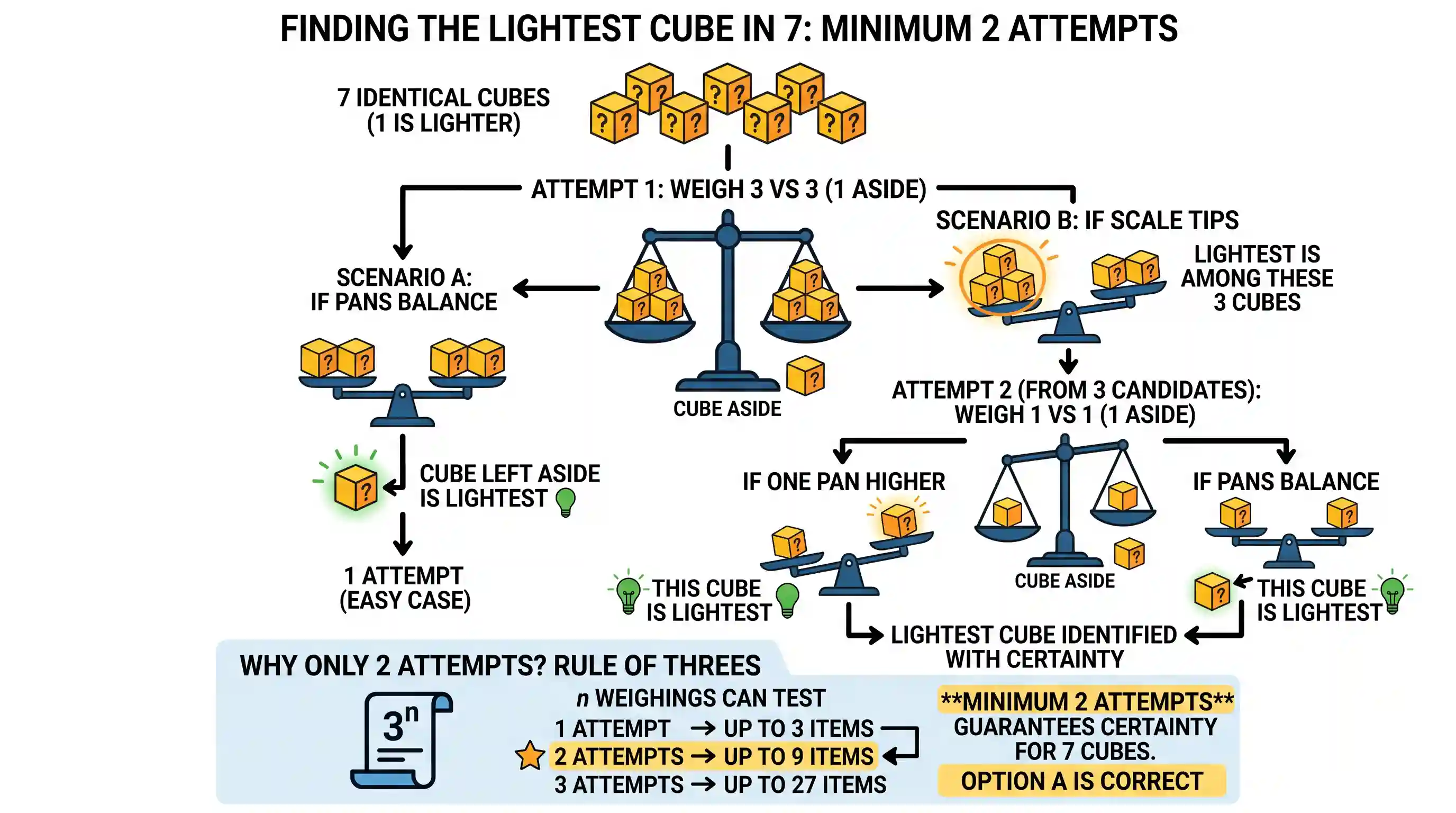
Option A is correct. This problem is a standard application of the classic mathematical "balance puzzle" (also known as the counterfeit coin problem, first formally published by E. D. Schell in the American Mathematical Monthly in 1945). To find a single lighter item out of a given set, the minimum number of weighings (n) required is (\lceil \log_3(c) \rceil), where (c) is the total number of items. Because each weighing on a two-pan balance scale yields three possible outcomes (left pan lighter, right pan lighter, or perfectly balanced), (n) attempts can uniquely identify an odd item among up to (3^n) items. Since (3^1 = 3) and (3^2 = 9), exactly 2 attempts are mathematically required to test any number of items from 4 to 9, including our 7 cubes.
Here is the step-by-step practical proof: Attempt 1: Place 3 cubes on the left pan and 3 on the right pan, leaving 1 cube aside.
- If the scale balances, the odd cube is the 1 left aside.
- If the scale tips, the lighter cube is among the 3 cubes on the higher pan. Attempt 2: Take those 3 lighter cubes. Weigh 1 against 1, leaving 1 aside.
- If the scale balances, the odd cube is the 1 left aside.
- If it tips, the odd cube is the one on the higher pan.
Why the other options are incorrect:
- Option B (3): While you could find the cube in 3 attempts, it is mathematically suboptimal and not the true minimum required.
- Option C (4): Four attempts greatly exceed the minimum threshold needed to evaluate 7 items.
- Option D (1): A single attempt can evaluate a maximum of 3 items ((3^1)), leaving uncertainty when dealing with 7 items.
Takeaway: Remember the "Rule of Threes" for balance scale puzzles: (n) weighings can test up to (3^n) objects. Therefore, 2 weighings cover up to 9 objects.
Related questions
More UPSC Prelims practice from the same subject and topic.
- Prelims 2026CSATother
Two identical straight rods are painted in five distinct colours so that each of them gets divided into five equal parts along the length. In one of them, the portions are marked P1, P2, P3, P4 and P5…
- Prelims 2026CSATother
Seven persons A, B, C, D, E, F and G travel by three cars X, Y, Z. A and another two of them travel by X. Only E travels with G. C travels by Z, but B does not travel by Y. Besides, A and B do not tra…
- Prelims 2026CSATother
There are four statements X, Y, Z and W. Their relations are as follows : If X is incorrect, then so is Z; if Y is incorrect, then W is correct; if W is correct, then X is incorrect. Which of the foll…
- Prelims 2026CSATother
Consider the following statements : Every red is blue. Every blue is green. Every green is yellow. Which of the following statements denoted by P, Q and R are correct? P. Every blue is yellow. Q. Ever…
- Prelims 2026CSATother
A person facing the East travels 4 km straight and then turns right and travels 3 km, then further turns left and travels 2 km and finally turns left and travels 3 km. The minimum distance between the…
- Prelims 2026CSATother
Eight persons P, Q, R, S, T, U, V and W sit around a round table in eight different seats placed with equal distance between any two consecutive seats. Both P and R are adjacent to Q. Both T and R are…