Consider the following statements : Every red is blue. Every blue is green. Every green is yellow. Which of the following statements denoted by P, Q and R are correct? P. Every blue is yellow. Q. Every red is green. R. Every red is yellow. Select the answer using the code given below.

- AP and Q only
- BQ and R only
- CP and R only
- DP, Q and RCorrect
Explanation
This question tests the principles of categorical syllogism and logical deduction, specifically applying the transitive property of subsets in set theory.
Why Option D is correct: Let us represent the given premises mathematically as subset relations:
- 'Every red is blue' means the set of Red (R) is a subset of Blue (B): R ⊂ B.
- 'Every blue is green' means Blue (B) is a subset of Green (G): B ⊂ G.
- 'Every green is yellow' means Green (G) is a subset of Yellow (Y): G ⊂ Y.
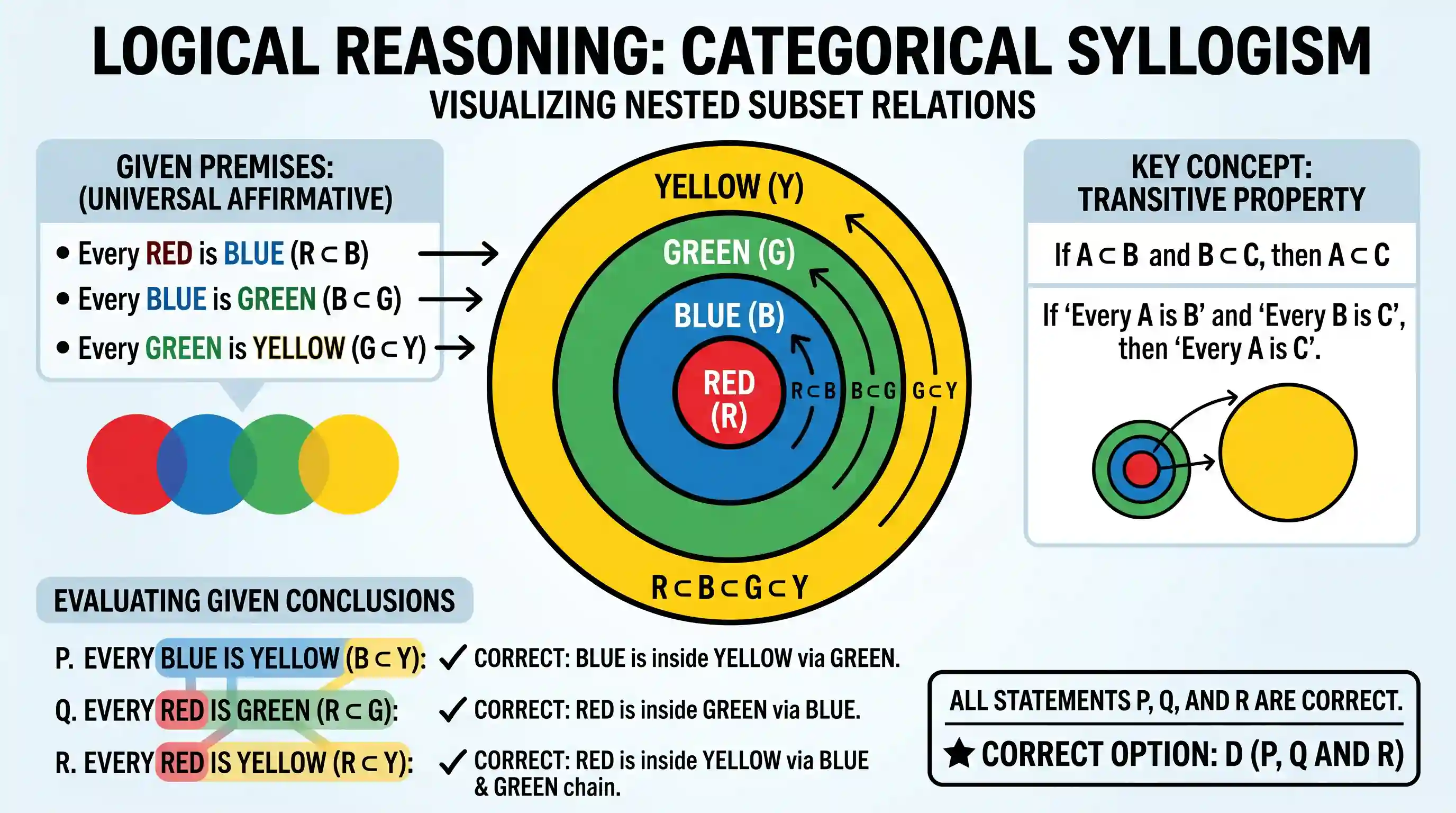
Combining these premises yields a continuous chain of subsets: R ⊂ B ⊂ G ⊂ Y. We evaluate the given conclusions based on the universally accepted mathematical rule of transitivity (if A ⊂ B and B ⊂ C, then A ⊂ C):
- Statement P (Every blue is yellow): Since B ⊂ G and G ⊂ Y, it mathematically follows that B ⊂ Y. Statement P is correct.
- Statement Q (Every red is green): Since R ⊂ B and B ⊂ G, it follows that R ⊂ G. Statement Q is correct.
- Statement R (Every red is yellow): Since R ⊂ G (as proven in Q) and G ⊂ Y, it logically dictates that R ⊂ Y. Statement R is correct.
Because all three statements (P, Q, and R) are logically sound deductions, Option D is the correct answer.
Why the other options are incorrect:
- Option A (P and Q only): This option is incorrect because it fails to account for Statement R, which is a definitively true deduction.
- Option B (Q and R only): This option is incorrect as it arbitrarily omits Statement P, which logically follows from the premises.
- Option C (P and R only): This is incorrect because it excludes Statement Q, ignoring the direct transitive relationship established between red and green.
Concluding Takeaway: When dealing with continuous 'All A are B' (Universal Affirmative) propositions, visualize nested concentric circles. If set A is inside B, and B is inside C, the transitive property guarantees that A is entirely inside C.
Related questions
More UPSC Prelims practice from the same subject and topic.
- Prelims 2026CSATother
Two identical straight rods are painted in five distinct colours so that each of them gets divided into five equal parts along the length. In one of them, the portions are marked P1, P2, P3, P4 and P5…
- Prelims 2026CSATother
Seven persons A, B, C, D, E, F and G travel by three cars X, Y, Z. A and another two of them travel by X. Only E travels with G. C travels by Z, but B does not travel by Y. Besides, A and B do not tra…
- Prelims 2026CSATother
There are four statements X, Y, Z and W. Their relations are as follows : If X is incorrect, then so is Z; if Y is incorrect, then W is correct; if W is correct, then X is incorrect. Which of the foll…
- Prelims 2026CSATother
Seven cubes are identical in shape. Out of these, the weight of each of the six cubes is equal and the weight of the remaining cube is less than the weight of any other cube. A balance is used to iden…
- Prelims 2026CSATother
A person facing the East travels 4 km straight and then turns right and travels 3 km, then further turns left and travels 2 km and finally turns left and travels 3 km. The minimum distance between the…
- Prelims 2026CSATother
Eight persons P, Q, R, S, T, U, V and W sit around a round table in eight different seats placed with equal distance between any two consecutive seats. Both P and R are adjacent to Q. Both T and R are…