Passage: ...keep clean fuel cheaper than dirty fuel. Now even as coal is banned, the price of natural gas makes industry uncompetitive. Question: Which of the following statements is/are correct? 1. Thermal power stations in Delhi were required to summarily shut down. 2. CNG supplies had to be assured once diesel vehicles were prohibited from plying. 3. The Supreme Court banned the use of coal across the National Capital Region. Select the answer using the code given below.

- A1 and 2
- B3 only
- C2 onlyCorrect
- D2 and 3
Explanation
The correct answer is Option C (2 only). This question evaluates the historical and administrative realities of environmental policies implemented to combat air pollution in Delhi and the National Capital Region (NCR).
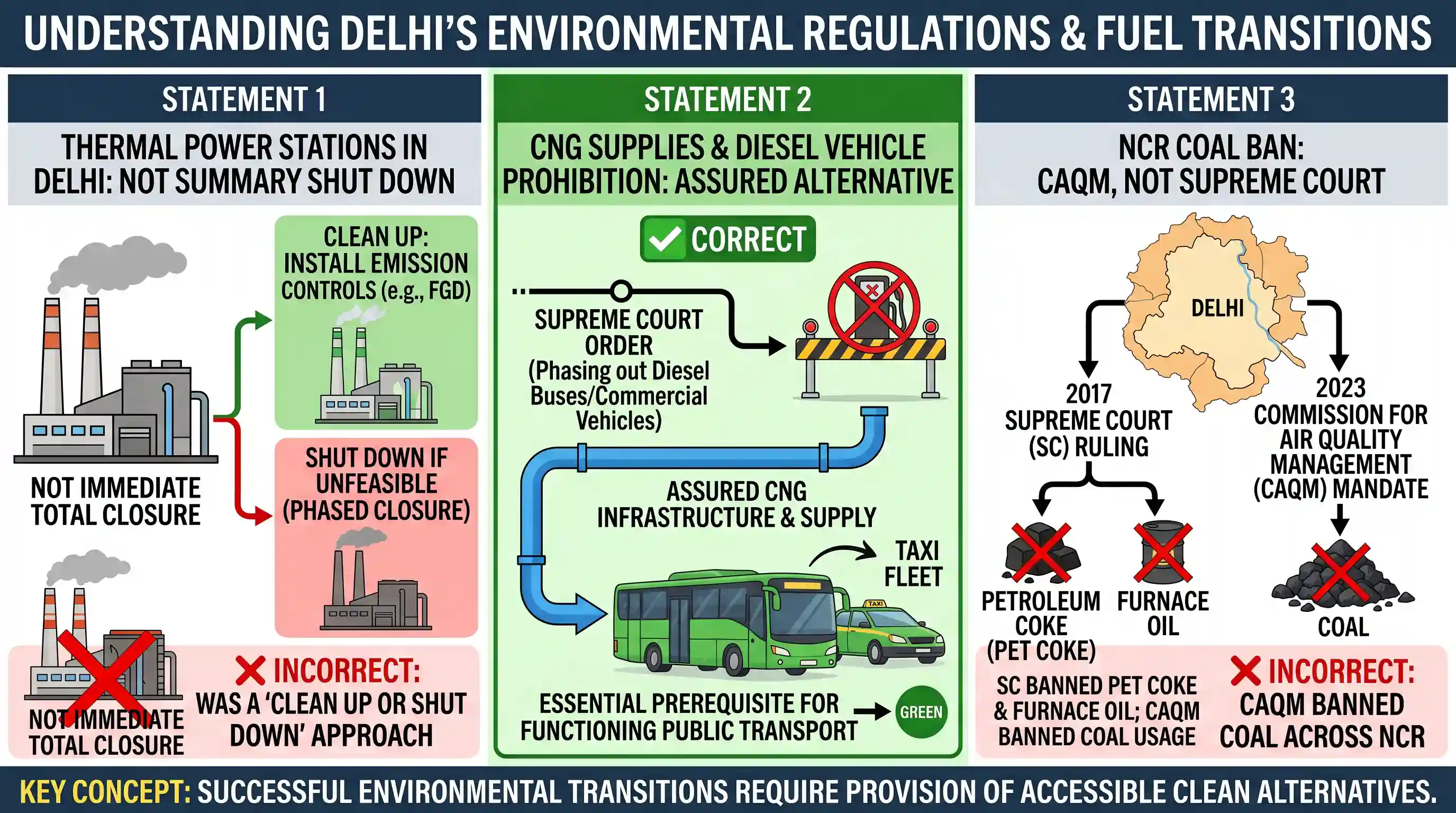
Why the correct option is correct: Statement 2 is correct: Delhi's mass transition to Compressed Natural Gas (CNG) in the late 1990s and early 2000s demonstrated that environmental bans require accessible alternatives. When the Supreme Court mandated the phasing out of diesel buses and commercial vehicles to curb severe particulate emissions, ensuring a steady, economically viable supply of CNG was a mandatory prerequisite to keep public transport functioning.
Why the incorrect options are wrong: Statement 1 is incorrect: Thermal power stations in and around Delhi were not ordered to "summarily shut down" without recourse. Instead, environmental authorities and courts mandated a "clean up or shut down" approach, requiring plants to either install emission-control technologies (like Flue Gas Desulfurization units) or face phased closure, an action that has seen patchy implementation. Statement 3 is incorrect: The Supreme Court's landmark 2017 ruling banned the use of heavily polluting petroleum coke (pet coke) and furnace oil in the NCR. However, the comprehensive ban on approved coal usage across the entire NCR (effective January 1, 2023) was instituted by the Commission for Air Quality Management (CAQM), not directly by the Supreme Court.
Takeaway: Successful environmental transitions rely on a strategic "push and pull" mechanism—banning dirty fuels (push) will only succeed if administrators ensure the availability and affordability of clean alternatives (pull).
Related questions
More UPSC Prelims practice from the same subject and topic.
- Prelims 2026GS1environment
With reference to Madhav National Park, which of the following statements is/are correct ? 1. It was declared a Tiger Reserve in India in 2025. 2. Sakhya Sagar, which is designated as a Ramsar Site, i…
- Prelims 2026GS1environment
Consider the following statements about Rhynchostylis retusa (Foxtail orchid) : 1. It is an epiphytic orchid. 2. The species is endemic to North-east India. 3. It is the State flower of Arunachal Prad…
- Prelims 2026GS1environment
At the United Nations Ocean Conference (UNOC) held in June, 2025 in France, the Food and Agricultural Organization (FAO) of the United Nations demonstrated its leading voice on marine and ocean issues…
- Prelims 2026GS1environment
Which one of the following is the first Plan Vivo certified Reducing Emissions from Deforestation and Forest Degradation (REDD+) project in India ?
- Prelims 2026GS1environment
Consider the following statements with reference to India's response to climate change : I. India's Long-Term Low Emission Development Strategy (LT-LEDS) is a crucial tool for achieving net-zero emiss…
- Prelims 2026GS1environment
With respect to the Western Hoolock Gibbons, which of the following statements is/are correct? 1. A Sanctuary in North-east India is home to this ape species listed as Endangered in the International …