Passage: ...keep clean fuel cheaper than dirty fuel. Now even as coal is banned, the price of natural gas makes industry uncompetitive. Question: Which of the following inferences is/are correct? 1. The source of the energy we consume is the key to the battle for cleaner air. 2. Bans are effective where the will is strong and the people are convinced that such bans are for the greater good of society. 3. There is judicial approval for a policy that intervenes fiscally to facilitate benevolent pricing for cleaner fuel. Select the answer using the code given below.

- A1 and 2
- B2 and 3
- C1 and 3Correct
- D1 only
Explanation
The correct answer is Option C (1 and 3). This reading comprehension question is based on environmental commentary regarding India's fuel transition, notably discussed by experts like Sunita Narain in Down To Earth, which analyzes the Supreme Court's historical 1998 directives on combating Delhi's air pollution.
Why the correct options are correct:
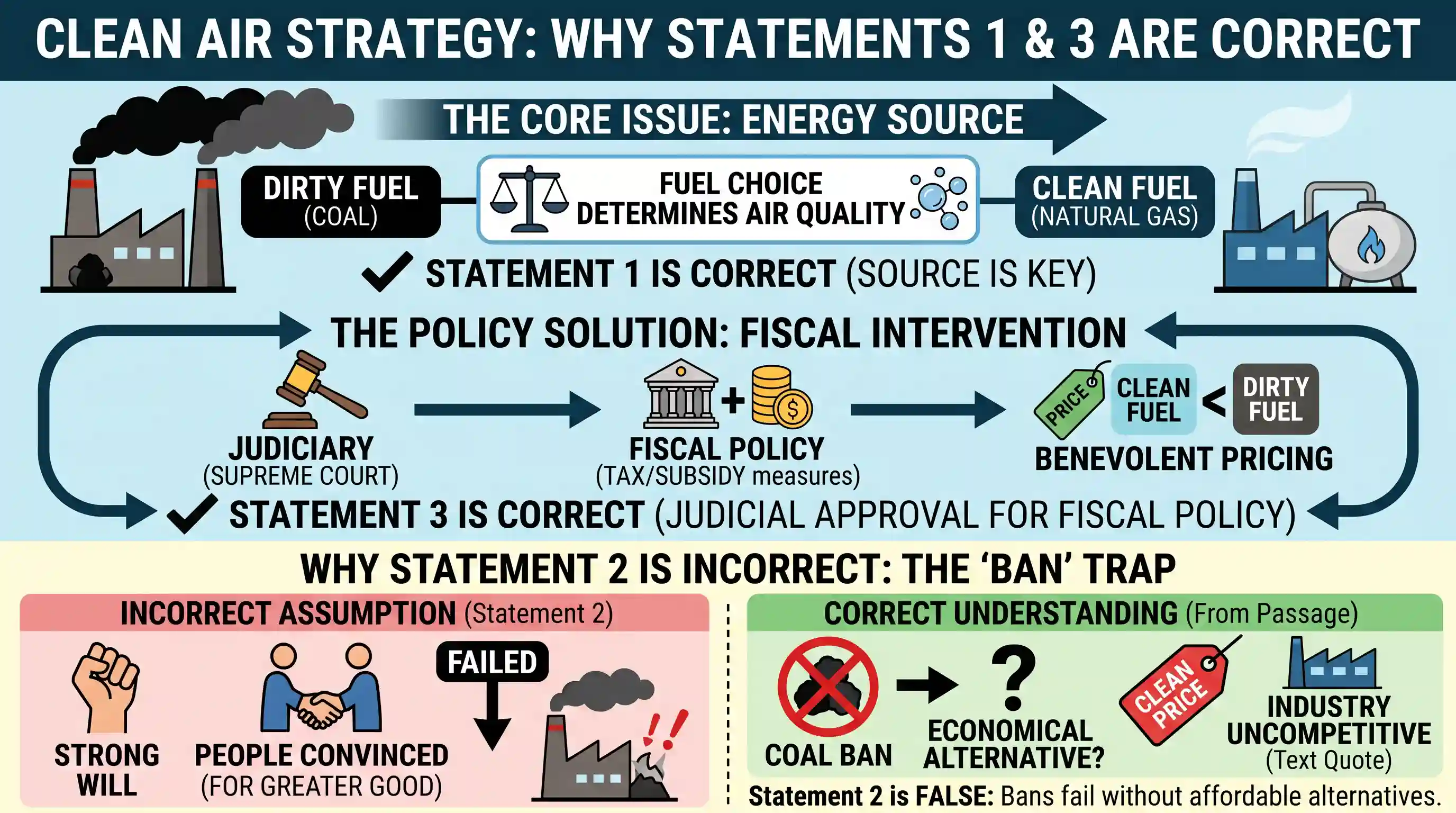
- Statement 1 is correct: The core argument of the passage centers on replacing "dirty fuel" (coal) with "clean fuel" (natural gas). This establishes that the choice of energy source is the fundamental battleground for achieving cleaner air.
- Statement 3 is correct: The full context of this passage explicitly notes that the Supreme Court agreed on the necessity of "fiscal measures" to keep clean fuels affordable. Therefore, "judicial approval" (Supreme Court mandates) clearly exists for a "policy that intervenes fiscally" (tax/subsidy measures) to facilitate "benevolent pricing" (making clean fuel cheaper than dirty fuel).
Why the wrong options are wrong:
- Statement 2 is incorrect: The passage pragmatically argues that for a ban (like the coal ban) to be effective, there must be a cost-effective, viable alternative (like competitively priced natural gas). It does not attribute the success of bans to abstract, emotional concepts like a "strong will" or a moral conviction for the "greater good of society."
Takeaway: In UPSC CSAT Reading Comprehension, always trace inferences back to the practical arguments made by the author. Avoid emotionally appealing but unstated traps; focus instead on the economic, legal, or logistical facts provided in the text.
Related questions
More UPSC Prelims practice from the same subject and topic.
- Prelims 2026GS1environment
With reference to Madhav National Park, which of the following statements is/are correct ? 1. It was declared a Tiger Reserve in India in 2025. 2. Sakhya Sagar, which is designated as a Ramsar Site, i…
- Prelims 2026GS1environment
Consider the following statements about Rhynchostylis retusa (Foxtail orchid) : 1. It is an epiphytic orchid. 2. The species is endemic to North-east India. 3. It is the State flower of Arunachal Prad…
- Prelims 2026GS1environment
At the United Nations Ocean Conference (UNOC) held in June, 2025 in France, the Food and Agricultural Organization (FAO) of the United Nations demonstrated its leading voice on marine and ocean issues…
- Prelims 2026GS1environment
Which one of the following is the first Plan Vivo certified Reducing Emissions from Deforestation and Forest Degradation (REDD+) project in India ?
- Prelims 2026GS1environment
Consider the following statements with reference to India's response to climate change : I. India's Long-Term Low Emission Development Strategy (LT-LEDS) is a crucial tool for achieving net-zero emiss…
- Prelims 2026GS1environment
With respect to the Western Hoolock Gibbons, which of the following statements is/are correct? 1. A Sanctuary in North-east India is home to this ape species listed as Endangered in the International …