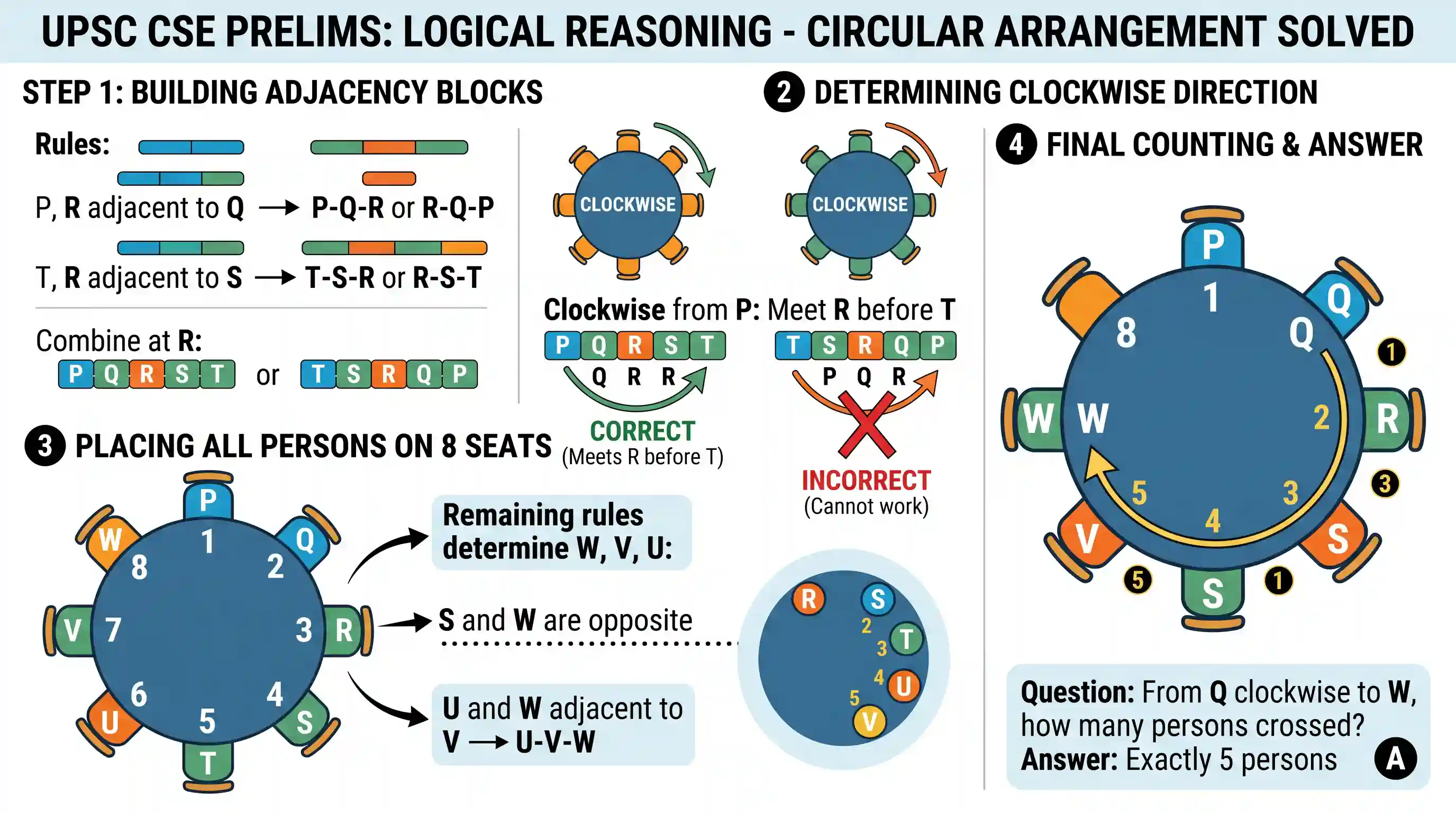
Eight persons P, Q, R, S, T, U, V and W sit around a round table in eight different seats placed with equal distance between any two consecutive seats. Both P and R are adjacent to Q. Both T and R are adjacent to S. Both U and W are adjacent to V. S and W are on opposite chairs. If while going in the clockwise direction around the table from P, one meets R before T, then how many persons shall Q cross while moving in the clockwise direction around the table before meeting W?

- A5Correct
- B4
- C2
- D1
Explanation
Correct Option Analysis (Option A): This problem is a classic circular arrangement puzzle characteristic of the UPSC Civil Services Aptitude Test (CSAT) Paper-II.
- Forming the Primary Block: The statement "Both P and R are adjacent to Q" yields the sequence P-Q-R or R-Q-P. Similarly, "Both T and R are adjacent to S" yields T-S-R or R-S-T. Merging these overlapping segments at 'R' generates a five-person block: P-Q-R-S-T or T-S-R-Q-P.
- Determining Direction: The condition dictates that moving clockwise from P, one meets R before T. If the clockwise order were T-S-R-Q-P, starting from P would mean meeting T before R. Therefore, the strict clockwise sequence must be P-Q-R-S-T. Let us assign them seats 1 through 5 respectively.
- Placing the Remaining Persons: S is seated at position 4. In an equal-distance 8-seat circular arrangement, the opposite seat is mathematically separated by exactly three chairs (Position + 4). Thus, the seat opposite S (4) is 8. The puzzle specifies S and W are opposite, locking W at seat 8.
- Completing the Circle: "U and W are adjacent to V" dictates the sequence U-V-W. With W at 8 and P already at 1, V must occupy seat 7 and U must occupy seat 6. The final clockwise arrangement is P(1), Q(2), R(3), S(4), T(5), U(6), V(7), W(8).
- Calculating the Crossings: Moving clockwise from Q (seat 2) to W (seat 8), Q crosses R(3), S(4), T(5), U(6), and V(7). This totals exactly 5 persons, making Option A correct.
Wrong Options Analysis:
- Option B (4): Incorrect due to a potential arithmetic counting error; the block between Q and W contains exactly 5 persons, not 4.
- Option C (2): Incorrect because it severely underestimates the consecutive block of persons separating Q and W.
- Option D (1): Incorrect as this specifically represents the number of persons Q would cross if moving in the counter-clockwise direction (crossing only P at seat 1 to reach W at 8), violating the question's prompt.
Takeaway: In circular logical arrangements, isolate and merge overlapping adjacent elements into a single macro-block first, then apply directional (clockwise/anti-clockwise) and geometric constraints (opposites) to lock the final positions.
Related questions
More UPSC Prelims practice from the same subject and topic.
- Prelims 2026CSATother
Two identical straight rods are painted in five distinct colours so that each of them gets divided into five equal parts along the length. In one of them, the portions are marked P1, P2, P3, P4 and P5…
- Prelims 2026CSATother
Seven persons A, B, C, D, E, F and G travel by three cars X, Y, Z. A and another two of them travel by X. Only E travels with G. C travels by Z, but B does not travel by Y. Besides, A and B do not tra…
- Prelims 2026CSATother
There are four statements X, Y, Z and W. Their relations are as follows : If X is incorrect, then so is Z; if Y is incorrect, then W is correct; if W is correct, then X is incorrect. Which of the foll…
- Prelims 2026CSATother
Consider the following statements : Every red is blue. Every blue is green. Every green is yellow. Which of the following statements denoted by P, Q and R are correct? P. Every blue is yellow. Q. Ever…
- Prelims 2026CSATother
Seven cubes are identical in shape. Out of these, the weight of each of the six cubes is equal and the weight of the remaining cube is less than the weight of any other cube. A balance is used to iden…
- Prelims 2026CSATother
A person facing the East travels 4 km straight and then turns right and travels 3 km, then further turns left and travels 2 km and finally turns left and travels 3 km. The minimum distance between the…