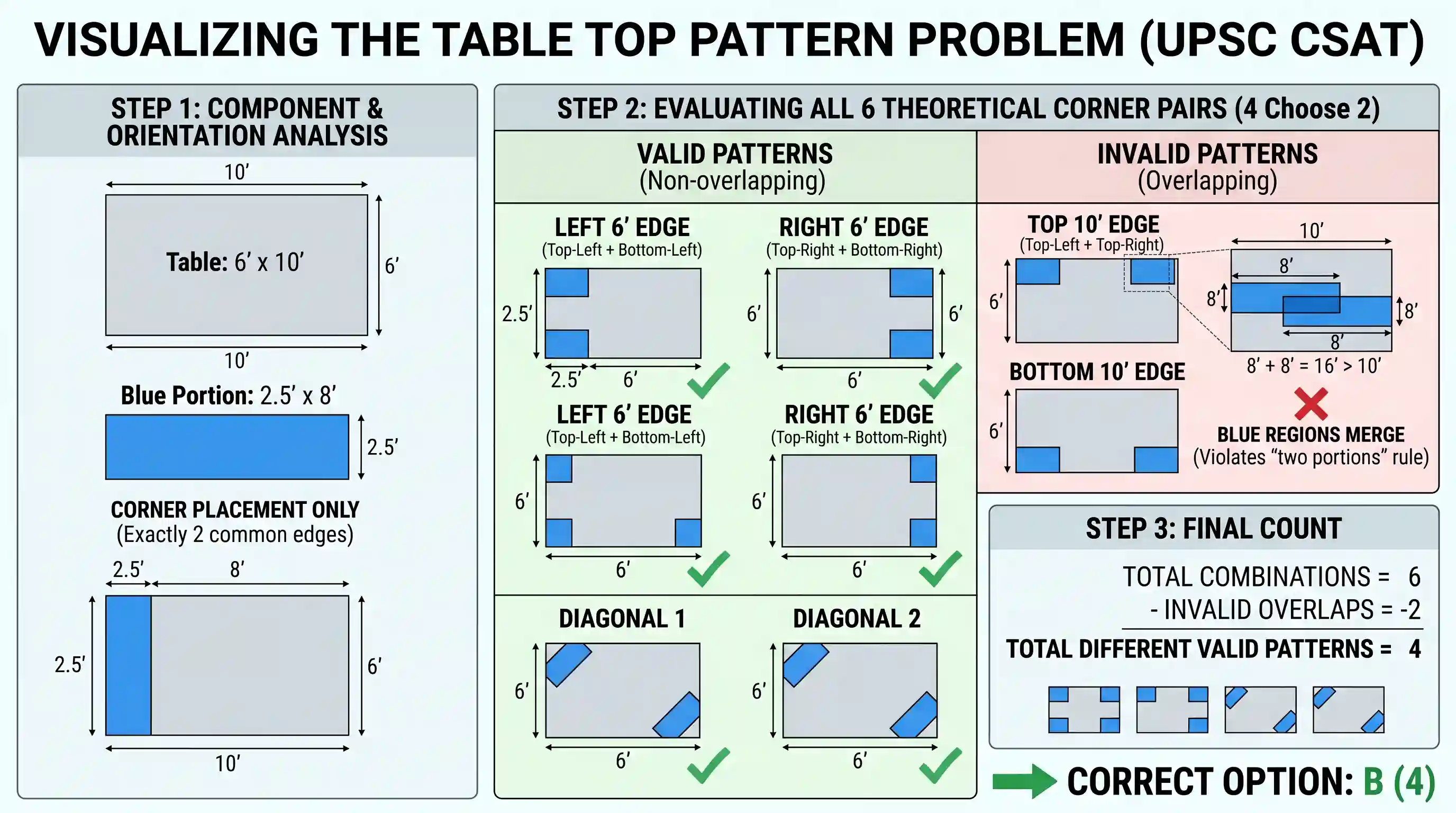
The top of a table is rectangular and its dimensions are 6′ × 10′. Two rectangular portions of the table top are painted in blue colour; both these portions have dimensions 2.5′ × 8′ and each of them has exactly two sides common with two edges of the table top. If the table is fixed to the ground and the remaining portion of the table top is painted in white, how many different patterns are possible when observed from above?

- A2
- B4Correct
- C6
- D8
Explanation
Why the correct option is correct: To form the pattern, two 2.5' × 8' blue rectangular portions must be placed on a 6' × 10' table. Because each blue portion shares exactly two sides with the table's edges, they must be situated in the corners. The 8' length of the blue rectangle cannot fit along the 6' width of the table, so it must align with the 10' length, while the 2.5' side aligns with the 6' width. This leaves 4 fixed corner positions for the blue rectangles.
Choosing 2 corners out of 4 provides ⁽⁴₂⁾ = 6 possible pairs. However, we must consider spatial overlap. If two blue rectangles are placed on the same 10' edge, their combined length (8' + 8' = 16') exceeds the table's 10' boundary. They would overlap, merging into a single non-rectangular shape (or a single fused rectangle) and violating the condition of having "two rectangular portions." Subtracting these 2 overlapping pairs (top edge and bottom edge) leaves 6 - 2 = 4 valid combinations: two pairs sharing a 6' edge (where the combined width is 2.5' + 2.5' = 5' ≤ 6', meaning no overlap) and two diagonal pairs. With the table fixed to the ground, these 4 configurations yield distinct patterns.
Why the wrong options are wrong:
- Option A (2): Fails to count the non-overlapping adjacent pairs sharing the 6' edges, only counting the diagonals.
- Option C (6): Fails to account for the spatial overlap constraint along the 10' edges, improperly including the merged shapes.
- Option D (8): Incorrectly assumes the 8' side can be placed along the 6' edge, or miscalculates the available spatial orientations.
Takeaway: In spatial reasoning problems, combinatorics formulas like ⁽⁴₂⁾ must be cross-checked against physical boundaries. Overlap constraints frequently eliminate theoretical combinations.
Related questions
More UPSC Prelims practice from the same subject and topic.
- Prelims 2026GS1other
Which of the following statements with regard to the Grand Slam Tennis Tournaments is/are correct ? 1. The tournaments have a shared governance structure establishing the partnership among the four Gr…
- Prelims 2026GS1other
Ms. X is a mid-level civil service official working in the urban development department of a major city. Recently, she was involved in approving a contract for a public infrastructure project — a new …
- Prelims 2026GS1other
Which one of the following pairs is not correctly matched? (Indian Army Corps) : (Headquarters)
- Prelims 2026CSATother
For ⅓ < x < y < 2, which of the following statements is/are always correct? I. x + 1/x < y + 1/y II. √(1 + y²)/y < √(1 + x²)/x Select the answer using the code given below.
- Prelims 2026CSATother
What is the minimum number of times one needs to measure to get 298 litres of water from a tank, if the measuring cylinders have capacities 1 litre, 6 litres, 25 litres and 100 litres?
- Prelims 2026CSATother
There are four types of weights, namely 1 kg, 2 kg, 5 kg and 10 kg. What is the maximum number of different ways one can measure 20 kg, if at least eight but not more than eleven weights of 1 kg are t…