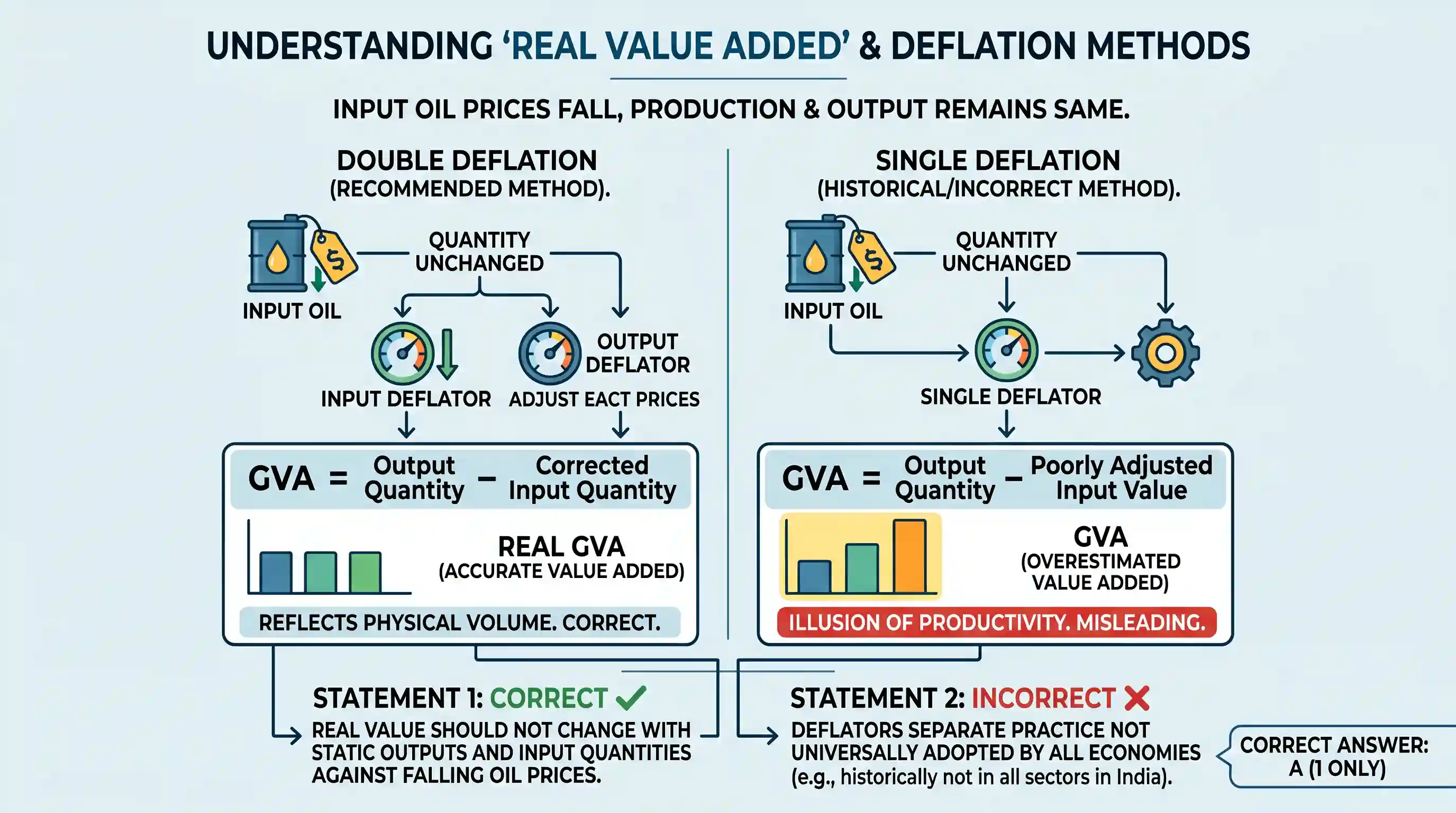
Passage: How is deflation done? Most countries use a method called 'double deflation', where input and output prices are deflated separately. Consider a manufacturer importing oil for use in production. If oil prices fall, output prices do not and quantities remain the same, real value added should not change. But if the same deflator is used for inputs and outputs, as in India, it would look as if the manufacturer had become more productive. Question: Which of the following statements is/are correct? 1. Real value should not change in the instance of static output cost and unchanged quantities against falling oil prices. 2. Deflators are to be used separately for inputs and outputs, and this is a practice universally adopted by all economies. Select the answer using the code given below.

- A1 onlyCorrect
- B2 only
- CBoth 1 and 2
- DNeither 1 nor 2
Explanation
Correct Answer: Option A
Statement 1 is correct: In national income accounting, "real value added" aims to measure the actual physical volume of production by stripping away price effects [6]. If a manufacturer uses the exact same quantity of oil to produce the exact same quantity of output, their actual productivity (real value) has not changed. A drop in nominal oil prices increases nominal profits, but real value added remains static. Double deflation accurately captures this by applying separate price deflators to inputs and outputs [6]. If a single deflator is used, falling input prices falsely inflate the real value added, making the manufacturer look more productive when they are merely benefiting from cheaper raw materials [5], [6].
Statement 2 is incorrect: "Double deflation" is the statistical method of applying separate price deflators to intermediate inputs and gross outputs to accurately calculate real Gross Value Added (GVA) [3], [4]. While the United Nations System of National Accounts (SNA 2008) recommends double deflation, it is not universally adopted by all economies [5], [6]. Many developing nations, including India historically, have relied on "single deflation" or "single extrapolation" for certain sectors due to data constraints [6]. For instance, India's traditional GDP calculation relied heavily on single deflation for the manufacturing sector, which sparked major debates about GDP overestimation during periods of crashing global oil prices [3], [5].
Takeaway: Real value added tracks volume (quantities), not nominal price changes. While Double Deflation (using separate deflators for inputs and outputs) is the global gold standard for GDP calculation, data limitations prevent it from being a universally adopted practice.
Related questions
More UPSC Prelims practice from the same subject and topic.
- Prelims 2026CSATeconomy
Which of the following assumptions is/are valid? 1. Deflation strategies can be used to make manufacturers appear to be doing better than they actually are. 2. When input and output prices are both de…
- Prelims 2026GS1economy
Consider the following statements with reference to the Sagarmala Programme of the Government of India : I. The Sagarmala Programme seeks to achieve port-led economic growth through cost-effective and…
- Prelims 2026GS1economy
In what way(s) does the Vizhinjam International Seaport represent a structural shift in India's maritime trade and logistics policy? 1. By functioning exclusively as a domestic cargo hub to reduce rel…
- Prelims 2026GS1economy
An e-commerce revenue model where the seller has control over pricing but doesn't keep products in stock and instead transfers customer orders and shipment details to a third-party supplier, who then …
- Prelims 2026GS1economy
Which one of the following correctly represents the three key sub-indices of the Financial Inclusion Index (FI-Index) of the Reserve Bank of India (RBI) ?
- Prelims 2026GS1economy
Which one of the following best describes the key objective of India's 'Open Network for Digital Commerce' (ONDC) initiative ?